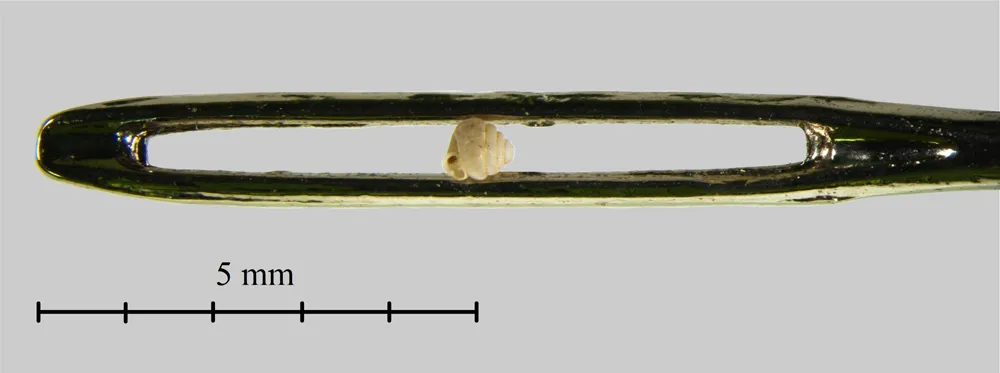
How many angels can dance on the head of a pin? Who knows? But 10 Angustopila dominikae snails can fit within the eye of a needle.
The newly discovered snail species, found in China, may be the world's smallest land snail. The height of its shell is only 0.03 inches (0.86 millimeters), making it a mere crumb of a creature.
The tiny snails are part of a group called microgastropods, which are snails shorter than 0.2 inches (5 mm). This is a large group, according to Barna Páll-Gergely of Shinshu University in Japan and colleagues, who wrote in 2014 in the journal ZooKeys that snails this small account for most of the diversity in tropical land snails. Previous microsnails discovered by the researchers measured just a millimeter or so (0.04 inches) in shell height; they've also discovered a snail less than 0.08 inches (2 mm) in height that lives, as far as anyone knows, only in one cave in South Korea. [Microscopic Marvels: See Amazing Photos of Tiny Marine Life]
Tiny Angustopila dominikae was identified by a single empty shell found below limestone cliffs in Guangxi, China. It likely spends its life on the cliff walls.
(Image credit: Barna Páll-Gergely)
The newest, tiniest snail is one of seven species recently discovered in China, the researchers reported today (Sept. 28) in ZooKeys. Named in honor of Páll-Gergely's wife, Dominika, A. dominikae was found in soil samples from beneath limestone cliffs in Guangxi province. The snail is light gray, with a round, delicate whirl structure, and probably spends its life clinging to the limestone cliffs, the researchers reported. (They identified the new species by a single empty shell.)
The researchers also discovered six other new tiny snails in the province. Angustopila fabella came from the same cliffside sediments as A. dominikae and measures 0.03 to 0.04 inches (0.86 to 1.02 mm). Its scientific name fabella comes from the Latin word for "little bean," which refers to the shell's bean-shaped opening.
A new micro-snail species, Angustopila subelevata averages just over 0.03 inches (0.87 millimeters) in shell height, making it among the tiniest land snails in the world. This snail also comes from Guangxi province.
(Image credit: Barna Páll-Gergely)
Another new species, Angustopila subelevata, measures only about 0.036 inches (0.91 mm) in height. Another, Angustopila szekeresi, grows to be not much taller (0.04 inches, or 1.03 mm). The researchers also discovered a slightly larger (but still miniscule) snail, Hypselostoma lacrima, measuring about 0.05 inches (1.33 mm) in shell height. A similar species, Hypselostoma socialis, is about the same size but has a different shell configuration.
Finally, the researchers discovered Krobylos sinensis, a veritable giant among the new snail species, at 0.09 to 0.1 inches (2.2 to 2.7 mm) tall. This snail probably makes its homes under stones and in crevices around the limestone cliff base, the researchers reported.
Sign up for the Live Science daily newsletter now
Get the world’s most fascinating discoveries delivered straight to your inbox.
The researchers also reported more details on the discovery of a not-quite-new tiny snail, Angustopila huoyani. This 0.036-inch-tall (0.91 mm) snail had previously been found in one cave about 310 miles (500 kilometers) away from the current study site.
"This finding underscores the need to explore more cave systems in order to make inferences about subterranean biodiversity in China," the researchers wrote.
Stephanie Pappas is a contributing writer for Live Science, covering topics ranging from geoscience to archaeology to the human brain and behavior. She was previously a senior writer for Live Science but is now a freelancer based in Denver, Colorado, and regularly contributes to Scientific American and The Monitor, the monthly magazine of the American Psychological Association. Stephanie received a bachelor's degree in psychology from the University of South Carolina and a graduate certificate in science communication from the University of California, Santa Cruz.