













Nepal Quake Could Have Been Much Deadlier, Scientists Say

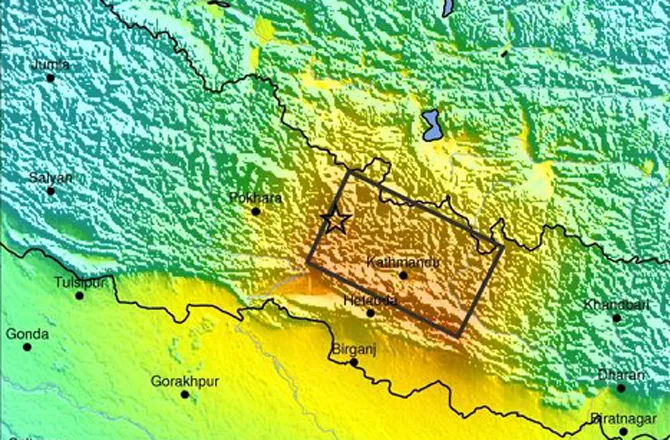
A magnitude-7.8 earthquake that shook Nepal in April killed some 9,000 people and injured 23,000 more, but the death toll in the valley of Kathmandu could have been much worse, researchers say. The quake shook in a way that spared many small buildings in the city but devastated those more than two stories high, a new study finds.
The reason the shaking occurred in that way, the geologists say, is that the quake moved east rather than west, accelerating the ground at about 5.5 feet per second (1.6 meters per second). The shaking outside the Kathmandu valley, where the city itself lies, was at about one wave per second, or 1 Hertz, which caused the ground inside the valley to move in resonance at a lower frequency that did more damage to taller buildings. A person standing on the ground outside the city would feel the ground move fast enough that it feel like being on a boat on slow, 3-foot-tall (0.9 m) waves.
The frequency of shaking, measured in Hertz, that will damage a tall building can be roughly calculated by dividing the number of stories in the building by 10, said study co-author Jean-Philippe Avouac, a professor of geology at the California Institute of Technology (Caltech). This measurement is called the natural frequency, or the number of times per second something will vibrate without being pushed by outside forces. (Guitar strings, for example, have a natural frequency that makes the tone when you pluck them). [Nepal Earthquake Photos: Odd Effects of Kathmandu Temblor]
"The smaller buildings will move as a solid body," Avouac said. "The taller ones will not. A 10-story building would be very sensitive to a frequency of one Hertz."
When the April 25 quake struck Nepal, seismic monitors and GPS stations were located throughout the country and some were right on top of the earthquake's epicenter, which meant researchers could sift through an unprecedented amount of data, Avouac said. For the first time, scientists could get a close look at the anatomy of a temblor on a thrust fault, where one part of the Earth's crust is sliding over another part. Most big thrust fault locations are underwater, so they are typically harder to monitor, he added.
The fault line in the Himalayas is the Main Central Thrust fault, which stretches all the way from Pakistan to the border between Tibet and India, north of Bangladesh. This kind of fault is different from the faults that cut through California, where two pieces of crust — the North American and the Pacific plates — slide against each other. In Nepal, the Indian plate is sliding underneath the Eurasian, which formed the Himalayas.
As the Indian plate thrusts under the Eurasian plate the latter crumples up, and the result is the tallest mountain range on Earth. But the plates don't slide past each other perfectly smoothly. Sometimes they catch and slip, and when they slip, this releases energy that triggers earthquakes.
Get the world’s most fascinating discoveries delivered straight to your inbox.
In Nepal's case the epicenter of the April 25 quake was some 49.7 miles (80 kilometers) northwest of Kathmandu. On the day of the quake, the built-up tension from two gargantuan slabs of rock was released. An 86-mile (140 km) stretch of the fault "unzipped," meaning the two plates moved past each other, the researchers said. This sent a pulse of energy east along the fault (nearly right under Kathmandu), moving about 2 miles (3.3 km) per second. The initial pulse of energy lasted only 6 seconds, but the quake shook the area for a whole minute, the researchers said. [Image Gallery: This Millennium's Destructive Earthquakes]
Then, the seismic monitors picked up something unusual, Avouac said. One of the monitors that showed its position via GPS was located on hard rock northwest of Kathmandu. During the quake, it moved south and in an east-west motion, the researchers said. On a graph it wasn't stepwise, but rather smooth.
"That pulse came as surprise to me," Avouac said. "The shape is quite smooth, not like a step but a longer tail." Ordinarily at the start of earthquakes, the ground moves side to side and up and down, shaking the way a bartender shakes a drink mixer. But in this case, the ground moved in one direction and then stopped, similar to a car hitting the brakes.
Meanwhile, the GPS monitor in the valley showed an oscillating motion, with a regular period of 3 to 4 seconds (about 0.33 to 0.25 Hertz). "The basin started to resonate for 50 seconds or so," Avouac said. The lower frequency would preferentially damage taller buildings, he added.
The Nepal earthquake's unusual pulse meant that the death toll from the quake was actually smaller than it would have been otherwise. "When I read the emails from USGS, I was originally prepared for [a] death toll of several hundred thousand," Avouac said. For comparison, a quake in Kashmir in 2005 had killed 85,000 people and was less intense, he added.
Kathmandu isn't out of the woods, though. Avouac said the area was very lucky that the quake moved east rather than west. Had it gone west, the quake would have set off an area that hasn't moved much since an earthquake in 1505.
This means there is a lot of pent-up energy in the rock, and when it releases, the quake will likely be big. "The ground has to move 10 meters [33 feet] if we were to release all that strain," Avouac said. "That means we would have a quake of more than [magnitude] 8.5." He added that such an earthquake is inevitable — it's only a matter of time. "Five hundred years is already a [long time]" between quakes in that area, he said. "I would be surprised if it's not in the coming century, and I expect to see it in my lifetime."
In another study, detailed today in the journal Nature Geoscience, researchers found the April quake in Nepal released only a fraction of the seismic energy of the underlying fault. That means there is potential for another huge earthquake in the future, they said.
Avouac and his colleagues published their findings today (Aug. 6) in the journal Science.
Follow LiveScience on Twitter @livescience. We're also on Facebook & Google+. Original article on Live Science.
