It's quick and easy to access Live Science Plus, simply enter your email below. We'll send you a confirmation and sign you up for our daily newsletter, keeping you up to date with the latest science news.
Hundreds of millions of years ago, marine animals swam in a vast ocean near the supercontinent of Gondwana. Now, these creatures' fossils litter the rocky desert of southeastern Morocco. Fossil collectors and researchers have found a vast trove of ancient life in a formation called the Fezouata Biota, including fossils of horseshoe crabs, giant lobsterlike animals and armored worms from the Ordovician Period, about 485 million to 444 million years ago. [Read the full story on the Moroccan fossils]
Ancient arthropod
This fossil shows the oldest representative of the cheloniellid arthropods, which lived for hundreds of millions of years after the Ordovician Period. (Copyright Peter Van Roy.)
This fossil, from the Fezouata Biota, is among the oldest horseshoe crabs on record. It shows a sub-adult that has fused segments at its rear, a characteristic that living horseshoe crabs still have today. (Copyright Peter Van Roy.)
Armored Worm
The Fezouata Biota is home to exceptionally preserved fossils. In the past, researchers had found only the hard parts of the machaeridians (plumulites bengtsoni), leading to speculation that they might be barnacles or perhaps mollusks. This is the first known fossil to show preservation of the worm's soft tissues, and proves that P. bengtsoni is a segmented worm. (Copyright Peter Van Roy.)
Sign up for the Live Science daily newsletter now
Get the world’s most fascinating discoveries delivered straight to your inbox.
Marrellomorph arthropod
A marrellomorph arthropod found in the Fezouata Biota that likely belongs to the genus Furca. (Copyright Peter Van Roy.)
Anomalocaridid hill
A view of the hill where fossil collectors found exceptionally preserved fossils of ancient arthropods called anomalocaridids. The Lower Ordovician Lower Fezouata Formation crops out in the hills in the foreground. (Copyright Peter Van Roy.)
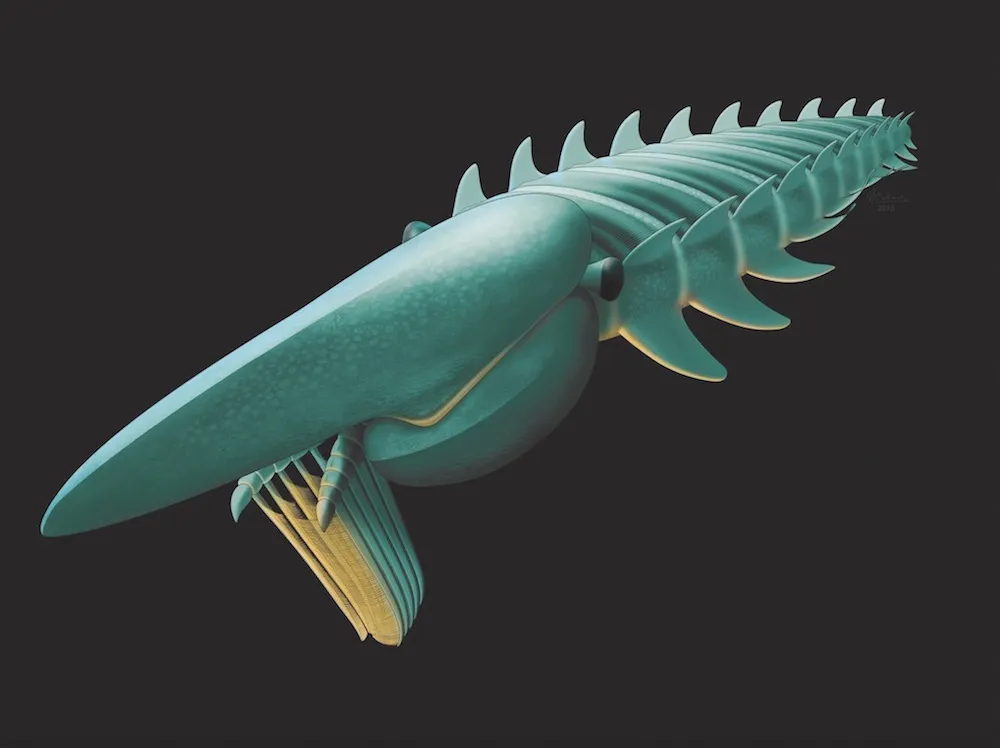
Sea monster
An artist's interpretation of Aegirocassis benmoulai, a remarkably well-preserved 480-million-year-old arthropod known as an anomalocaridid. (Copyright Marianne Collins | ArtofFact.)
Revealing fossil
The fossil of the anomalocaridid (Aegirocassis benmoulai), a giant filter feeder that swam in what is now southeastern Morocco. The incredibly detailed fossil shows that A. benmoulai had two sets of swimming flaps, which was not evident until researchers studied this specimen. (Copyright Peter Van Roy.)
Laura is the managing editor at Live Science. She also runs the archaeology section and the Life's Little Mysteries series. Her work has appeared in The New York Times, Scholastic, Popular Science and Spectrum, a site on autism research. She has won multiple awards from the Society of Professional Journalists and the Washington Newspaper Publishers Association for her reporting at a weekly newspaper near Seattle. Laura holds a bachelor's degree in English literature and psychology from Washington University in St. Louis and a master's degree in science writing from NYU.

 Live Science Plus