It's quick and easy to access Live Science Plus, simply enter your email below. We'll send you a confirmation and sign you up for our daily newsletter, keeping you up to date with the latest science news.
About 425 million years ago, a sneaky wormlike parasite invaded a crustacean before the two were fossilized together in the limestone of modern-day England, a new study finds.
The parasite, a newly identified species, is an ancient type of tongue worm, an arthropod that has a wormlike body with a head and two pairs of limbs, the researchers said. It is the first adult tongue worm to be found in the fossil record, they added.
"This is the most important fossil evidence yet discovered of the origins of this type of parasitism," study co-author Derek Briggs, a professor of geology and geophysics at Yale University and curator of invertebrate paleontology at the Yale Peabody Museum of Natural History, both in New Haven, Connecticut, said in a statement. [The 10 Most Diabolical and Disgusting Parasites]
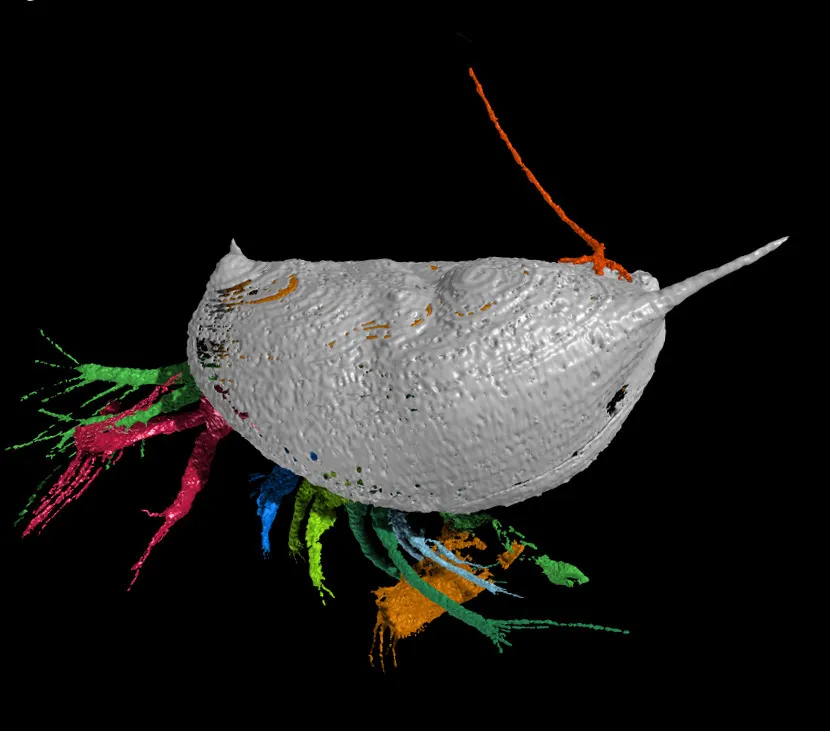
The new species was dubbed Invavita piratica, meaning "ancient intruder," as a nod to maritime piracy. It was discoveredin a crustacean host, called Nymphatelina gravida, a marine creature with two shells connected by a hinge. In fact, the researchers found several specimens of I. piratica in the fossil, which the scientists found in limestone rocks in Herefordshire, England.
The I. piratica specimens are "exceptionally preserved," and range in size from about 0.04 to 0.16 inches (1 to 4 millimeters) long, the researchers wrote in the study.
This image shows the crustacean fossil without its shell. The tongue worms are in orange, and the host is shown in the other colors.
(Image credit: D. Siveter, D. Briggs, D. Siveter, M. Sutton)
"This discovery is important not only because examples of parasites are exceptionally rare in the fossil record, but also because the possible host of fossil tongue worms — and the origin of the lifestyle of tongue worms — has been the subject of much debate," said the study's lead author, David Siveter, a paleontologist at the University of Leicester, in the United Kingdom.
Researchers found several of the parasites inside the crustacean's shell, near a bundle of eggs that may have belonged to the host, the researchers said. Other parasites were anchored to the outside of the shell, a position that is unique even among living tongue worms, the researchers said.
Sign up for the Live Science daily newsletter now
Get the world’s most fascinating discoveries delivered straight to your inbox.
Nowadays, there are about 140 known species of parasitic tongue worms, known as pentastomids, which mostly prey on vertebrates, especially fish and reptiles.
However, these parasitic worms are known sometimes to live in the gut-respiratory system of humans, which the worms infect after a person eats an intermediate host, such as a fish, the researchers said.
Laura is the managing editor at Live Science. She also runs the archaeology section and the Life's Little Mysteries series. Her work has appeared in The New York Times, Scholastic, Popular Science and Spectrum, a site on autism research. She has won multiple awards from the Society of Professional Journalists and the Washington Newspaper Publishers Association for her reporting at a weekly newspaper near Seattle. Laura holds a bachelor's degree in English literature and psychology from Washington University in St. Louis and a master's degree in science writing from NYU.