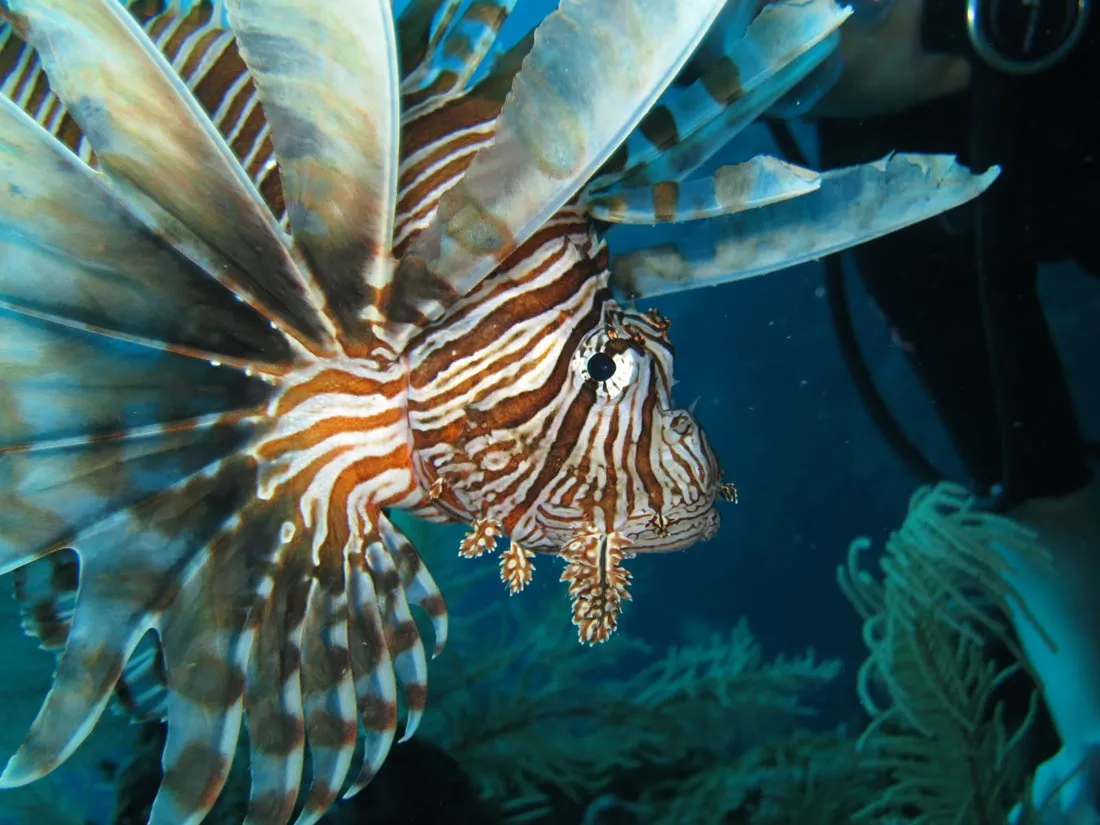
Lionfish, an invasive Pacific Ocean species, have been wiping out native fish populations in the Caribbean Sea and Atlantic Ocean for the past couple of decades. Now, research reveals the "terminator"-style approach to hunting that has likely made them so successful: When other predatory fish quit stalking their prey to look for easier targets, lionfish just keep on killing.
"Lionfish seem to be the ultimate invader," study researcher Kurt Ingeman, a doctoral student at Oregon State University, said in a statement. "Almost every new thing we learn about them is some characteristic that makes them a more formidable predator. And it's now clear they will hunt successfully even when only a few fish are present. This behavior is unusual and alarming."
Ingeman, who presented his research at the annual meeting of the Ecological Society of America in Sacramento, California, studied populations of the fairy basslet, a common lionfish prey, at reefs in the Bahamas. [Alien Invaders: Photos of Destructive Invasive Species]
Under normal conditions, the population of a small reef fish like the fairy basslet tends to fluctuate. These fish hide in rocks and crevices for shelter, Ingeman explained, meaning they become more difficult for predators to hunt when their population sinks to low numbers. But when predatory fish move on to other areas where prey are more abundant and thus easier to catch, the population of fairy basslets gets a chance to bounce back, and the cycle continues.
The fairy basslet is a common prey of lionfish in the Atlantic Ocean and a popular aquarium fish.
(Image credit: Oregon State University)
However, fairy basslets get no such relief when lionfish are present. Ingeman found that low-density populations of the prey fish that were living in reefs invaded by lionfish experienced a mortality rate four times higher than their counterparts living in reefs exposed to native predators like groupers and trumpet fish.
Lionfish, which are covered in venomous spines, are such successful invaders because they can tolerate a variety of habitats and they reproduce at alarming rates. They also have a voracious appetite and aren't too picky about what they eat. In some spots in the Atlantic, scientists estimate lionfish have wiped out 90 percent of native fish.
In Atlantic and Caribbean waters, lionfish have no natural predators. Not even sharks could help curb the spread of the species, a study released last year found. Another recent investigation revealed that lionfish, thought to be confined to shallow environments, are thriving in surprisingly deep waters off the coast of Florida.
Sign up for the Live Science daily newsletter now
Get the world’s most fascinating discoveries delivered straight to your inbox.
It's still unclear whether native prey fish are adapting to their new tormentors.
"There's a strong pressure here for natural selection to come into play eventually," Ingeman said in the statement. "We know that fish can learn and change their behavior, sometimes over just a few generations. But we don't have any studies yet to demonstrate this is taking place with native fish populations in the Atlantic."
Megan has been writing for Live Science and Space.com since 2012. Her interests range from archaeology to space exploration, and she has a bachelor's degree in English and art history from New York University. Megan spent two years as a reporter on the national desk at NewsCore. She has watched dinosaur auctions, witnessed rocket launches, licked ancient pottery sherds in Cyprus and flown in zero gravity. Follow her on Twitter and Google+.