













Surprise! Icebergs Spotted in Lake Superior

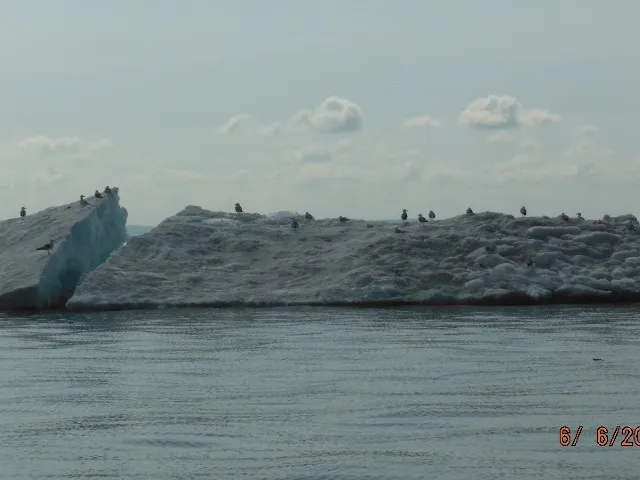
Though it's starting to feel like summer in the Great Lakes region, with temperatures soaring into the 80s (Fahrenheit), icebergs are still loitering in Lake Superior — a reminder of an especially harsh winter.
Last week, a marine warden with the Wisconsin Department of Natural Resources was patrolling Lake Superior when she spotted seagulls resting on a huge chunk of ice near Madeline Island, off the northern coast of Wisconsin.
"Normally the ice is mostly gone by end of April with some bays having some ice chunks floating around," said warden Amie Egstad. "We were doing commercial net checks and had been seeing the ice floating around the area. This one was the biggest we had seen so far." [Photos: Summer Icebergs in Lake Superior]
The iceberg rose 12 to 14 feet (3.5 to 4 meters) above the water and stretched 40 feet (12 m) long and 20 feet (6 m) wide, though much of the block was hidden underwater, Egstad told Live Science in an email.
"The surface water temperature in this area is only 34 Fahrenheit [1.1 degrees Celsius] so it will be a bit before the ice is actually gone," Egstad said.
The giant ice cubes seen by Egstad are lingering after a frigid winter, during which ice covered nearly 100 percent of Lake Superior, the deepest, largest and northernmost of the five Great Lakes. In March, all five of the lakes combined hit 91 percent ice cover, the most ice since the record of 94.7 percent was set in 1979, according to the Great Lakes Environmental Research Laboratory.
At the end of May, Lake Superior surface-water temperatures were about 1 or 2 degrees Fahrenheit (0.5 or 1 degree Celsius) below their long-term average. However, scientists with the Great Lakes Integrated Sciences and Assessments Center (GLISA) forecast that surface temperatures over the deepest parts of the lake will still be in the 40s F (about 4 C), at least 6 degrees F below normal by August, because these deeper waters take longer to mix with the surface waters and get thoroughly warm.
Get the world’s most fascinating discoveries delivered straight to your inbox.
Scientists say the winter's deep freeze will have lasting effects beyond persistent icebergs and colder-than-average water for swimming. The Great Lakes will likely have higher water levels and occasional blankets of fog as well.
"It's going to be the summer of fog. The water will stay really cold, but summer air tends to be warm and humid," Peter Blanken, a GLISA collaborator from the University of Colorado, explained in a statement. "And any time you get that combination, you're going to have condensation and fog — basically evaporation in reverse."
Chilly water will also delay the start of the yearly evaporation season by four to six weeks. Less evaporation could be a good thing for the Great Lakes, which last year experienced record low water levels. Lake Superior could see water-level gains of up to 10 inches (25 centimeters) by next spring, depending on rainfall, said GLISA climatologist John Lenters.
Follow Megan Gannon on Twitter and Google+. Follow us @livescience, Facebook & Google+. Original article on Live Science.
