














World's Largest Gold Crystal Found

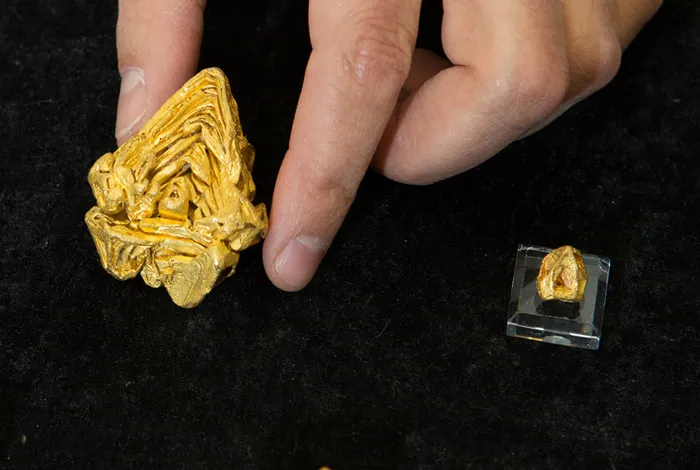
It's the size of a golf ball, but a lot more valuable: Scientists at Los Alamos National Laboratory's Lujan Neutron Scattering Center have verified that a heavy piece of gold, found years ago in Venezuela, is, in fact, a single crystal of the valuable element — and it's worth an estimated $1.5 million.
The lump of gold, which weighs 217.78 grams (about 7.7 ounces), was brought to Los Alamos to confirm whether it was a single crystal of gold, or a more common multiple-crystal structure. "The structure or atomic arrangement of gold crystals of this size has never been studied before, and we have a unique opportunity to do so," Miami University geologist John Rakovan said in a statement.
To determine the nugget's internal structure, Rakovan and his colleagues used two sophisticated machines: a neutron single-crystal diffraction (SCD) instrument, which determines the atomic arrangement of single crystals; and a high-pressure/preferred orientation (or HIPPO) instrument, which measures the crystal structure and the orientation of crystals in a polycrystalline material. These noninvasive techniques determined that the gold piece was, indeed, a very large and very rare single crystal of gold.
Follow Marc Lallanilla on Twitter and Google+. Follow us @livescience, Facebook & Google+.
Get the world’s most fascinating discoveries delivered straight to your inbox.
