 Live Science Plus




You are now subscribed
Your newsletter sign-up was successful
Want to add more newsletters?

Delivered Daily
Daily Newsletter
Sign up for the latest discoveries, groundbreaking research and fascinating breakthroughs that impact you and the wider world direct to your inbox.

Once a week
Life's Little Mysteries
Feed your curiosity with an exclusive mystery every week, solved with science and delivered direct to your inbox before it's seen anywhere else.

Once a week
How It Works
Sign up to our free science & technology newsletter for your weekly fix of fascinating articles, quick quizzes, amazing images, and more
Delivered daily
Space.com Newsletter
Breaking space news, the latest updates on rocket launches, skywatching events and more!

Once a month
Watch This Space
Sign up to our monthly entertainment newsletter to keep up with all our coverage of the latest sci-fi and space movies, tv shows, games and books.

Once a week
Night Sky This Week
Discover this week's must-see night sky events, moon phases, and stunning astrophotos. Sign up for our skywatching newsletter and explore the universe with us!
Join the club
Get full access to premium articles, exclusive features and a growing list of member rewards.
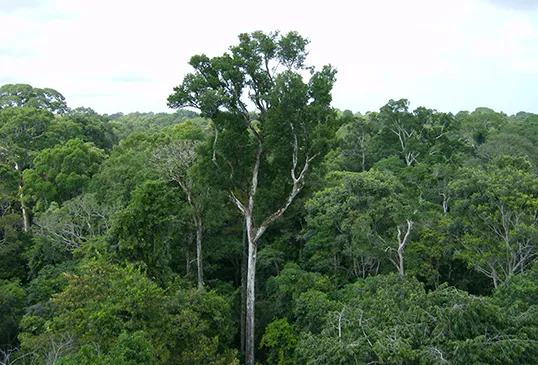
Pristine Amazon forests pull in more carbon dioxide than they put back into the atmosphere, according to a new study. The findings confirm that natural Amazon forests help reduce global warming by lowering the planet's greenhouse gas levels, the researchers said.
When scientists account for the world's carbon dioxide, their totals suggest some of the greenhouse gas disappears into land-based carbon traps. These natural carbon "sinks," such as forests, absorb and store carbon dioxide, helping to lower the greenhouse gas levels in the atmosphere. (Living trees take in carbon dioxide, which they need to grow. Dead trees release their stored carbon back into the atmosphere, through decay.)
But the model of a rainforest as carbon sink is based on small, heavily-studied tree areas called test plots, which means the concept could lose its accuracy when scaled up to the size of a continent. For example, in the Amazon forest, huge swaths of trees can die at once, which can't be accounted for by test plots. In 2005, a single storm killed half a billion trees in the Amazon forest. [Amazon Photos: Trees That Dominate the Rainforest]
To better measure the carbon on the rainforest's breath, researchers tracked tree death throughout the Amazon. Lead study author Fernando Espírito-Santo, a research scientist at NASA's Jet Propulsion Laboratory (JPL) in Pasadena, Calif., combined satellite data, airborne lidar (laser surface imagery) and tree counts to compare carbon consumed by living trees with emissions from dead trees.
Espírito-Santo found that dead Amazonian trees emit an estimated 1.9 billion tons (1.7 billion metric tons) of carbon to the atmosphere each year. In a normal year, the Amazon rainforest absorbs about 2.2 billion tons (2 billion metric tons) of carbon dioxide, studies suggest. And the big storms that blow down millions of trees at once barely budge the forest's carbon output, the study found.
"We found that large natural disturbances — the sort not captured by plots — have only a tiny effect on carbon cycling throughout the Amazon," study co-author Sassan Saatchi of JPL said in a statement.
The study did not account for tree deaths from logging or deforestation, the researchers said.
The Amazon River basin is home to the largest rainforest on Earth, covering about 2.67 million square miles (6.9 million square kilometers) in seven countries. Each year, about 2 percent of the entire Amazon forest dies of natural causes. The researchers found that only about 0.1 percent of those deaths are caused by blowdowns.
The findings were published March 16 in the journal Nature Communications.
Email Becky Oskin or follow her @beckyoskin. Follow us @livescience, Facebook & Google+. Original article on Live Science.

