













Pi in the Sky: Long String of Digits Written Over Austin

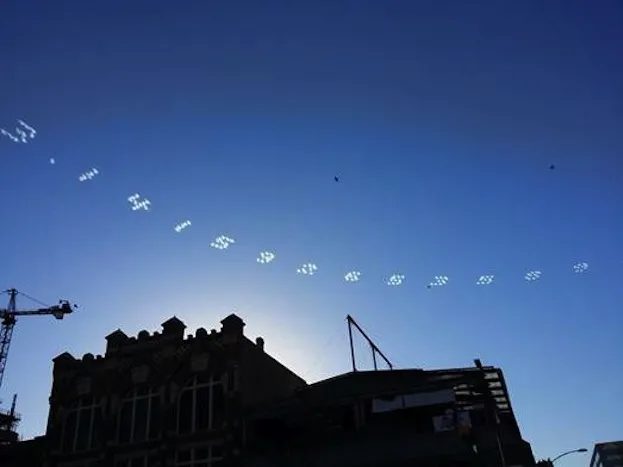
Those still lingering at the South by Southwest festival in Austin on Thursday (March 13) may have noticed a string of numbers emerging in the sky.
On the eve of Pi Day (which is Friday, March 14), five synchronized aircraft wrote out the first few hundred digits in pi's infinite sequence.
Starting with the famous 3.14, the dot matrix-style numbers went on for miles, according to AirSign, the company that organized the "Pi in the Sky" stunt, which started at 6:28 p.m.
"We chose 6:28 because it's pi times two, a number some believe is the truer reflection of the power of the circle," company officials wrote in a blog post.
Pi, or π, is a mathematical constant that represents the ratio of a circle's circumference to its diameter (π = c/d). No matter the size of the circle, pi remains the same. Because pi is an irrational number, it cannot be expressed as a simple fraction. Rather, pi can be written as an infinite decimal that never repeats (3.14159…). By December 2013, computers had calculated pi to a record 12 trillion digits, according to Numberworld.org.
Pi multiplied by two (6.28318...) is called tau and it is defined as the ratio of a circle's circumference to its radius. Some mathemeticians have argued that tau would be more useful as a mathematical constant as it appears more often in calculations.
Planes writing numbers in the sky with their jet stream. #piinthesky awesome. Thanks @airsignusa pic.twitter.com/xEWuwbUb8Q
Get the world’s most fascinating discoveries delivered straight to your inbox.
— Keri Lewis Brown (@kerilewisbrown) March 14, 2014
I don't always instagram pictures of the sky, but when I do, it's because they're sky writing pi. #piinthesky pic.twitter.com/DBzVANz9H8
— Sarah Dieken (@SarahDieken) March 14, 2014
Follow Megan Gannon on Twitter and Google+. Follow us @livescience, Facebook & Google+. Original article on Live Science.
