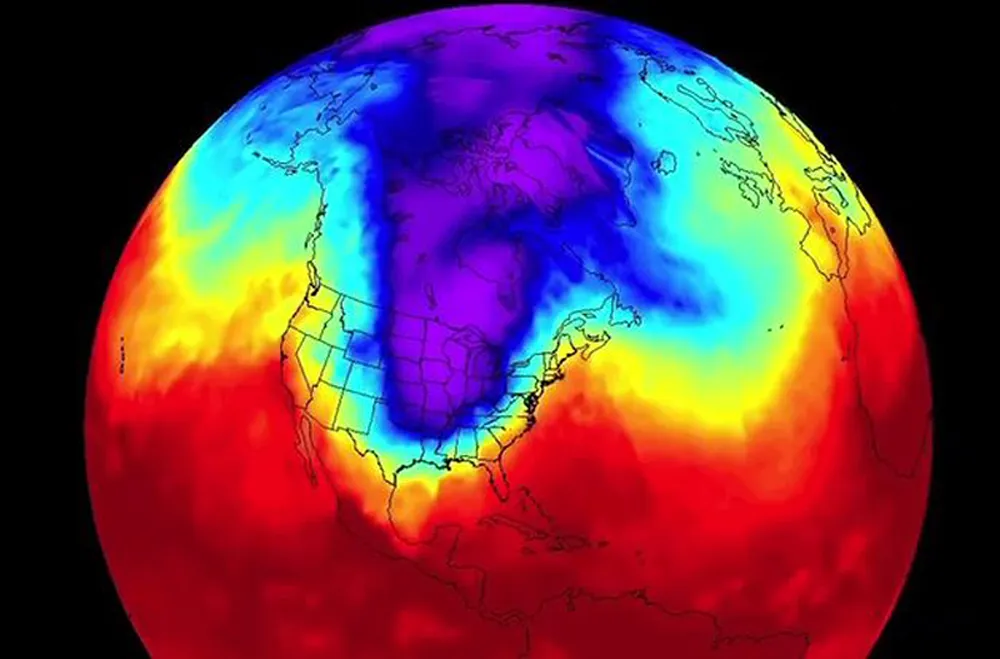
Another bout of painfully cold Arctic air is on its way to the northern United States, reviving talk of what has become popularly known as the "polar vortex."
By Thursday, temperatures will have dropped to as low as 30 degrees Fahrenheit (17 degrees Celsius) below the average temperature for this time of the year, meteorologists say, with highs dipping down into the teens in New York City and into the single digits in Chicago. Average temperatures for this time of year in those regions are generally closer to 45 and 40 F (7.2 and 4.4 C), respectively, said Bernie Rayno, a meteorologist with Accuweather.
While it's not necessarily inaccurate to refer to the event as the "polar vortex," Rayno said, the increased hype around this phrase since January's deep chill has warped people's perceptions of what is actually a fairly common weather phenomenon. [Weirdo Weather: 7 Rare Weather Events]
Latest Videos From
"We have seen this happen every winter in the past 24 years I have been a meteorologist, but this winter, it has happened more frequently in the upper Midwest and Northeast," Rayno told Live Science.
The polar vortex, despite what its name may imply, is not a storm but a "planetary-scale mid- to high-latitude circumpolar cyclonic circulation, extending from the middle troposphere to the stratosphere," according to a portion of the American Meteorological Society's recently updated definition. (The middle troposphere and stratosphere are components of the Earth's atmosphere.)
That vortex is always present, Rayno said, but it's generally trapped at polar latitudes due to a barricade created by the jet stream, the air current that travels from west to east across the United States. But when the jet stream sinks farther south than usual due to changes in weather patterns, it can allow cold air to flood south and bathe the country in unusually bitter temperatures.
While temperatures this week are not expected to plunge as low as they did in the January event, Rayno said that this may be the coldest event of the season relative to average temperatures for the time of year.
And if the cold weren't enough to get folks anxious for spring to come, a snowstorm is also expected to hit the Northeast directly before the bitter temperatures descend on the region, Rayno said.
Follow Laura Poppick on Twitter. Follow us @livescience, Facebook& Google+. Original article on Live Science.