















The Roots of Creativity Found in the Brain

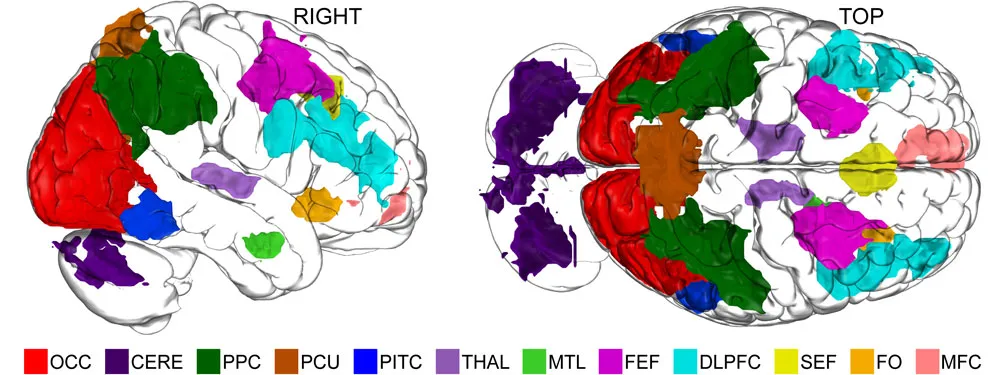
The ability of humans to create art, think rationally or invent new tools has long interested scientists, and a new study reveals how the brain achieves these imaginative feats.
Human imagination stems from a widespread network of brain areas that collectively manipulate ideas, images and symbols, the study finds.
Creativity in art, science, music and other fields requires the ability to combine different mental representations to form new ones. [Creative Genius: The World's Greatest Minds]
For example, if a person is asked to imagine a banana spinning around quickly and getting bigger or smaller, he can do so effortlessly, said study researcher Alex Schlegel, a cognitive neuroscientist at Dartmouth College in Hanover, N.H.
"When you start to look at more complex cognitive process like imagination or creative thinking, it's not just isolated [brain] areas that are responsible, but communication of the entire brain that's required," Schlegel told LiveScience.
In the study, the researchers focused on visual forms of imagination.
Schlegel and his colleagues asked participants to imagine certain shapes, and sometimes manipulate them by either combining them with other shapes or mentally breaking the shapes apart. They put people in a magnetic resonance imaging (MRI) scanner to measure their brain activity during the task.
Get the world’s most fascinating discoveries delivered straight to your inbox.
The scans showed that a broad network of brain areas were involved in the imagination task, and they appeared to be working in concert. In particular, manipulating the images involved a network of four core brain areas — the occipital cortex, the posterior parietal cortex (PPC), the posterior precuneus and the dorsolateral prefrontal cortex (DLPFC) — which are involved in visual processing, attention and executive functions.
In addition, several other brain regions were active during the task, suggesting the brain's mental workspace involves a more extended network.
Previous studies suggested the brain's visual processing areas are also involved in creating imagery. But the new study looked at not only how the brain forms images, but also how it modifies them.
The imagination experiment was somewhat unrealistic compared with creative tasks in everyday life. "It would be great if we could stick someone in an MRI machine and say 'create some art,'" Schlegel said. But for a scientific study, the task must be more uniform, he said.
Understanding imagination reveals what makes humans unique among animals, Schlegel said.
The findings could ultimately help improve artificial intelligence. Computers are good at a lot of things, but are less adept at seeing patterns or thinking creatively. "The more we understand how the human brain does this, the better we can design machines," Schlegel said.
The study was detailed this week in the journal Proceedings of the National Academy of Sciences.
Follow Tanya Lewis on Twitter and Google+. Follow us @livescience, Facebook & Google+. Original article on LiveScience.
