















UFO or Warplane? F-35 Jet Completes 1st Nighttime Vertical Landing

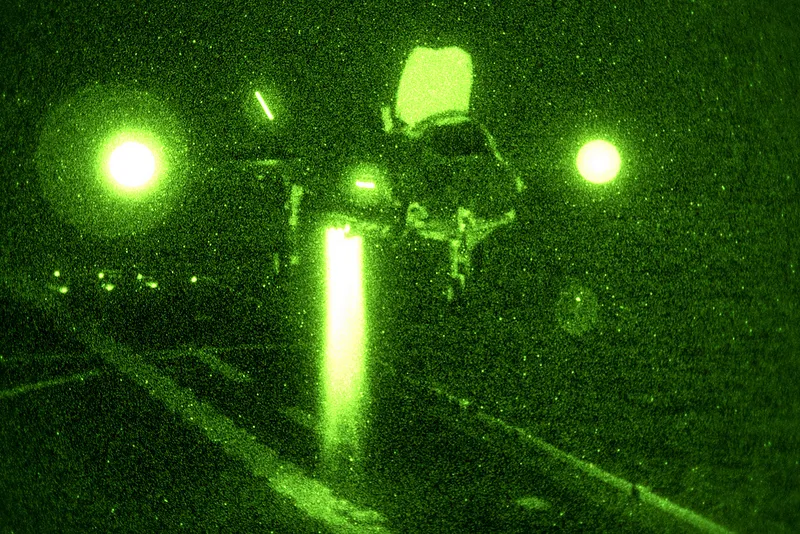
An F-35B Lightning II, a fighter jet specially designed to take off on a short runway and land vertically, successfully completed its first-ever vertical night landing at sea, a key milestone for the next-generation warplane.
United States Marine Corps test pilot Maj. C.R. Clift piloted the aircraft on its landmark test flight earlier this year, on April 2.
Newly released video footage of the landing, shot in night vision, shows the F-35B's short takeoff and subsequent vertical hover and touchdown, an impressive spectacle that makes the vehicle look more like a UFO than an airplane. [In Photos: F-35 Fighter Jet Makes 1st Vertical Night Landing]
The April test flight occurred over the Atlantic Ocean and was designed to gather data on the helmet and lighting conditions necessary for night operations. The aircraft's successful vertical landing at sea took place aboard the USS Wasp, a U.S. Navy amphibious assault ship. The F-35B is currently undergoing a series of tests at sea, as part of the aircraft's development program.
"The completion of this test event demonstrates the F-35B is one step closer to delivering a critical capability to the U.S. Marine Corps and F-35B partners in the United Kingdom and Italy," Lt. Gen. Chris Bogdam, executive officer of the F-35 program, said in a statement. "There is plenty of work to be done and progress to be made, but we're on a solid path forward."
The plane's short takeoff and vertical landing capabilities will allow the warfighter to operate from a range of diverse locations, including amphibious ships, aircraft carriers and airfields, according to U.S. Marine Corps officials.
"The F-35B will enable the Marine Corps to preserve its expeditionary nature and bring the next generation of warfighting capabilities to the Joint Force," Lt. Gen. Robert Schmidle, Marine Corps Deputy Commandant for Aviation, said in a statement. "The first nighttime vertical landing represents the continued success of the program as well as the completion of yet another milestone towards realizing the full capabilities of the F-35B."
Get the world’s most fascinating discoveries delivered straight to your inbox.
The first F-35B test flights began in 2011, and 72 vertical landings and takeoffs have occurred aboard the USS Wasp. Since the program was initiated, pilots have also conducted approximately 700 short takeoffs and completed more than 380 vertical landings, including the first operational vertical landing at the Marine Corps Air Station in Yuma, Ariz., on March 21, 2013.
Follow Denise Chow on Twitter @denisechow. Follow LiveScience @livescience, Facebook & Google+. Original article on Live Science.

Denise Chow was the assistant managing editor at Live Science before moving to NBC News as a science reporter, where she focuses on general science and climate change. Before joining the Live Science team in 2013, she spent two years as a staff writer for Space.com, writing about rocket launches and covering NASA's final three space shuttle missions. A Canadian transplant, Denise has a bachelor's degree from the University of Toronto, and a master's degree in journalism from New York University.