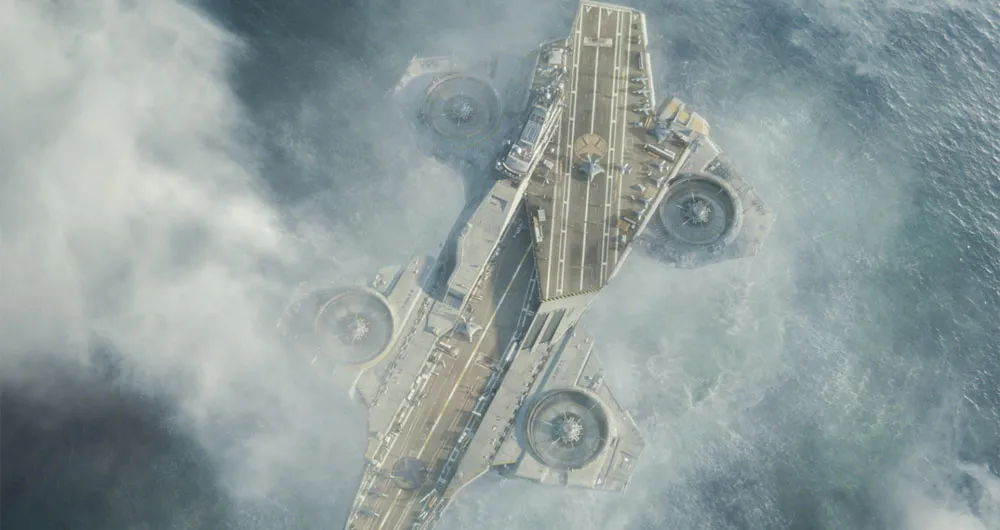
Moviegoers can easily recognize flights of fancy when they see the Avengers assemble aboard the flying "Helicarrier" aircraft carrier in Hollywood's latest superhero blockbuster. But could the U.S. Navy ever build the fantastical military marvel if it wanted a flying air base?
The Navy has experimented with less-ambitious flying aircraft carriers in the 1930s — its rigid airships such as the USS Macon and USS Akron could each carry up to five biplane fighter aircraft. But the modern military's budget would likely burst trying to build and operate a full-size flying aircraft carrier that weighs 100,000 tons and stretches the length of three football fields, according to a U.S. Navy official at Naval Air Systems Command.
"We would want to minimize the weight and cost of a flying carrier itself in order to maximize the number and capability of the aircraft that could be carried on it," the Navy official said. "The number and size of the thrusters required to lift the carrier, the number and size of the engines to drive them, the fuel to keep the engines running, etc., all sum to make the system unrealistic."
Military VTOL aircraft crowd the decks of the flying Helicarrier from the Avengers film
(Image credit: Marvel Studios)
That reality rests upon the simple fact that it's much cheaper to float, rather than fly, the weight of a huge aircraft carrier containing dozens of military jets and more than 5,000 members of the ship's crew and air wing. An aircraft carrier designed without any flight assistance — such as wings — would require huge amounts of power for the thrusters in both lifting mode and in forward airborne flight.
The fictional Helicarrier appears to use ducted rotors for its vertical takeoff and landing technology (or VTOL) — not too far off from real Navy aircraft such as the AV-8B Harrier fighter jet, the V-22 Osprey, and the upcoming carrier version of the F-35 Joint Strike Fighter. Such VTOL aircraft represent the "ultimate in operational flexibility," but also represent the most expensive air transport options for the U.S. military.
For now, the U.S. Navy seems happy with the cost-efficiency and flexibility of its floating aircraft carriers — a naval weapon that has dominated the seas since World War II. U.S. taxpayers will likely feel equally happy to pay the movie ticket cost to see the flying Helicarrier, rather than fund one in real life.
"The combination of a floating aircraft carrier, with the flexibility of the aircraft that are based on it (including rotary wing aircraft) offers a great balance of efficiency and flexibility," the Navy official said.
Sign up for the Live Science daily newsletter now
Get the world’s most fascinating discoveries delivered straight to your inbox.
This story was provided by InnovationNewsDaily, a sister site to LiveScience. You can follow InnovationNewsDaily Senior Writer Jeremy Hsu on Twitter @ScienceHsu. Follow InnovationNewsDaily on Twitter @News_Innovation, or on Facebook.
Jeremy has written for publications such as Popular Science, Scientific American Mind and Reader's Digest Asia. He obtained his masters degree in science journalism from New York University, and completed his undergraduate education in the history and sociology of science at the University of Pennsylvania.