 Live Science Plus


You are now subscribed
Your newsletter sign-up was successful
Want to add more newsletters?

Delivered Daily
Daily Newsletter
Sign up for the latest discoveries, groundbreaking research and fascinating breakthroughs that impact you and the wider world direct to your inbox.
Once a week
Life's Little Mysteries
Feed your curiosity with an exclusive mystery every week, solved with science and delivered direct to your inbox before it's seen anywhere else.

Once a week
How It Works
Sign up to our free science & technology newsletter for your weekly fix of fascinating articles, quick quizzes, amazing images, and more
Delivered daily
Space.com Newsletter
Breaking space news, the latest updates on rocket launches, skywatching events and more!

Once a month
Watch This Space
Sign up to our monthly entertainment newsletter to keep up with all our coverage of the latest sci-fi and space movies, tv shows, games and books.

Once a week
Night Sky This Week
Discover this week's must-see night sky events, moon phases, and stunning astrophotos. Sign up for our skywatching newsletter and explore the universe with us!
Join the club
Get full access to premium articles, exclusive features and a growing list of member rewards.
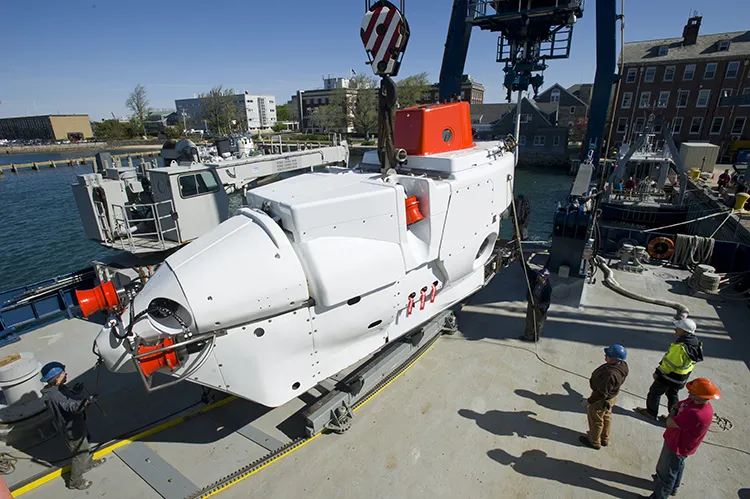
Alvin the submersible is going on a cross-country journey after a $41 million upgrade.
The scientific sub has a storied career in deep-ocean research. Its famous voyages include a trip to survey the wreckage of the Titanic in 1996 and to discover a lost hydrogen bomb in the Mediterranean Sea in 1966. It has explored the Deepwater Horizon oil spill area in the Gulf of Mexico as well as deep hydrothermal vents in the Pacific Ocean.
At that depth, Alvin will have access to 98 percent of the ocean, upgrade project leader Susan Humphris of the Woods Hole Oceanographic Institution told LiveScience in July.
The research vessel Atlantis left Woods Hole in Massachusetts on Saturday (May 25) with Alvin aboard. The Atlantis and its cargo will travel through the Panama Canal to reach Oregon on June 20.

"This is an important moment in the long process of building the sub and bringing it back online," Susan Avery, the president and director of Woods Hole, said in a statement. "Alvin is a cornerstone of U.S. deep-ocean research, enabling untold scientific discoveries and greater understanding of our ocean. We're eager to have it back in service."
After a series of test dives off Monterey, Calif., this September, Alvin will take a cruise in November to ensure its systems are functioning properly. It will then return to service in December.
Alvin's new 3-inch-thick (7.6 centimeters) titanium sphere can hold a pilot and two scientists. It has a slightly larger interior than the sub's previous quarters and five viewing ports for visibility. In the upgrade, Alvin also received upgraded lighting and an improved command and control system.
The R/V Atlantis also received an upgrade for its job as submersible carrier. The changes included a strengthened A-frame, the structure used to launch the sub and haul it back onboard, and a renovated hangar for Alvin's storage.
Follow Stephanie Pappas on Twitter and Google+. Follow us @livescience, Facebook & Google+. Original article on LiveScience.com.

