 Live Science Plus






Big Meteorite Discovered in Antarctica
You are now subscribed
Your newsletter sign-up was successful
Want to add more newsletters?

Delivered Daily
Daily Newsletter
Sign up for the latest discoveries, groundbreaking research and fascinating breakthroughs that impact you and the wider world direct to your inbox.

Once a week
Life's Little Mysteries
Feed your curiosity with an exclusive mystery every week, solved with science and delivered direct to your inbox before it's seen anywhere else.

Once a week
How It Works
Sign up to our free science & technology newsletter for your weekly fix of fascinating articles, quick quizzes, amazing images, and more
Delivered daily
Space.com Newsletter
Breaking space news, the latest updates on rocket launches, skywatching events and more!
Once a month
Watch This Space
Sign up to our monthly entertainment newsletter to keep up with all our coverage of the latest sci-fi and space movies, tv shows, games and books.

Once a week
Night Sky This Week
Discover this week's must-see night sky events, moon phases, and stunning astrophotos. Sign up for our skywatching newsletter and explore the universe with us!
Join the club
Get full access to premium articles, exclusive features and a growing list of member rewards.
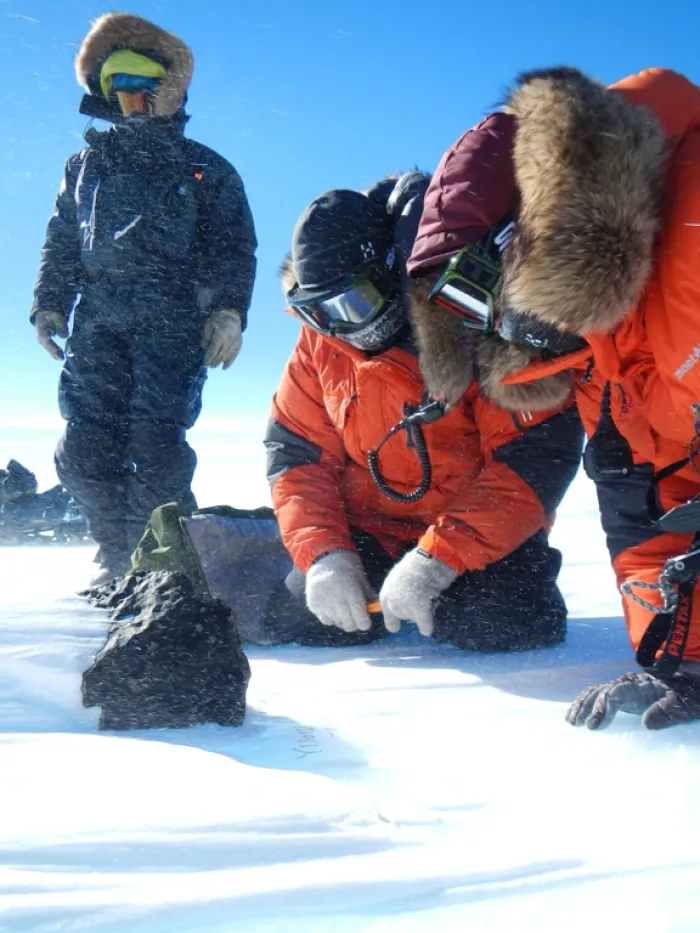
Meteorite hunters at the bottom of the world bagged a rare find this southern summer: a 40-pound (18 kilogram) chunk of extraterrestrial rock.
A team from Belgium and Japan discovered the hefty meteorite as the members drove across the East Antarctic plateau on snowmobiles. Initial tests show it is an ordinary chondrite, the most common type of meteorite found on Earth, Vinciane Debaille, a geologist from Université Libre de Bruxelles in Belgium, said in a statement.
"This is the biggest meteorite found in East Antarctica for 25 years," Debaille said. "This is something very exceptional. When you find such a meteorite on Earth, it means that when it was in the sky, it was much larger." [Images of the Antarctic meteorite.]

The Russian meteor that burst into fragments above the Chelyabinsk region on Feb. 15 is also an ordinary chondrite, according to initial tests by Russian scientists.
Every year, scientists travel to Antarctica to search for meteorites. Their charred black crust stands out starkly in the white snow, and the cold, dry climate helps preserve any organic chemicals inside the rocks.
The expedition collected 425 meteorites in 40 days, with a total weight of 165 pounds (75 kg). Debaille said they may have found one Mars meteorite and one piece of the asteroid Vesta among the many discoveries.
The researchers canvassed the Nansen Ice Field, 86 miles (140 kilometers) south out of the International Polar Foundation's Princess Elisabeth station. The United States also sent scientists out on the polar ice to collect meteorites this season, from McMurdo Station on the opposite end of the continent.
Reach Becky Oskin at boskin@techmedianetwork.com. Follow her on Twitter @beckyoskin. Follow OurAmazingPlanet on Twitter @OAPlanet. We're also on Facebook and Google+.

