 Live Science Plus






Earthquake Shake Test Clobbers NYC Brownstone
You are now subscribed
Your newsletter sign-up was successful
Want to add more newsletters?

Delivered Daily
Daily Newsletter
Sign up for the latest discoveries, groundbreaking research and fascinating breakthroughs that impact you and the wider world direct to your inbox.

Once a week
Life's Little Mysteries
Feed your curiosity with an exclusive mystery every week, solved with science and delivered direct to your inbox before it's seen anywhere else.

Once a week
How It Works
Sign up to our free science & technology newsletter for your weekly fix of fascinating articles, quick quizzes, amazing images, and more

Delivered daily
Space.com Newsletter
Breaking space news, the latest updates on rocket launches, skywatching events and more!

Once a month
Watch This Space
Sign up to our monthly entertainment newsletter to keep up with all our coverage of the latest sci-fi and space movies, tv shows, games and books.

Once a week
Night Sky This Week
Discover this week's must-see night sky events, moon phases, and stunning astrophotos. Sign up for our skywatching newsletter and explore the universe with us!
Join the club
Get full access to premium articles, exclusive features and a growing list of member rewards.
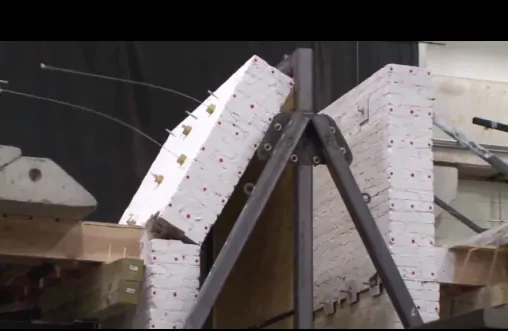
New York City's brick houses would fall apart if an earthquake the size of the one that struck in Christchurch, New Zealand in 2011 hit near the metropolis, a recent earthquake simulation found.
The shake table test broke an unreinforced brick wall in half on Feb. 18 at the University at Buffalo's Multidisciplinary Center for Earthquake Engineering Research.
Unreinforced masonry buildings account for about 80 percent of New York City's housing and appear commonly throughout the East Coast, said structural engineer Juan Aleman, a graduate student at the university.
The good news is that a similar brick wall, reinforced with steel rods and bolts as is done in earthquake-prone California, withstood the shaking. "We're trying to understand, 'How much better does a building perform when it has been retrofitted?'" said Gilberto Mosqueda, a structural engineering professor at the University of California, San Diego, who took part in the test.
Data from the simulation will help Aleman model New York City's vulnerability to earthquakes. "We will try to understand what will happen in a real building if an earthquake of magnitude 5.0 or greater happens," he told OurAmazingPlanet.
The 2011 Virginia earthquake, which hit a sparsely populated region, destroyed as many as seven houses and caused major damage to 120 other buildings in the surrounding region, according to government reports.
Reach Becky Oskin at boskin@techmedianetwork.com. Follow her on Twitter @beckyoskin. Follow OurAmazingPlanet on Twitter @OAPlanet. We're also on Facebook and Google+.

