 Live Science Plus






19th-Century Shipwrecks Discovered Off Israel's Coast
You are now subscribed
Your newsletter sign-up was successful
Want to add more newsletters?

Delivered Daily
Daily Newsletter
Sign up for the latest discoveries, groundbreaking research and fascinating breakthroughs that impact you and the wider world direct to your inbox.

Once a week
Life's Little Mysteries
Feed your curiosity with an exclusive mystery every week, solved with science and delivered direct to your inbox before it's seen anywhere else.

Once a week
How It Works
Sign up to our free science & technology newsletter for your weekly fix of fascinating articles, quick quizzes, amazing images, and more

Delivered daily
Space.com Newsletter
Breaking space news, the latest updates on rocket launches, skywatching events and more!

Once a month
Watch This Space
Sign up to our monthly entertainment newsletter to keep up with all our coverage of the latest sci-fi and space movies, tv shows, games and books.

Once a week
Night Sky This Week
Discover this week's must-see night sky events, moon phases, and stunning astrophotos. Sign up for our skywatching newsletter and explore the universe with us!
Join the club
Get full access to premium articles, exclusive features and a growing list of member rewards.
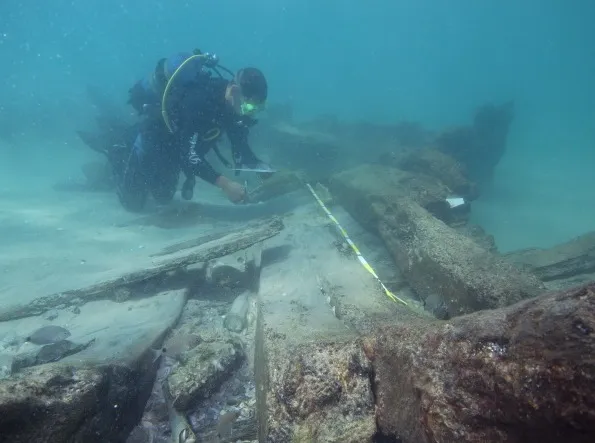
Archaeologists have discovered four 19th-century warships, and possibly the remains of an ancient Greek harbor, off the coast of Israel.
The fleet was found at the ancient port of Akko, one of the major ports of the Mediterranean during the Hellenistic period from 300 B.C. to 100 B.C. The new discoveries could point to even more ancient, elusive shipwrecks.
"I'm very interested in finding a well-preserved example of an ancient multi-decked warship from the Hellenistic age," study author Bridget Buxton, an archaeologist from the University of Rhode Island, said in a statement. "These ships were incredible pieces of technology, but we don't know much about their design, because no hulls have been found. However, a combination of unusual environmental and historical factors leads us to believe we have a chance of finding the remains of one of these ships off the northern coast of Israel."
The team found the four warships in 2011 using sound waves to probe beneath the ocean floor off the coast of Akko in northern Israel. The city has been a busy port since antiquity. After storms briefly washed away some of the sediment burying the ships, the Israeli Antiquities Authority peeked into one of the 105-foot (32-meter)-long ships. Sediment has since reburied the fleet. Wood from the ship came from Turkey, laboratory analysis showed.

The researchers believe the ships, once part of an Egyptian fleet, sank during the Egyptian Ottoman war when Admiral Osman Nurredin Bey attempted to retake the city of Akko in 1831.
In the process of excavating in the area, the team also found the remains of a ship shed that was possibly used to bring in warships during the Hellenistic period. At the site, they found remnants of Hellenistic stonework, ancient pottery, mooring materials and a stone quay. These fragments suggest a much older, ancient Greek port may lie beneath the seafloor — along with even more ancient shipwrecks.
"We've got fragmentary historic records for this area in the Hellenistic period, and now we've found a very important feature from the ancient harbor. Ancient shipwrecks are another piece of the puzzle that will help us to rewrite the story of this region at a critical time in Mediterranean history," Buxton said in a statement.
The findings were presented at the annual meeting of the American Schools of Oriental Research on Nov. 15 and 17 in Chicago.
Follow LiveScience on Twitter @livescience. We're also on Facebook & Google+.

