 Live Science Plus





You are now subscribed
Your newsletter sign-up was successful
Want to add more newsletters?

Delivered Daily
Daily Newsletter
Sign up for the latest discoveries, groundbreaking research and fascinating breakthroughs that impact you and the wider world direct to your inbox.
Once a week
Life's Little Mysteries
Feed your curiosity with an exclusive mystery every week, solved with science and delivered direct to your inbox before it's seen anywhere else.
Once a week
How It Works
Sign up to our free science & technology newsletter for your weekly fix of fascinating articles, quick quizzes, amazing images, and more

Delivered daily
Space.com Newsletter
Breaking space news, the latest updates on rocket launches, skywatching events and more!

Once a month
Watch This Space
Sign up to our monthly entertainment newsletter to keep up with all our coverage of the latest sci-fi and space movies, tv shows, games and books.

Once a week
Night Sky This Week
Discover this week's must-see night sky events, moon phases, and stunning astrophotos. Sign up for our skywatching newsletter and explore the universe with us!
Join the club
Get full access to premium articles, exclusive features and a growing list of member rewards.
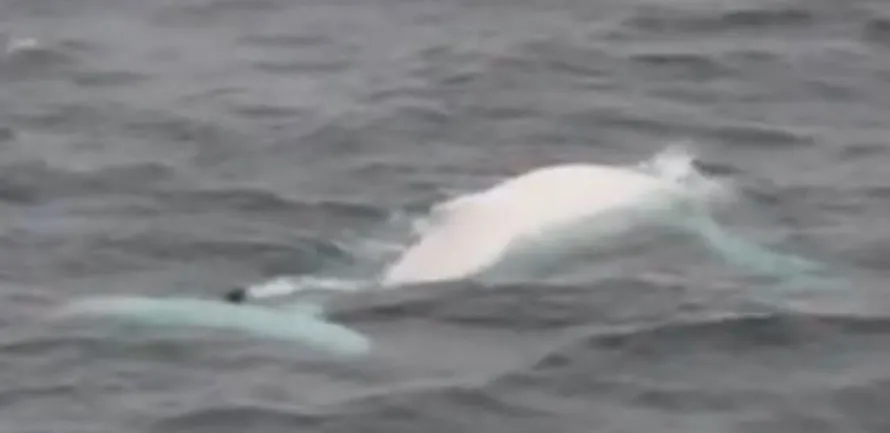
Call me Dan.
It may not have the same ring as "Call me Ishmael," the eternal first line of Herman Melville's "Moby Dick," but facts are facts and Dan Fisher has to start his own story of a white whale somewhere.
Fisher says that in his 10 years working at sea, he's never seen anything like it, according to the Daily Mail. But one sighting in a decade isn't bad considering the whale he filmed is only the second known adult white humpback on the planet.
The first is Migaloo, a humpback who's made numerous cameos off Australia's east coast. The whale's name means "white fella" in Aboriginal, and he's usually spotted as he makes his annual migration to Antarctic waters during the southern spring.
While Migaloo is thought to be affected by albinism, a genetic condition that stifles melanin pigmentation, it's possible his Norwegian counterpart is not albino, but leucistic. Leucism can affect pigments other than melanin; it doesn't result in the pink eyes characteristic of albinism; and it can leave an animal with splotches of color, such as the ones seen briefly on the underside of the Norwegian whale's tail in the video. [The Pink and White Album: Amazing Albino Animals]
Iceberg, scientists' name for an all-white killer whale recorded earlier this year off of eastern Russia, is still the only known adult orca with the snowy coloration.
The albino whale in Melville's "Moby Dick" and the creature's true-life inspiration, Mocha Dick, are not humpbacks, but sperm whales.
Mocha Dick is so named because his pale form was first spotted near the island of Mocha, off the coast of Chile, in the early 19th century. He's reputed to have survived close to 100 sea battles with whaling ships, taking down 20 of them before he met his downfall.
The stories have it, though, that Mocha Dick's ferocity never came unprovoked, and he was supposedly drawn into his last-ever fight because a whaler slew a calf directly in sight of the young whale's mother.
Mocha Dick was turned into 100 barrels of oil and perhaps the greatest American novel ever written.
Follow Life's Little Mysteries on Twitter @llmysteries. We're also on Facebook & Google+.
