Solar Eclipses: An Observer's Guide (Infographic)

Get the world’s most fascinating discoveries delivered straight to your inbox.
You are now subscribed
Your newsletter sign-up was successful
Want to add more newsletters?
Delivered Daily
Daily Newsletter
Sign up for the latest discoveries, groundbreaking research and fascinating breakthroughs that impact you and the wider world direct to your inbox.
Once a week
Life's Little Mysteries
Feed your curiosity with an exclusive mystery every week, solved with science and delivered direct to your inbox before it's seen anywhere else.
Once a week
How It Works
Sign up to our free science & technology newsletter for your weekly fix of fascinating articles, quick quizzes, amazing images, and more
Delivered daily
Space.com Newsletter
Breaking space news, the latest updates on rocket launches, skywatching events and more!
Once a month
Watch This Space
Sign up to our monthly entertainment newsletter to keep up with all our coverage of the latest sci-fi and space movies, tv shows, games and books.
Once a week
Night Sky This Week
Discover this week's must-see night sky events, moon phases, and stunning astrophotos. Sign up for our skywatching newsletter and explore the universe with us!
Join the club
Get full access to premium articles, exclusive features and a growing list of member rewards.
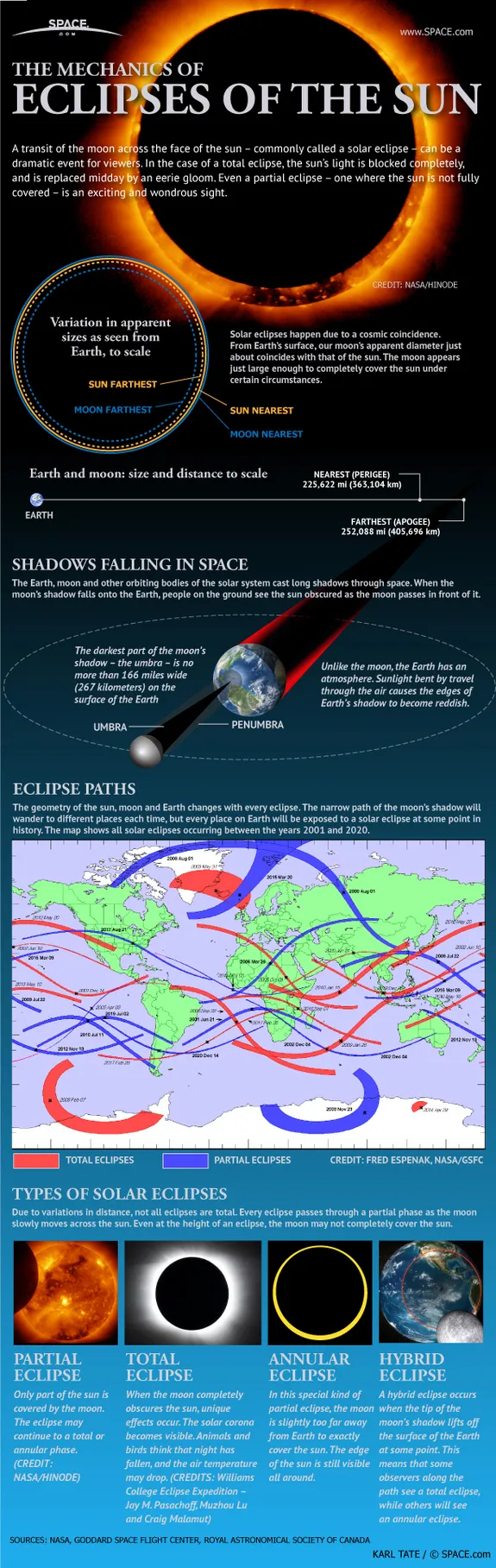
Solar eclipses are one of the cosmic wonders of our solar system. They occur when the new moon blocks part or all of the sun as seen from the surface of the Earth. Check out the SPACE.com Infographic above to see how solar eclipses work.
When the moon passes in front of sun, as viewed from Earth, the eclipse that occurs is visible from a narrow path on Earth that corresponds to the location of the moon's shadow. During a total solar eclipse, this path is known as the path of totality. WARNING: Never look directly at the sun during an eclipse with a telescope or your unaided eye. Severe eye damage can result and scientists use special filters to safely view the sun.

Complete Coverage of the May 20 Annular Solar Eclipse
There are several other types of solar eclipses.
In addition to total eclipses of the sun, the moon can block part of the sun's disk (a partial solar eclipse), or leave only an outer ring of the sun visible in a so-called annular solar eclipse. A hybrid solar eclipse occurs when the tip of the moon's shadow lifts off the surface of the Earth at some point, allowing some observers to see a total eclipse while others witness an annular eclipse.
- Amazing Total Solar Eclipse Photos
- CAUTION! - How to SAFELY Observe the Sun (Video)
- Venus Transit of 2012: Complete Coverage
Get the world’s most fascinating discoveries delivered straight to your inbox.