
 Live Science Plus


Prescription Drug Abuse Kills (Infographic)

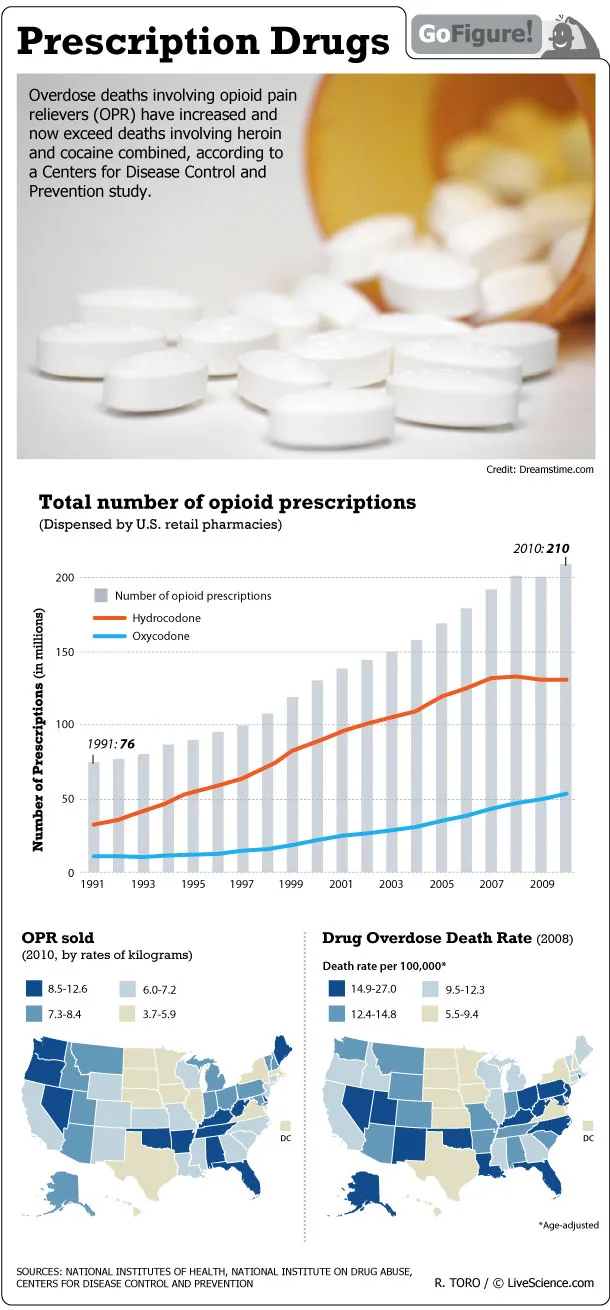
Deaths from overdoses of prescription painkillers have more than tripled in the past decade, according to a report by the Centers for Disease Control and Prevention (CDC).
The new finding shows that more than 40 people die every day from overdoses involving narcotic pain relievers like hydrocodone (Vicodin), methadone, oxycodone (OxyContin), and oxymorphone (Opana).
"Overdoses involving prescription painkillers are at epidemic levels and now kill more Americans than heroin and cocaine combined," Dr. Thomas Frieden, director of the CDC, said in a statement in November.

The increased use of prescription painkillers for nonmedical reasons, essentially for the high they provide, and without a prescription, has contributed to the large number of overdoses and deaths, according to the CDC. In 2010, about 12 million people ages 12 and older reported using prescription painkillers nonmedically, according to the National Survey on Drug Use and Health.
The CDC numbers varied by state, with 2008 data showing a high of 27 deaths per 100,000 people in New Mexico related to overdoses and a low of 5.5 deaths per 100,000 people in Nebraska. In Oklahoma, 1 in 12 people ages 12 and older reporting they had used prescription painkillers for nonmedical reasons, while just 1 in 30 said the same in Nebraska. Prescription painkiller sales per person were more than three times higher in the highest state, Florida, than in the lowest state, Illinois.
Other findings regarding prescription painkillers are just as blue, it seems. Research published this year in the International Journal of Drug Policy revealed that the abuse of prescription drugs may be a gateway to abuse of hard, illegal drugs such as heroin. The scientists focused on teens who abused both injection drugs and prescription drugs; Eighty-five percent said they abused opioid painkillers, which include Vicodin and OxyContin, before trying heroin. On average, the painkiller abuse started two years before heroin use.
And hospitals are noticing. Visits to emergency departments involving nonmedical use of prescription narcotic pain relievers more than doubled between 2004 and 2008, according to a study released in 2010 by the Substance Abuse and Mental Health Services Administration (SAMHSA) and the U.S. Centers for Disease Control and Prevention.
The soaring abuse of prescription painkillers may be having another side-effect: doctors afraid to prescribe the drugs to those in need. Two studies reported in 2010 in the Journal of Pain and Palliative Care Pharmacotherapy and The Rx Consultant, revealed that millions of Americans are showing up at pharmacies, in pain but without prescriptions, as physicians — fearful of drug abuse — hesitate to prescribe pain medications. At least 30 percent of patients with moderate chronic pain and more than 50 percent with severe pain fail to achieve adequate relief, said lead researcher Katherine Hahn, a pharmacist and chair of the Oregon Pain Management Commission. Hahn suggested the shortcomings are due to inadequate physician training, personal biases, and doctors' fears of prescription drug abuse.
- Trippy Tales: The History of 8 Hallucinogens
- Understanding the 10 Most Destructive Human Behaviors
- Top 10 Leading Causes of Death
