 Live Science Plus





You are now subscribed
Your newsletter sign-up was successful
Want to add more newsletters?

Delivered Daily
Daily Newsletter
Sign up for the latest discoveries, groundbreaking research and fascinating breakthroughs that impact you and the wider world direct to your inbox.

Once a week
Life's Little Mysteries
Feed your curiosity with an exclusive mystery every week, solved with science and delivered direct to your inbox before it's seen anywhere else.

Once a week
How It Works
Sign up to our free science & technology newsletter for your weekly fix of fascinating articles, quick quizzes, amazing images, and more

Delivered daily
Space.com Newsletter
Breaking space news, the latest updates on rocket launches, skywatching events and more!

Once a month
Watch This Space
Sign up to our monthly entertainment newsletter to keep up with all our coverage of the latest sci-fi and space movies, tv shows, games and books.

Once a week
Night Sky This Week
Discover this week's must-see night sky events, moon phases, and stunning astrophotos. Sign up for our skywatching newsletter and explore the universe with us!
Join the club
Get full access to premium articles, exclusive features and a growing list of member rewards.
A skeleton can hold many clues about its deceased flesh-and-blood owner, and now research indicates that bones can show whether or not that person was overweight.
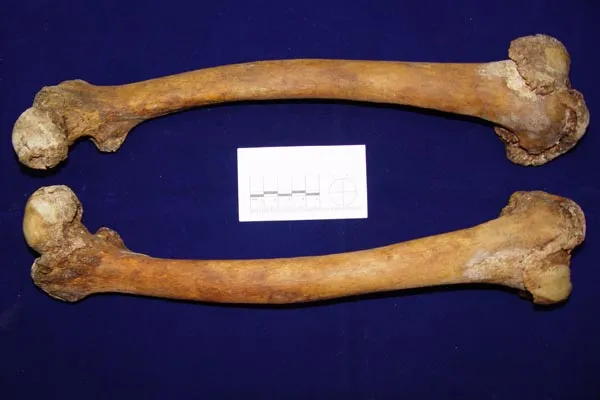
The key to ascertaining this is the thigh bone — a thick, weight-bearing bone called the femur. By studying the remains of 121 white men, two anthropologists have found the overweight men had wider femur bones.
Ann Ross, an anthropologist at North Carolina State University and one of the researchers, described the change in the bone as "almost like a buttress making something stronger."
"A lot of people have the impression that bone is not alive, but it is a very alive tissue, and it is continuously changing, and it changes due to the stressors that are placed on it," Ross said.
Other research has revealed that overweight and obese people move differently than those of normal weight to compensate for the extra heft they are carrying. For example, one study found that obese people took wider steps when walking than people of normal weight. These changes may alter the forces on the femur and cause it to change its shape, according to Ross and fellow researcher Gina Agostini.
They found that overweight men among the 121 skeletons had femurs that were wider from side-to-side. Changes in width from front-to-back of the femur showed no relationship to body weight.
In order to control for sex differences and possible genetic effects on variation in femur width, Ross and Agostini studied only white male skeletons. The next step will be to look at the relationship between femur width and body weight among women and different ethnic populations, Ross said.
The clues investigators can glean from a skeleton include age at death, sex, the presence of certain bone-altering diseases, ethnic ancestry and cause of death. This research could give them another clue with which to work when trying to identify a body, Ross said. However, it would be trickier to apply to ancient populations because their physical activity was much different than ours, she said.
The study was published in the March issue of the Journal of Forensic Sciences.
You can follow LiveScience writer Wynne Parry on Twitter @Wynne_Parry.

