













'Vestigial' human ear-wiggling muscle actually flexes when we're straining to hear
A mechanism that activates specific muscles in our ears is a leftover from our evolutionary past, back when our ancestors depended more on their hearing for survival.

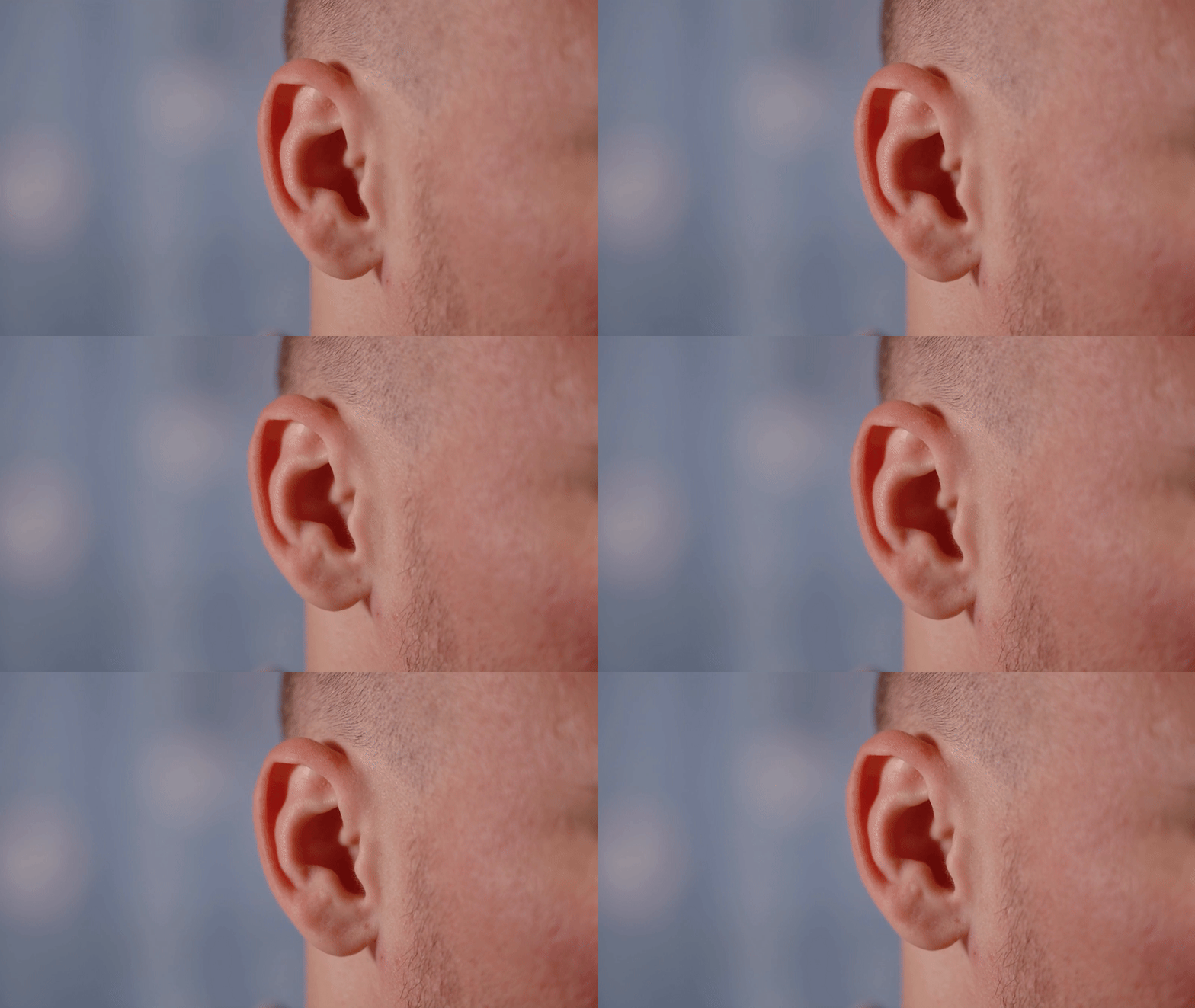
The little muscles that enable people to wiggle their ears unconsciously flex when we're trying to pick one sound out of a din of noise, a new study finds.
Think about how cats, dogs and certain monkeys twitch their ears in response to new sounds. This instinctive movement isn't just for show; it helps funnel sound toward the animals' eardrums, thereby sharpening their ability to pinpoint and process noise.
Recent research conducted at Saarland University in Germany revealed that humans also move their ears in response to sound — at least to some degree. When we strain to catch what someone is saying in a noisy room, for example, small muscles in our outer ears, called the superior auricular muscles, kick into action, likely in an attempt to sharpen our hearing ability. Because the muscle is small, though, it probably has little effect on our hearing ability.
Now, building on their previous research, the Saarland University scientists have conducted a new study, published Jan. 31 in the journal Frontiers in Neuroscience, to zoom in more closely on how the superior auricular muscle responds when people strain to hear. They think the research could have practical applications for improving hearing-aid technology in the future.
Related: 10 body parts that are useless in humans (or maybe not)
A remnant of our ancestors
Although the auricular muscles of modern humans are small and weak, in our distant ancestors, these muscles likely moved the ears back and forth, thus improving hearing by capturing sound more effectively. Some people can still wiggle their ears voluntarily, but nonetheless, these muscles are considered "vestigial" — evolutionary remnants with little practical use today.
That said, the researchers behind the new study wonder if the muscles could be useful for hearing-aid technology someday. One potential application is the integration of artificial intelligence that can sense and decode muscular movements.
Get the world’s most fascinating discoveries delivered straight to your inbox.
"If the superior auricular muscles, the ones that perk the ears up, are activated, the hearing aid would know that the user is expending a lot of effort to hear and understand something," study co-author Steven Hackley, a researcher at the University of Missouri, told Live Science in an email. "The hearing aid would then boost the sound level for sounds coming from that direction," Hackley suggested.
To learn more about these small ear muscles, Hackley and colleagues recruited 20 participants with normal hearing and attached electrodes to their scalp to track electrical activity in their superior and posterior auricular muscles, which are found above and behind the ears respectively.
While seated in a soundproof room with their heads secured in a chin rest to prevent movement, the participants listened to an audiobook while a distracting podcast played at the same time. These sounds came from speakers positioned either in front of or behind the participants.
The participants completed 12 five-minute trials of this experiment, each at one of three difficulty levels: low, medium or high. At the easiest level, the audiobook stood out from the podcast with a decent volume and distinct sound, making it much easier to focus on. However, as the difficulty increased, the podcasts were made louder and took on a similar pitch to the audiobook. This shift made it more challenging, though not impossible, for participants to focus on the audiobook.
Based on the electrode recordings, the researchers noted that when sounds came from behind the participants, their posterior auricular muscles fired up more than when the sounds were played directly in front of them. This reflex may be a now-vestigial trait that once helped our ancestors detect sounds from outside their field of view, the researchers hypothesized.
By comparison, the activity of the superior auricular muscles wasn't affected by the direction of the sound. But as the listening challenge grew more difficult, these muscles became much more active. The study authors suggested that the activity of the superior auricular muscles correlates to listening effort, meaning how hard someone is consciously working to hear. However, other experts expressed caution in interpreting the results.
RELATED STORIES
"I am not totally comfortable drawing that conclusion," Matthew Winn, a researcher at the University of Minnesota who was not involved in the study, told Live Science in an email. "The response might instead reflect arousal or noise frustration, which is a thing that "happens to you," as opposed to listening effort, which is a thing that you decide to bring to a situation," he suggested. "Arousal," in this context, refers to a state of heightened state of alertness, or responsiveness to sound.
Does this increased muscle activity help modern humans hear better? Probably not.
"The ear movements that we have been studying are probably too tiny to have any effect on hearing," Hackley said. "We call them "micro-movements" because they usually are less than a millimeter or two [less than one-tenth of an inch]."
Nonetheless, Hackley hopes these findings will translate into practical applications in the future, perhaps to augment hearing aids.

Clarissa Brincat is a freelance writer specializing in health and medical research. After completing an MSc in chemistry, she realized she would rather write about science than do it. She learned how to edit scientific papers in a stint as a chemistry copyeditor, before moving on to a medical writer role at a healthcare company. Writing for doctors and experts has its rewards, but Clarissa wanted to communicate with a wider audience, which naturally led her to freelance health and science writing. Her work has also appeared in Medscape, HealthCentral and Medical News Today.
You must confirm your public display name before commenting
Please logout and then login again, you will then be prompted to enter your display name.