 Live Science Plus




You are now subscribed
Your newsletter sign-up was successful
Want to add more newsletters?

Delivered Daily
Daily Newsletter
Sign up for the latest discoveries, groundbreaking research and fascinating breakthroughs that impact you and the wider world direct to your inbox.

Once a week
Life's Little Mysteries
Feed your curiosity with an exclusive mystery every week, solved with science and delivered direct to your inbox before it's seen anywhere else.

Once a week
How It Works
Sign up to our free science & technology newsletter for your weekly fix of fascinating articles, quick quizzes, amazing images, and more

Delivered daily
Space.com Newsletter
Breaking space news, the latest updates on rocket launches, skywatching events and more!

Once a month
Watch This Space
Sign up to our monthly entertainment newsletter to keep up with all our coverage of the latest sci-fi and space movies, tv shows, games and books.

Once a week
Night Sky This Week
Discover this week's must-see night sky events, moon phases, and stunning astrophotos. Sign up for our skywatching newsletter and explore the universe with us!
Join the club
Get full access to premium articles, exclusive features and a growing list of member rewards.
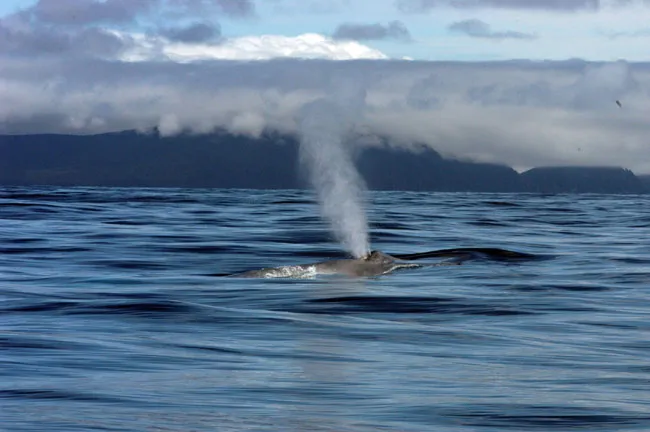
The filter-feeding strategy of blue whales, the largest animals on Earth, may explain their enormous size, according to a study that determined a single mouthful of food can contain 457,000 calories, or 240 times as much energy as they burn when grabbing that mouthful.
Blue and some other whale species eat by taking enormous mouthfuls of water and filtering out their meals, often tiny crustaceans called krill, using plates of baleen made of keratin, a protein found in hair, fingernails and feathers. A team of researchers led by Jeremy Goldbogen, who is now at the Scripps Institution of Oceanography, calculated the efficiency of eating this way.
Their math supports the long-standing assumption that baleen whales are much more efficient feeders than their smaller relatives, the toothed whales, which hunt down individual prey. The finding is detailed today (Dec. 9) in the Journal of Experimental Biology.
Although the finding isn't a surprise, the baleen whales' efficiency is unprecedented in the animal kingdom, said study researcher Robert Shadwick, who studies animal biomechanics at the University of British Columbia.
"When they take a gulp of water, they are filling their mouths with the amount of water equal to their own body mass, so there is nothing that comes close to doing that," Shadwick told LiveScience.
These whales may eat an enormous quantity of food in a single gulp, but the effort is taxing. As the animals dive, they lunge into a school of krill and their mouths open to 80 degrees and inflate like a parachute as water gushes in. This creates a drag, slowing the whale. Whales can make up to six lunges in a dive, according to the researchers.
To figure out how much energy the whales use when they dive, researchers recorded 200 dives between 2002 and 2007. Then a doctoral student, Goldbogen used recordings of the sounds whales made as they dived through the water to calculate their speed. He recruited a parachute aerodynamics expert to help work out the forces acting on the whales as they lunged. Ultimately, they calculated that the whales spent as much as 8,071 kilojoules (1,900 Calories) on a single lunge.
The researchers then measured the jaw bones of whales in museums to estimate the volume of the whales' mouths. They combined this with krill densities to determine how much energy the animals captured in one mouthful. The answer: up to 1,912,680 kilojoules (about 457,000 Calories).
"They are doing something that is energetically very expensive, but they are getting an enormous payoff," Shadwick said.
- Gallery: World's Biggest Beasts
- Video: Blue Whales Migrate North to Alaska
- 10 Amazing Things You Didn't Know About Animals
You can follow LiveScience writer Wynne Parry on Twitter @Wynne_Parry.

