

Glaciers are essentially giant rivers of ice that are formed over eons as fallen snow is compressed into layers of ice. Glaciers are found on about 10 percent of Earth's land area, with most of them found in the Arctic and Antarctica regions, but some occurring high up on mountains, even in tropical areas. Glacial ice makes up the ice sheets that cover Antarctica and Greenland, with glaciers flowing out to sea, where their ends float on the water as ice shelves. Eventually pieces of the ice shelves break off, or calve, to form icebergs. The movement of glaciers scours the underlying rock, and a glacier's movement can be affected by climate change, with worries that global warming could cause substantial glacial melt and impact global sea levels. For the latest news on glacier research and stunning views of these rivers of ice, see below.

-
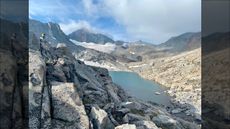 Yosemite's glaciers have survived 20,000 years — but we could be the first people to see Sierra Nevada ice-free
New research finds the disappearance of glaciers in the Sierra Nevada will be unprecedented in the human history of North America.
climate-change -
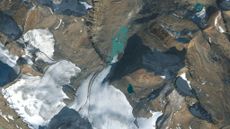 Glaciers across North America and Europe have lost an 'unprecedented' amount of ice in the past 4 years
Glaciers in Washington, Montana, British Columbia, Alberta and the Swiss Alps have set grim records over the past four years, with both the annual amount of ice lost and the four-year average reaching all-time highs.
climate-change -
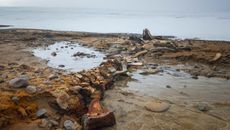 Ancient whale 'graveyard' discovered under melting Russian glacier
An Arctic expedition found a collection of ancient whale remains where a rapidly retreating glacier once lay.
10 Commentswhales -
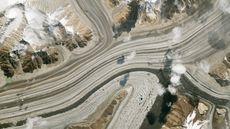 Trio of stripy glaciers merging in 'Earth's highest battleground' are part of a major anomaly scientists don't fully understand
Earth from space This 2023 astronaut photo shows three glaciers merging into a single massive ice mass in the Karakoram mountains. The stripy glaciers have gained ice in recent decades, despite the effects of human-caused climate change.
3 CommentsEarth from space -
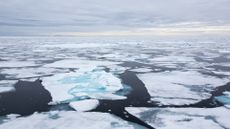 The North Pole could shift 90 feet west by 2100
As climate change melts ice sheets and glaciers, water is being redistributed across the globe — and could end up moving the point of Earth's axis of rotation.
2 Commentsclimate-change -
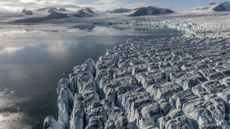 World's glaciers are losing enough ice to fill 3 Olympic pools every second, terrifying new study finds
A groundbreaking new study provides the first consistent global picture of glacier decline since 2000, revealing that glaciers across the world have lost a whopping 5% of their volume since then.
climate-change -
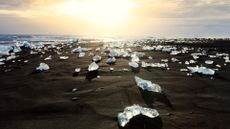 Diamond Beach: Iceland's spellbinding black sand beach covered in sparkling ice jewels
Icebergs and other glacial fragments regularly wash up on Iceland's southern Diamond Beach, making the sandy strip look like a field of gemstones.
rivers-oceans -
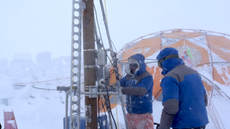 Ancient viral genomes plucked from glaciers reveal how pathogens have adapted to Earth's shifting climate
Over the past 41,000 years, viral communities have varied significantly between cold and warm climatic periods, scientists found.
climate-change -
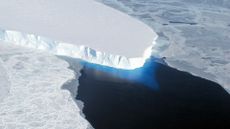 'Doomsday glacier' won't collapse the way we thought, new study suggestsantarctica


