













No, the James Webb Space Telescope probably didn't detect signs of alien life — but it soon could
The James Webb Space Telescope's possible detection of biological chemicals on the exoplanet K2-18b may just have been methane gas, a new study cautions. Planned follow-up observations could solve the mystery for good.

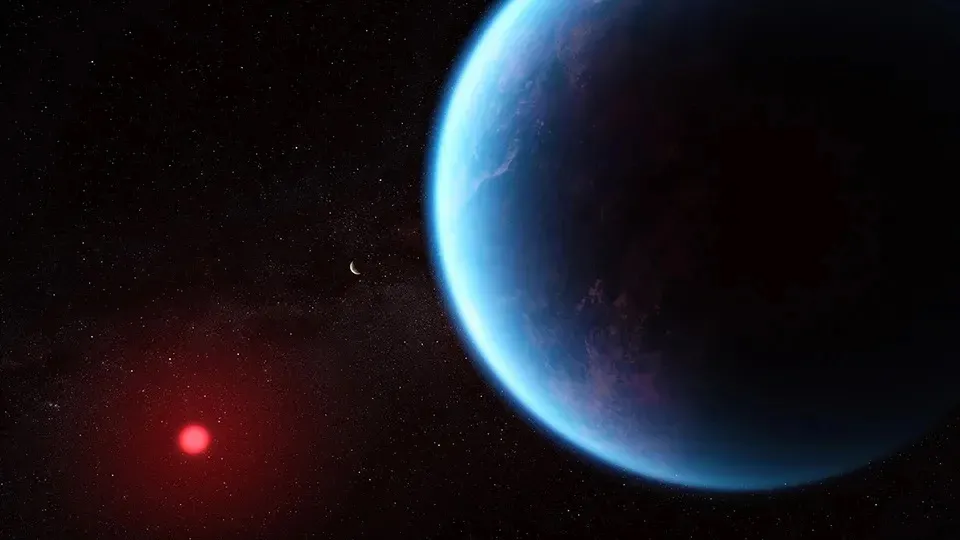
Were those "alien farts" that the James Webb Space Telescope (JWST) detected in an Earth-like planet's atmosphere last year, or were they just clouds of methane? A new study makes the case for the latter, potentially dampening hopes that life has already been discovered beyond our solar system.
The contentious exoplanet, called K2-18b, is a warm, watery world with a hydrogen-based atmosphere. Located about 120 light-years from Earth, it sits in the habitable zone around its home star, where liquid water (and, therefore, potentially life) is possible.
The distant world made headlines last year after observations with JWST's Near Infrared Spectrograph (NIRSpec) instrument revealed possible traces of a biologically produced gas called dimethyl sulfide (DMS) in the planet's atmosphere. On Earth, this chemical is known to originate only from microscopic marine creatures, such as phytoplankton — giving researchers hope that perhaps the oceans of K2-18b are swimming with life as well.
The detection came with caveats, however, mostly based on the faintness of the chemical signals when seen at such extreme distances from Earth.
"The DMS signal from the Webb telescope was not very strong and only showed up in certain ways when analyzing the data," study lead author Shang-Min Tsai, a project scientist at the University of California, Riverside, said in a statement. "We wanted to know if we could be sure."
Related: What's the best evidence we've found for alien life?
The new research, published Thursday (May 2) in The Astrophysical Journal Letters, further pumps the brakes on this tantalizing discovery. Motivated by the fact that organically produced DMS disappears rapidly in Earth's atmosphere before it can accumulate in large quantities, the researchers used computer simulations to model whether DMS could ever reach detectable levels in a hydrogen-rich exoplanet's atmosphere.
Get the world’s most fascinating discoveries delivered straight to your inbox.
The team determined that DMS can reach detectable levels — as long as the hypothetical critters in K2-18b's oceans pump out 20 times more DMS than plankton do on Earth.
That in itself isn't a deal-breaker for the potentially habitable waterworld; everything else we know about it makes the planet "an ideal situation in which to find life," Tsai added.
RELATED STORIES
However, the team's research also found that it is highly unlikely that JWST would be capable of separating a DMS signal from other, more common atmospheric gases at the specific wavelengths it examined with NIRSpec.
"The signal strongly overlaps with methane, and we think that picking out DMS from methane is beyond this instrument's capability," Tsai said.
Simply put, there could well be biological compounds in K2-18b's atmosphere and prolific life in its oceans, but JWST probably hasn't detected it.
The good news is that JWST has another instrument on board — the Mid-Infrared Instrument (MIRI) — that is capable of detecting a broader range of wavelengths and may be much better suited for parsing DMS from methane, the study authors wrote. Follow-up observations of K2-18b using MIRI are already scheduled for this year, with science results expected before year's end. If there is life on K2-18b — farting or otherwise — we may soon have a much better idea.

Brandon is the space / physics editor at Live Science. With more than 20 years of editorial experience, his writing has appeared in The Washington Post, Reader's Digest, CBS.com, the Richard Dawkins Foundation website and other outlets. He holds a bachelor's degree in creative writing from the University of Arizona, with minors in journalism and media arts. His interests include black holes, asteroids and comets, and the search for extraterrestrial life.