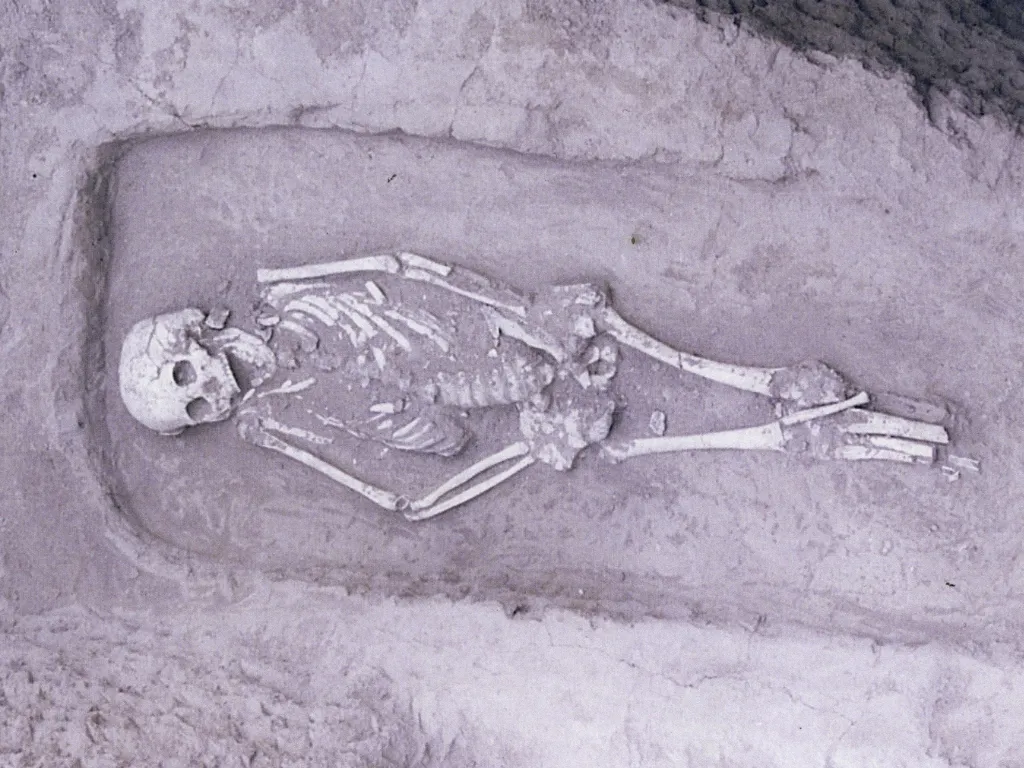
Archaeologists made an "extremely rare" find in China when they found a human skeleton with an uncommon form of dwarfism, according to a recent news report.
The skeleton was originally recovered from a burial site near the Yellow River in east-central China, along with other remains of people who had lived between 3300 and 2900 B.C., Forbes reported. All the skeletons were found with their hands placed on top of their bodies, except for one, whose hands were tucked behind its back. The bones of this skeleton appeared short and weak compared to the other skeletal remains; on closer inspection, the archaeologists diagnosed the young adult with skeletal dysplasia, also known as dwarfism.
A wide range of conditions fall under the umbrella term "skeletal dysplasia," but in general, these conditions tend to disrupt bone development, causing individuals to grow to shorter-than-average stature, the authors noted in a report published Dec. 13 in the International Journal of Paleopathology. Skeletal dysplasia is fairly rare in modern humans, occurring in about 3.22 out of every 10,000 births, but the condition crops up even less often in the archaeological record — to date, fewer than 40 cases have been discovered. Of these, most cases represent a relatively common form of dwarfism called achondroplasia, which causes the limbs to grow disproportionately shorter than the head and trunk.
But archaeologists at the burial site soon realized that they had stumbled upon an even rarer find. While the limbs of the skeleton appeared short, the bones of the head and trunk also seemed small. Judging by the skeleton's teeth, the team determined that the remains belonged to a young adult, but the skeleton's full-grown limb bones remained unfused. The authors diagnosed the Neolithic skeleton with a condition known as "proportionate dwarfism," rarely seen in either archaeological or living human populations.
The team theorized that the skeleton's short stature stemmed from "pediatric onset hypopituitarism and hypothyroidism," meaning that the individual likely developed either an underactive thyroid gland or pituitary gland early in life. Both glands direct the function of hormones throughout the body, and without their guidance, body tissues and organs may fail to grow as they should. The condition can stunt bone growth, cognitive development and heart and lung function; the individual uncovered in China likely required "support from other community members" to survive, the authors noted.
Unlike achondroplasia, which typically arises from a genetic mutation, thyroid and pituitary dysfunction is thought to be linked to a lack of essential nutrients, such as iodine. Rates of hypothyroidism remain higher in China than in the U.S., partly due to the fact that many Chinese people still consume iodine-deficient diets, according to Forbes.
Sign up for the Live Science daily newsletter now
Get the world’s most fascinating discoveries delivered straight to your inbox.
Although the short-statured skeleton was buried differently than the ones nearby in the tomb, the archaeologists aren't sure if or how the individual may have been treated in life. Confucian texts from the 4th century B.C. suggest that people with physical differences would not have been ostracized in Neolithic China. ("If virtue is pre-eminent, the body will be forgotten," the philosopher Zhuangzi once wrote.) But this sentiment clashes with historical accounts from the 2nd century B.C., which imply that those with dwarfism "were seen as outsiders," the authors noted.
"I think it is important for us to recognize that disability and difference can be found in the past, but these did not necessarily have negative connotations socially or culturally," co-author Siân Halcrow, an archaeologist at the University of Otago, told Forbes. "The ancient historical texts show that they may, in fact, have been revered in some situations."
Nicoletta Lanese is the health channel editor at Live Science and was previously a news editor and staff writer at the site. She is a recipient of the 2026 AHCJ International Health Study Fellowship, with a project focused on antibiotic stewardship practices in Japan and the U.S. They hold a graduate certificate in science communication from UC Santa Cruz and degrees in neuroscience and dance from the University of Florida. Beyond Live Science, Lanese's work has appeared in The Scientist, Science News, the Mercury News, Mongabay and Stanford Medicine Magazine, among other outlets. Based in NYC, she also remains involved in dance and performs in local choreographers' work.