













Photos: A 400-Year-Old War Grave Revealed

Battle of Lützen

In 2011, archaeologists uncovered a mass grave from the Battle of Lützen in Germany. Now, they have more clues about the violent lives and deaths of soldiers during the Thirty Years War.
On Nov. 16, 1632, the Protestant Swedish army and Catholic Holy Roman Empire's imperial army clashed during the Battle of Lützen in Germany. Up to 9,000 people were killed. [Read the full story on the mass grave discoveries]
War grave
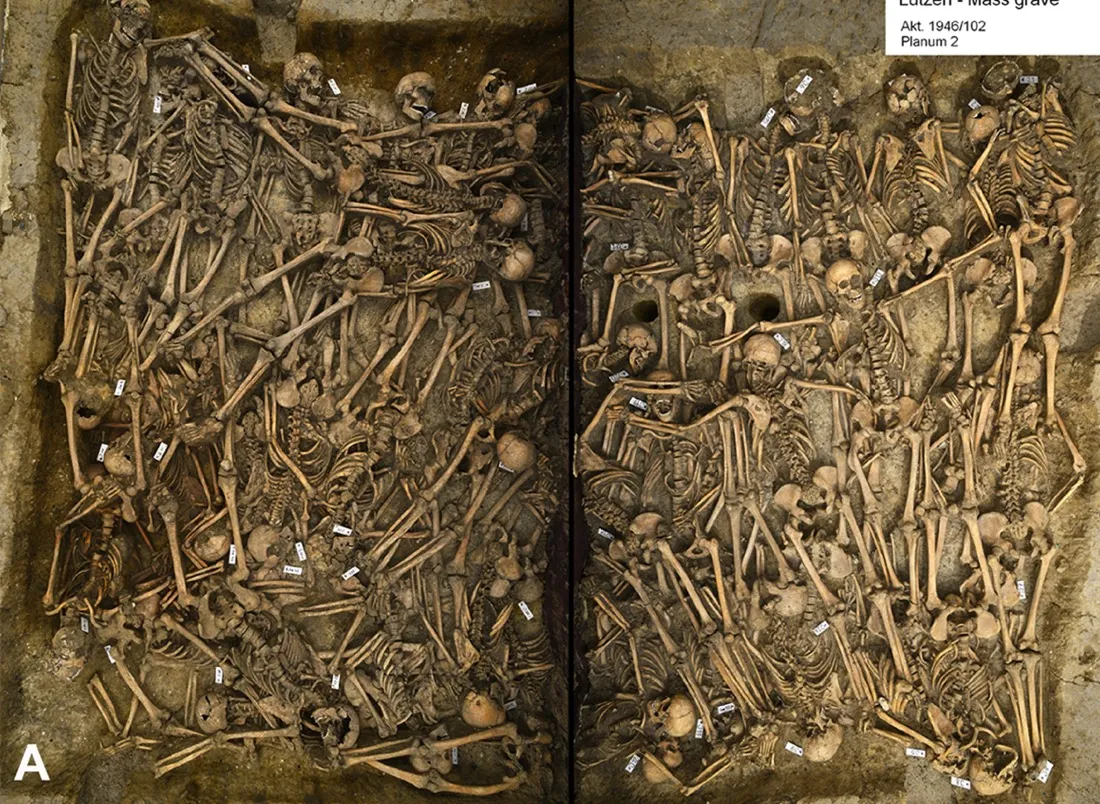
The site of the battle was relocated in 2006, and this mass grave was discovered in 2011. Instead of removing the skeletons one by one, archaeologists removed the whole gravesite in two blocks so that it could be studied in a lab.
A grim puzzle

Bioarchaeologists looked at the 47 bodies for signs of trauma that might reveal new insights about how the soldiers lived and died.
Rough living

The researchers found that the soldiers had a lot of healing and healed injuries, like the head wounds seen on this skull, suggesting that many of the men had already been involved in violent encounters before this battle. (Photo Credit: A. Hörentrup)
Gunfight

The most notable fatal injuries from the battle were gunshot wounds. This man was shot in the head, but was also carrying an unfired bullet in his mouth (pointed out by the arrow) that he likely planned to use.
Musket ball

This man was hit by a bullet on the left side of his head. A CT scan allowed researchers to pinpoint the lead musket ball that was still inside the skull.
Get the world’s most fascinating discoveries delivered straight to your inbox.
Cavalry attack

The researchers think the prevalence of gun wounds could be linked to a surprise cavalry attack, where a unit of the Swedish army was attacked by handgun-wielding imperial forces on horseback.
Gunshot and a fall

The oldest individual (between 40 and 50 years old) among the dead in the mass grave had fractures to the right cheekbone and the jawbone (A). The fracture to the right femur of another individual was likely associated with a fall, while a gunshot caused the fracture of the tibia. The shot to the tibia may have caused the fall and subsequent femur fracture, the researchers said. [Read the full story on the mass grave discoveries]
