 Live Science Plus





You are now subscribed
Your newsletter sign-up was successful
Want to add more newsletters?

Delivered Daily
Daily Newsletter
Sign up for the latest discoveries, groundbreaking research and fascinating breakthroughs that impact you and the wider world direct to your inbox.

Once a week
Life's Little Mysteries
Feed your curiosity with an exclusive mystery every week, solved with science and delivered direct to your inbox before it's seen anywhere else.

Once a week
How It Works
Sign up to our free science & technology newsletter for your weekly fix of fascinating articles, quick quizzes, amazing images, and more

Delivered daily
Space.com Newsletter
Breaking space news, the latest updates on rocket launches, skywatching events and more!

Once a month
Watch This Space
Sign up to our monthly entertainment newsletter to keep up with all our coverage of the latest sci-fi and space movies, tv shows, games and books.

Once a week
Night Sky This Week
Discover this week's must-see night sky events, moon phases, and stunning astrophotos. Sign up for our skywatching newsletter and explore the universe with us!
Join the club
Get full access to premium articles, exclusive features and a growing list of member rewards.
Nuclear fusion technology could get a breakthrough from an unexpected place: mayonnaise.
In a new study, published in May in the journal Physical Review E, scientists plopped the creamy condiment into a churning wheel machine and set it whirling to see what conditions made it flow.
This process could help elucidate the physics that occur at ultrahigh temperatures and pressures inside nuclear fusion reactors — without having to create those extreme conditions.
Nuclear fusion forges helium from hydrogen at the hearts of stars. In theory, it could be the source of nearly limitless clean energy on Earth — if the reaction could produce more energy than it requires to run.
That's a tall order; star-powered fusion occurs at 27 million degrees Fahrenheit (15 million degrees Celsius), according to NASA. And a star's massive gravity forces hydrogen atoms together, overcoming their natural repulsion. On Earth, however, we don't have those crushing pressures, so human-made fusion reactors must run 10 times hotter than the sun.
To reach these mind-melting temperatures, scientists use multiple approaches, including one called inertial confinement.
In this process, physicists freeze pea-sized pellets of gas — typically a mix of heavy isotopes, or versions, of hydrogen — into metal capsules. Then, they blast the pellets with lasers, which heats the gas to 400 million F (222 million C) in a flash — and, ideally, turns it into a plasma where fusion can occur, according to the statement.
Unfortunately, the hydrogen gas wants to expand, causing the molten metal to explode before hydrogen has time to fuse. This explosion occurs when the metal capsule enters an unstable phase and starts to flow.
Banerjee's team realized that molten metal behaves a lot like mayonnaise at lower temperatures: It can be elastic, meaning it bounces back when you push on it, or plastic, meaning it doesn't bounce back, or flowing.
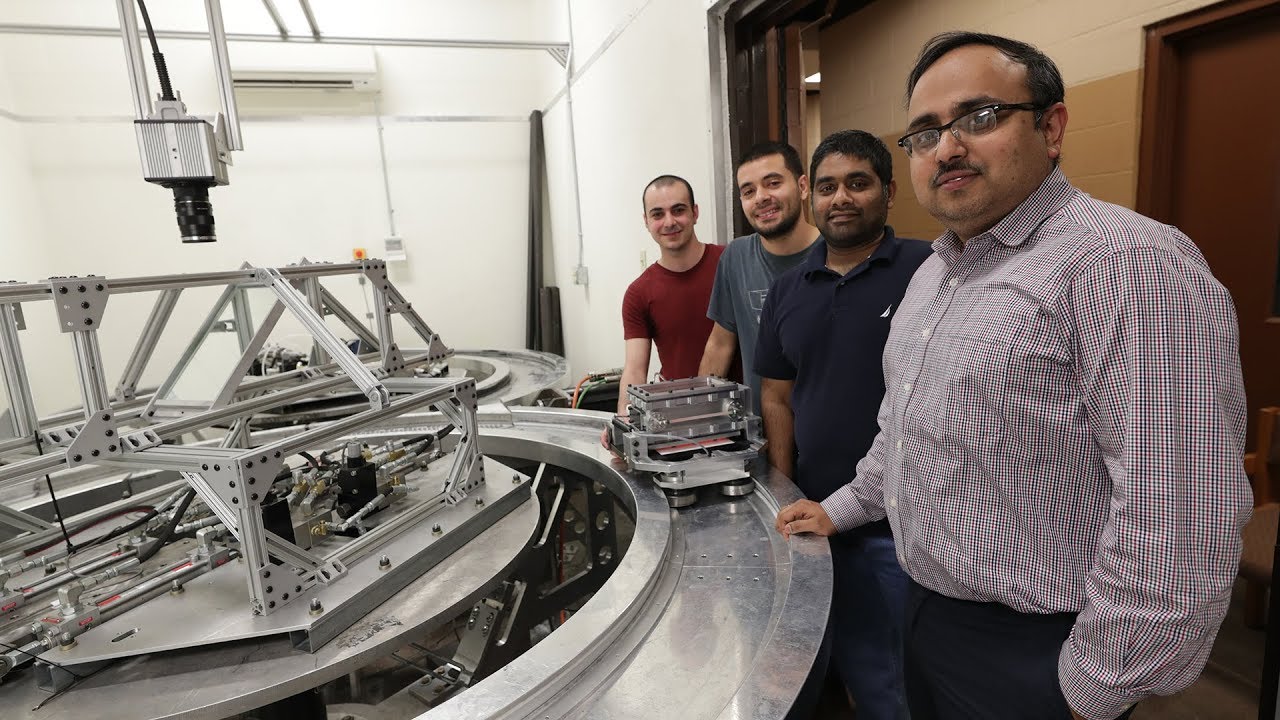
"If you put a stress on mayonnaise, it will start to deform, but if you remove the stress, it goes back to its original shape," he said. "So there's an elastic phase followed by a stable plastic phase. The next phase is when it starts flowing, and that's where the instability kicks in."
In the new study, the researchers placed mayonnaise in a machine that accelerated the egg-and-oil emulsion until it started to flow. Then, they characterized the conditions at which the condiment transitioned between plastic, elastic and unstable states.
"We found the conditions under which the elastic recovery was possible, and how it could be maximized to delay or completely suppress the instability," Banerjee said.
The study also found which conditions allowed for more energy yield.
Of course, mayonnaise and ultrahot metal capsules are different in many ways. So it remains to be seen whether the team's findings can be translated to a pellet of plasma many times hotter than the sun.

