













'Cannibal' coronal mass ejection from 'dark plasma plume' will slam into Earth tomorrow (Aug. 18)
The storm is classified as strong, but isn't expected to cause much disruption

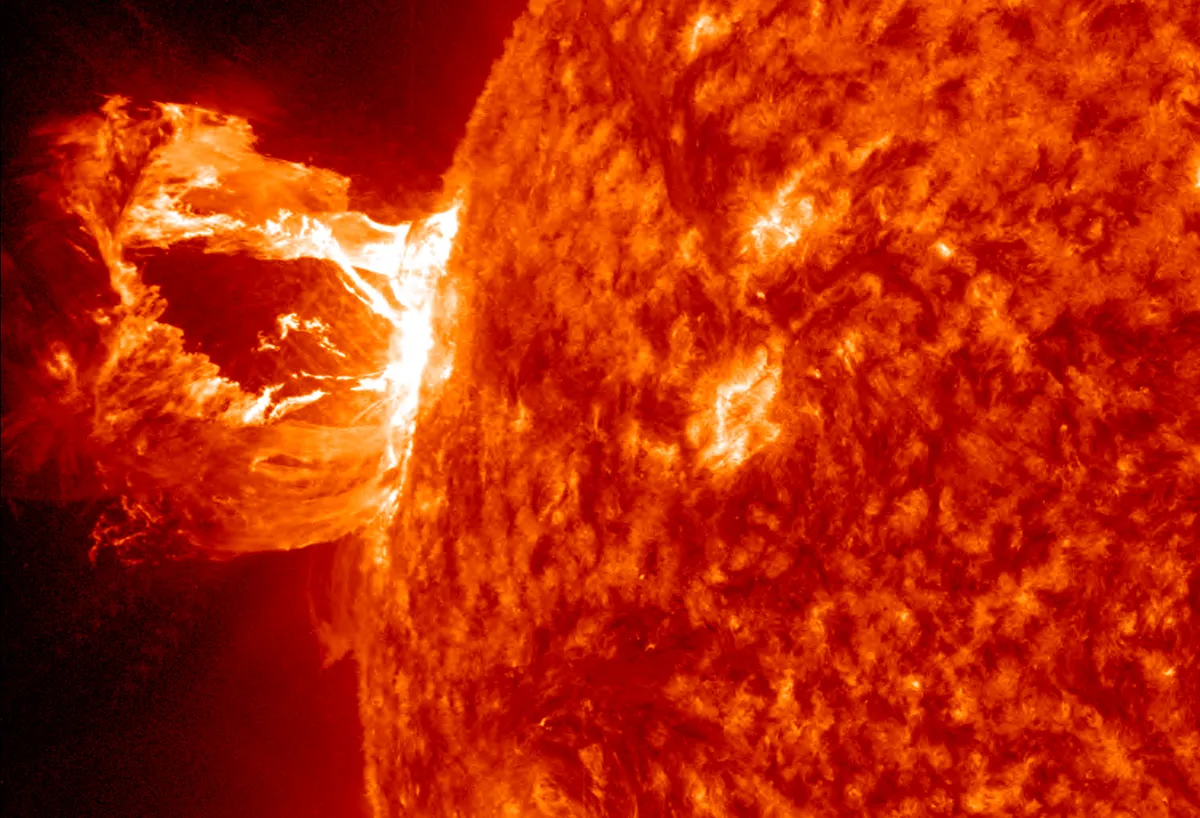
A plume of "dark plasma" hurled from the sun will be engulfed to form a "cannibal" coronal mass ejection which will sideswipe the Earth on Thursday (Aug. 18), causing a strong G3 geomagnetic storm.
The "dark plasma explosion" was first spotted by solar observers on Sunday (Aug. 14) as it erupted from a sunspot on the sun's surface at a speed of roughly 1.3 million mph (2.1 million km/h), tearing "through the sun's atmosphere, creating a coronal mass ejection (CME)," or explosive jets of solar material, spaceweather.com wrote in an update. Then, on Monday (Aug. 15), another CME, created by the collapse of a gigantic magnetic filament, was launched from the sun.
Sunspots are areas on the sun's surface where powerful magnetic fields, created by the flow of electrical charges, knot into kinks before suddenly snapping. The resulting release of energy launches bursts of radiation called solar flares, or plumes of solar material called coronal mass ejections. CMEs can also be launched by the collapse of unstable solar filaments, which are huge, suspended tubes of electrified gas (or plasma) that worm their way through the sun's atmosphere according to the whims of the star's magnetic field.
Related: Strange new type of solar wave defies physics
The two eruptions together will merge to form a cannibal coronal mass ejection, according to National Oceanic and Atmospheric Administration (NOAA) forecasts. Cannibal CMEs occur when one fast-moving solar eruption overtakes an earlier eruption in the same region of space, gobbling up the charged particles to form a giant, combined wavefront that, upon reaching Earth, triggers a powerful geomagnetic storm.
This cannibal CME is no different. When it arrives at Earth, the dark plasma plume — so named because of its comparatively cooler, darker appearance — will cause a G3 geomagnetic storm, according to NOAA's Space Weather Prediction Center (SWPC).
Geomagnetic storms occur when planets with strong magnetic fields, like our own, absorb the high speed barrage of solar debris from CMEs. During these storms, Earth's magnetic field gets compressed slightly by waves of highly energetic particles. These particles trickle down magnetic-field lines near the poles and agitate molecules in the atmosphere, releasing energy in the form of light to create colorful auroras, similar to the ones that make up the Northern Lights.
Get the world’s most fascinating discoveries delivered straight to your inbox.
Geomagnetic storms are classified from G1 to G5 according to their severity. G3 storms are strong geomagnetic storms, meaning that the oncoming sun blast could bring the dazzling aurora as far south as Illinois and Oregon, according to spaceweather.com. G3 storms can cause intermittent problems for low-frequency and satellite navigation; increased drag on low-Earth orbit satellites; and may require some power systems to make voltage corrections, according to the SWPC.
RELATED Stories
More extreme geomagnetic storms can disrupt our planet's magnetic field powerfully enough to send satellites tumbling to Earth, Live Science previously reported, and scientists have warned that extreme geomagnetic storms could even cripple the internet.
This storm comes as the sun ramps up into its most active phase of its roughly 11-year-long solar cycle.
Astronomers have known since 1775 that solar activity rises and falls in cycles, but recently, the sun has been more active than expected, with nearly double the sunspot appearances predicted by NOAA. Scientists anticipate that the sun's activity will steadily climb for the next few years, reaching an overall maximum in 2025 before decreasing again. A paper published July 20 in the journal Astronomy and Astrophysics proposed a new model for the sun's activity by separately counting sunspots in each hemisphere — a method the paper's researchers argue could be used to make more accurate solar forecasts.
Scientists think the largest solar storm ever witnessed during contemporary history was the 1859 Carrington Event, which released roughly the same energy as 10 billion 1-megaton atomic bombs. After slamming into Earth, the powerful stream of solar particles fried telegraph systems all over the world and caused auroras brighter than the light of the full moon to appear as far south as the Caribbean. If a similar event were to happen today, scientists warn, it would cause trillions of dollars in damage and trigger widespread blackouts, much like the 1989 solar storm that released a billion-ton plume of gas and caused a blackout across the entire Canadian province of Quebec, NASA reported.
Originally published on Live Science.

Ben Turner is a U.K. based writer and editor at Live Science. He covers physics and astronomy, tech and climate change. He graduated from University College London with a degree in particle physics before training as a journalist. When he's not writing, Ben enjoys reading literature, playing the guitar and embarrassing himself with chess.