













Michigan boy finds 'dragon's tooth' that belonged to a mastodon
"I think that was a sign that I'm going to be a paleontologist," the boy told local news reporters.

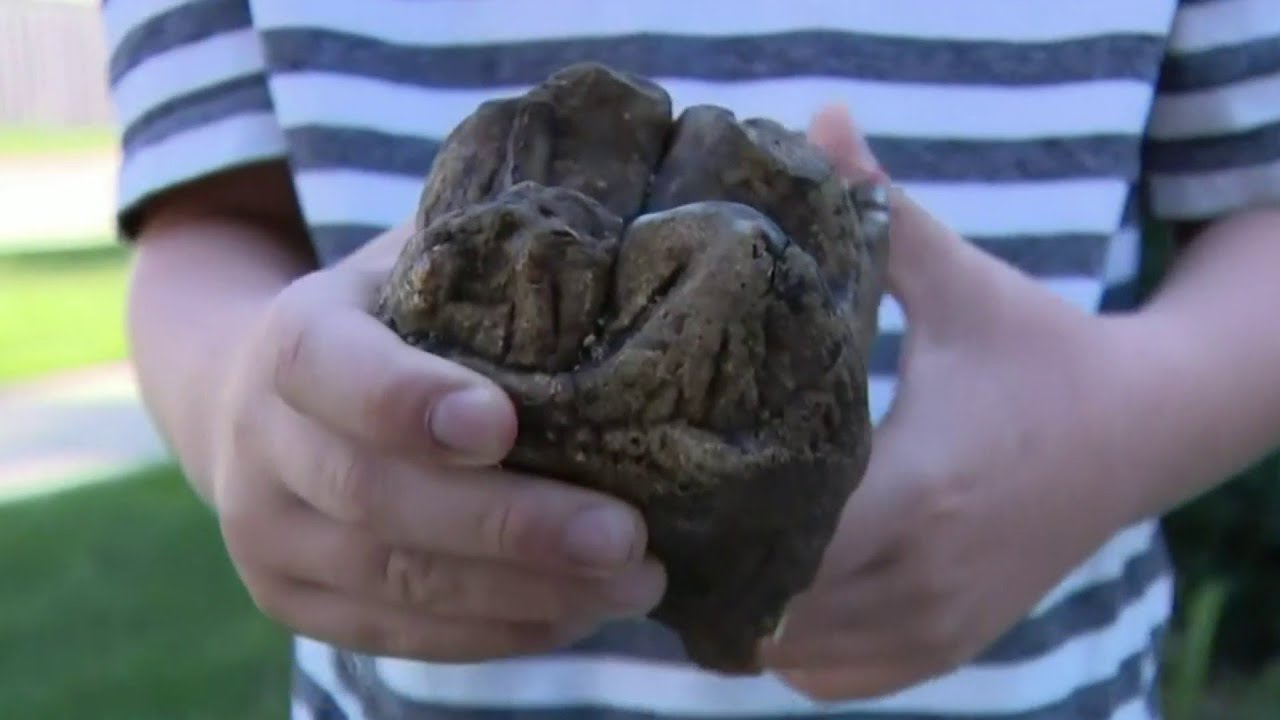
A boy in Michigan was recently hiking with his family when he stepped into a creek and stumbled over something rocky that resembled a tooth. At first, he thought it belonged to a dinosaur, but paleontologists later found that the massive molar came from a mastodon.
Julian Gagnon, age 6, discovered the tooth on Sept. 6 while on a walk at Dinosaur Hill Nature Preserve in Rochester Hills, Michigan, Detroit news outlet WDIV Local 4 reported Oct. 1.
"I just felt something on my foot, and I grabbed it up," Julian told WDIV. A Google search at home hinted that the tooth likely wasn't a dinosaur's (or a dragon's, as Gagnon also guessed, according to Michigan Live). Rather, the tooth's size and shape resembled those of mastodon teeth, and an analysis by University of Michigan's Museum of Paleontology (UMMP) scientists later confirmed that was the case, WDIV reported.
Related: Mastodon bones: Images of an early hunt
Mastodons are ancient relatives of modern elephants; they first appeared about 27 million to 30 million years ago, and they went extinct about 10,000 years ago. They lived in forests around the world, primarily in North and Central America, and grew to be about 8 to 10 feet (2.5 to 3 meters) tall and weighed as much as 6 tons (5.4 metric tons), according to the San Diego Natural History Museum.
RELATED CONTENT
The crown of the molar that Julian found was about the size of an adult human's fist, which ruled out many smaller species, Adam Rountrey, UMMP collection manager, told Michigan Live. Topping the crown were "tall bumps" that differentiate mastodon teeth from those of mammoths, another species of extinct ice age elephant relative that lived alongside mastodons, Rountrey added.
Julian decided that this discovery was the first in his "career" as a paleontologist, his mother, Mary Gagnon, told Michigan Live. The hopeful young scientist also wondered if he would receive a million dollars or become the president because of his find, but he settled for a behind-the-scenes tour of the University of Michigan's Ann Arbor Research Museums Center and a meeting with museum paleontologists, Michigan Live reported.
Get the world’s most fascinating discoveries delivered straight to your inbox.
Originally published on Live Science.

Mindy Weisberger is a science journalist and author of "Rise of the Zombie Bugs: The Surprising Science of Parasitic Mind-Control" (Hopkins Press). She formerly edited for Scholastic and was a channel editor and senior writer for Live Science. She has reported on general science, covering climate change, paleontology, biology and space. Mindy studied film at Columbia University; prior to LS, she produced, wrote and directed media for the American Museum of Natural History in NYC. Her videos about dinosaurs, astrophysics, biodiversity and evolution appear in museums and science centers worldwide, earning awards such as the CINE Golden Eagle and the Communicator Award of Excellence. Her writing has also appeared in Scientific American, The Washington Post, How It Works Magazine and CNN.