Get the world’s most fascinating discoveries delivered straight to your inbox.
You are now subscribed
Your newsletter sign-up was successful
Want to add more newsletters?
Join the club
Get full access to premium articles, exclusive features and a growing list of member rewards.
An account already exists for this email address, please log in.
Stunning 240 million-year-old 'Chinese dragon' fossil unveiled by scientists
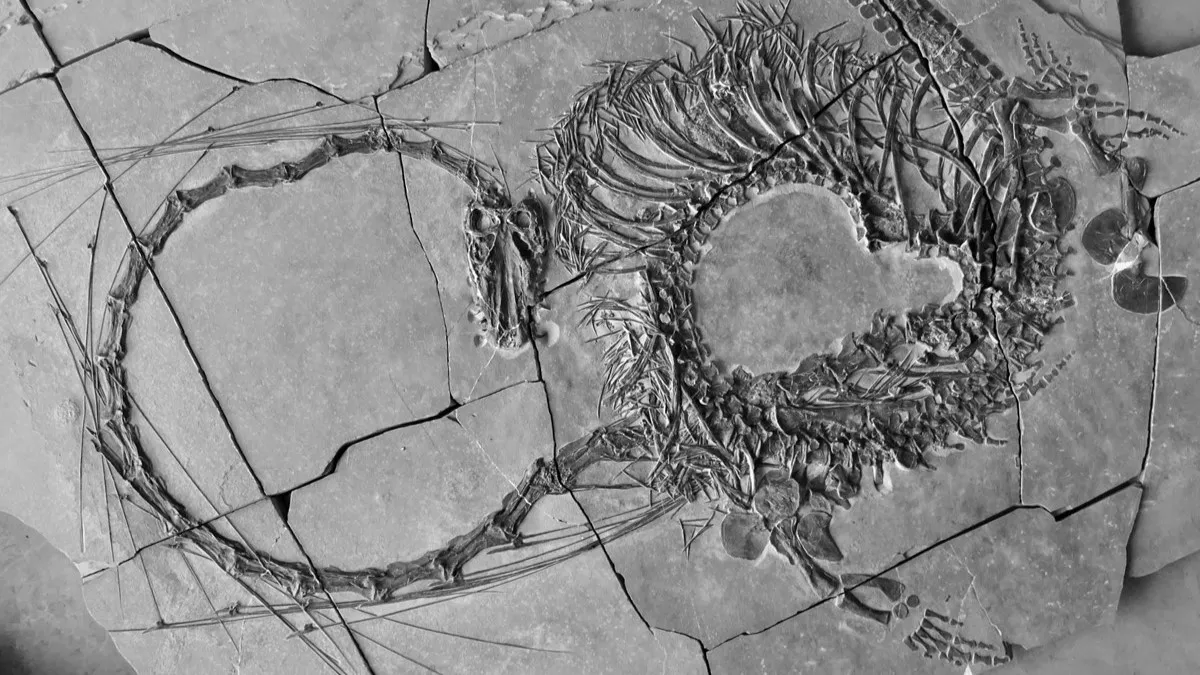
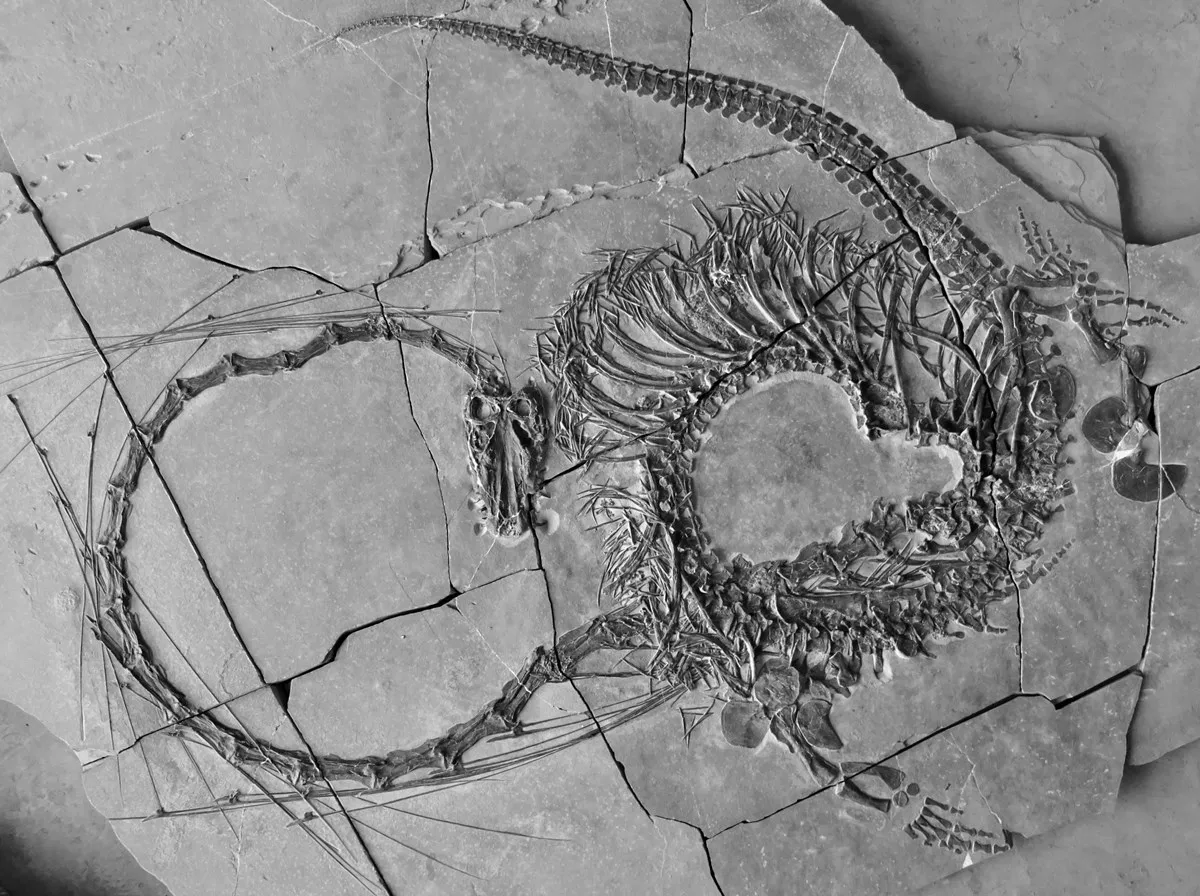
A bizarre dragon-like creature that lived during the Triassic period used its remarkably long neck to hunt unsuspecting prey in shallow water, scientists have found.
Scientists have unveiled stunning fossils of an ancient seaborne "dragon" discovered in China.
The 240 million-year-old animal — nicknamed the "Chinese dragon" — belongs to the species Dinocephalosaurus orientalis, a reptile that used its remarkably long neck to ambush unsuspecting prey in shallow waters during the Triassic period (252 million to 201 million years ago).
The species was first found in limestone deposits in southern China in 2003, but scientists have now pieced together remains to reconstruct the full 16.8-foot (5 meters) span of the spectacular ancient carnivore for the first time.
"It is yet one more example of the weird and wonderful world of the Triassic that continues to baffle paleontologists," Nick Fraser, keeper of natural sciences at National Museums Scotland said in a statement. "We are certain that it will capture imaginations across the globe due to its striking appearance, reminiscent of the long and snake-like, mythical Chinese Dragon."
A full-size photo of dinocephalosaurus orientalis.
(Image credit: National Museums Scotland)
The fossil reveals some of the ancient sea dragon's striking features.
Get the world’s most fascinating discoveries delivered straight to your inbox.
First and foremost is its neck, which stretches nearly 7.7 feet (2.3 meters) and contains 32 separate vertebrae — in comparison, giraffes (as well as humans) have only seven neck vertebrae.
The snake-like shape of the dragon's articulable neck likely gave it a remarkable ability to sneak up on its prey, which it did after maneuvering into position with its flippered limbs. Some of the fish snared in the dragon's serrated teeth are still preserved inside the sea monster's belly.
The researchers note that though the strange creature may be reminiscent of the Loch Ness Monster, it is not closely related to the long-necked plesiosaurs that inspired the famous mythical creature.
"We hope that our future research will help us understand more about the evolution of this group of animals, and particularly how the elongate neck functioned," first-author Stephan Spiekman, a postdoctoral researcher based at the Stuttgart State Museum of Natural History, said in the statement.
Ben Turner is a U.K. based writer and editor at Live Science. He covers physics and astronomy, tech and climate change. He graduated from University College London with a degree in particle physics before training as a journalist. When he's not writing, Ben enjoys reading literature, playing the guitar and embarrassing himself with chess.