













Why We Fear Snakes

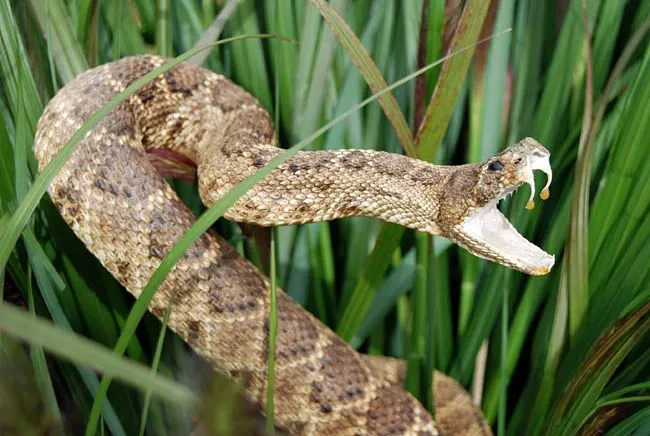
Fear of snakes is one of the most common phobias, yet many people have never seen a snake in person. So how is this fear generated?
New research suggests humans have evolved an innate tendency to sense snakes — and spiders, too — and to learn to fear them.
Psychologists found that both adults and children could detect images of snakes among a variety of non-threatening objects more quickly than they could pinpoint frogs, flowers or caterpillars. The researchers think this ability helped humans survive in the wild.
"The idea is that throughout evolutionary history, humans that learned quickly to fear snakes would have been at an advantage to survive and reproduce," said Vanessa LoBue, a post-doctoral fellow in psychology at the University of Virginia. "Humans who detected the presence of snakes very quickly would have been more likely to pass on their genes."
Previously, anthropologists have suggested the need to notice snakes in the wild may have led early primates to develop better vision and larger brains.
Eew!
The researchers were inspired to investigate the fear of snakes when they thought about how universally people dislike the slithering legless lizards.
Get the world’s most fascinating discoveries delivered straight to your inbox.
"This feeling is really common," LoBue told LiveScience. "We don’t see snakes all the time. There's really no reason for this overwhelming disgust or hatred of snakes."
LoBue's collaborator, Judy DeLoache, a professor of psychology at the University of Virginia, happens to be petrified of snakes.
"I have almost a phobia of snakes," DeLoache said. "When I see a picture of a snake, I'm like, "Oh my God, eew! The reason we got into this research was because I've always been fascinated by how it is that people develop it. My intuition was that there was something that made me feel afraid of snakes early on. You react to them very early on."
While babies and very young children do not usually fear snakes, they are unusually skilled at detecting them and show a predisposition to learn to fear snakes if they have bad experiences or even if they are exposed to negative portrayals of them in the media, the scientists found.
Spiders, too
To learn more, the psychologists showed adults and 3-year-old children images of a snake surrounded by objects of similar colors, such as frogs, caterpillars and flowers. Then they showed them pictures of a frog or a flower surrounded by snakes. Both groups were able to identify the hidden snake faster than the other hidden objects.
"We also did a study with spiders and found the same effect," LoBue said. Although the team has not tested other phobias, they don't think these predispositions would necessarily apply across the board.
"It would have to be something widespread, that you could encounter on a day-to-day basis," she said. "That’s why you don’t see lion and tiger and bear phobias as often. It would also have to be something that was around and dangerous while humans were evolving. Things that are dangerous right now, like guns, we haven’t had enough time to develop a predisposition to detect really quickly."
The results of the new study appear in the March 2008 issue of the journal, Psychological Science.
- Gallery: Snakes of the World
- Fear of Snakes Drove Pre-Human Evolution
- Flying Snakes: New Videos Reveal How They Do It
