













World's Longest Bug And 'Ninja' Slug Discovered in Borneo
An eccentric bunch of species have recently come out of hiding in the rainforests of Borneo, including the world's longest known stick insect — think two skinny pencils end-to-end, a slug that shoots "love darts," and a color-changing frog, scientists announce today.
The new WWF report details the 123 newly identified species that have been discovered since February 2007 when the three countries that make up Borneo agreed to conserve 85,000 square miles (220,000 square kilometers) of tropical rainforest, designated as the Heart of Borneo (HoB). [images of the newfound creatures]
That's a rate of discovery of three species per month. Previously, scientists have estimated that there are about 2 million known species of life on Earth, and anywhere from 5 million to 100 million species that remain undiscovered.
"As the past three years of independent scientific discovery have proven, new forms of life are constantly being discovered in the Heart of Borneo," said Adam Tomasek, who leads the WWF project.
Here's an introduction to the new gang:
Longest insect – Measuring more than 1.6 feet (0.5 meters) in length, the world's longest stick insect, called Phobaeticus chani, was found near Gunung Kinabalu Park, Sabah. So far, only three specimens of the species have been found, all in the Heart of Borneo.
Fiery snake – Kopstein’s Bronzeback snake (Dendrelaphis kopsteini) is about 5 feet (1.5 meters) long. Its neck is colored a bright orange, which fuses into an iridescent and vivid blue, green and brown pattern that extends the entire length of its body.
Get the world’s most fascinating discoveries delivered straight to your inbox.
Color-changing frog – Called Rhacophorus penanorum, this small frog species, whose males grow to just 1.4 inches (3.5 centimeters), was discovered in Gunung Mulu National Park, Sarawak, in the Heart of Borneo. Also called the Mulu flying frog, the amphibian has a small pointed snout and is unusual in that the species has bright green skin at night but changes color to display a brown hue during the day. Its eyes follow suit to change color as well. And while the minute animal may not fly with the birds, it uses its webbed feet and aerodynamic flaps of skin on the arms and legs to glide from tree to tree.
Spectacled bird – Named because of its prominent eye-rings, the spectacled flowerpecker has a grey body with bright white arcs above and below its eyes, a white throat and white tufts at the breast sides. Scientists think the flowerpecker is a canopy specialist, feeding off fruits high in tree canopies.
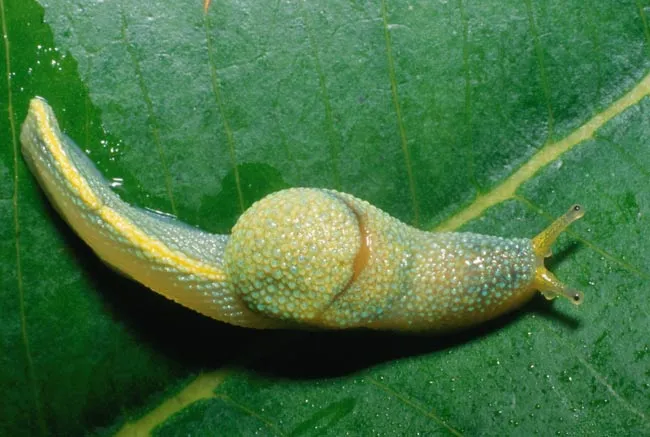
Ninja slug – This green and yellow slug (Ibycus rachelae) was discovered on leaves in a mountain forest at altitudes up to 6,233 feet (1,900 meters) in Sabah, Malaysia. The slug sports a tail that's three times the length of its head, which it wraps around its 1.6-inch-long (4 cm) body as if a pet cat. In fact, its discoverers initially planned to name the slug Ibycus felis, after its feline inspiration. Instead, they named it after the girlfriend of one of its discoverers, Menno Schilthuizen of the Netherlands Centre for Biodiversity 'Naturalis.'
Maybe there's more to the name than meets the eye: The slug species makes use of so-called love darts. Made of calcium carbonate, the love dart is a harpoon-like structure that pierces and injects a hormone into a potential mate. The dart could increase the slug's chances of reproduction.
"The distinction between slugs and snails is not so strict in that part of the tropics, because most of the slugs, including the new one we described, are semi-slugs meaning they still have a shell but the shell is so small that it can't retract its body into it," Schilthuizen told LiveScience.
And though they've found several new slug and snail species, Schilthuizen said this rainforest environment isn't ideal for the animals. That's because the soil is highly acidic, which dissolves the animals' limestone shells.
Overall, the Heart of Borneo is now called home by 10 primate species, more than 350 birds, 150 reptiles and amphibians and a staggering 10,000 plants that are found nowhere else in the world, according to the new report.
To keep these species and their lush home safe from demise, under the 2007 agreement, the three governments have committed to conserve and sustainably manage the area.
- Gallery: Borneo's Quirky Species
- 10 Things You Didn't Know About Animals
- Amazing Animal Abilities
Jeanna Bryner is managing editor of Scientific American. Previously she was editor in chief of Live Science and, prior to that, an editor at Scholastic's Science World magazine. Bryner has an English degree from Salisbury University, a master's degree in biogeochemistry and environmental sciences from the University of Maryland and a graduate science journalism degree from New York University. She has worked as a biologist in Florida, where she monitored wetlands and did field surveys for endangered species, including the gorgeous Florida Scrub Jay. She also received an ocean sciences journalism fellowship from the Woods Hole Oceanographic Institution. She is a firm believer that science is for everyone and that just about everything can be viewed through the lens of science.