













Two New 'Flying Lemur' Species Identified
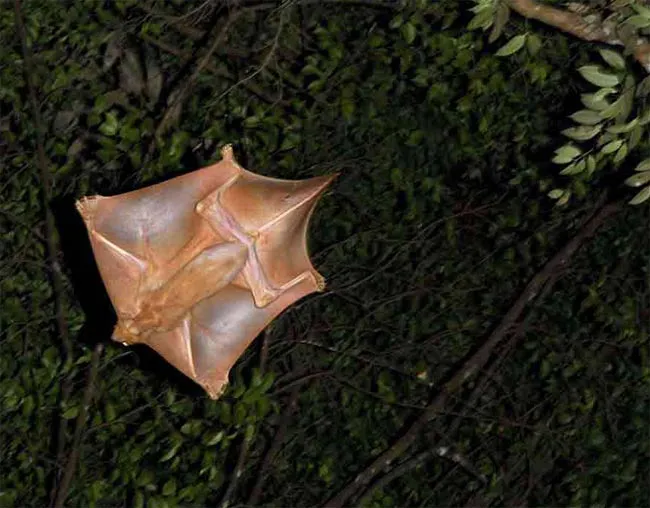
They aren't monkeys and they don't really fly, but the story of flying lemurs just got twice as interesting. Genetic material has revealed that one species of the acrobatic primate is really three.
Called colugos, flying lemurs aren't even really lemurs, but they are excellent gliders. A membrane of skin transforms its body into a flat parachute and allows colugos to soar over long distances of up to 450 feet (136 meters) from treetop to treetop. These mammals are the closest living relatives to primates (humans are primates too), having diverged from that group about 86 million years ago during the Late Cretaceous.
Before now, scientists recognized just two colugo species, the Sunda colugo (Galeopterus variegatus) and the Philippine colugo (Cynocephalus volans).
The Sunda colugo lives only in Indochina and Sundaland, an area of Asia that includes the Malay Peninsula, Borneo, Sumatra and Java, as well many smaller islands.
The researchers analyzed genetic material from Sunda colugos living on the Malay Peninsula (considered the mainland), Borneo and Java. The genetic differences were great enough to suggest the colugos living on each island had evolved into distinct species.
The finding is detailed in the Nov. 11 issue of the journal Current Biology.
The split between the species could have occurred as far back as 4 million to 5 million years ago, the researchers say. During this time, rising sea level may have prevented travel between the mainland and the islands, at least for the colugos.
Get the world’s most fascinating discoveries delivered straight to your inbox.
Even if sea level had dropped to expose land connections, the forested region had likely changed to open, marshy land. And while colugos make savvy tree jumpers, their locomotive skills drop to zilch on the ground. (Colugos can crawl slowly on the ground, but typically just do this as a means to get vertical in a tree.)
"Because there were no large trees established in those low-lying areas, most likely the colugos populations could not connect again, because there wasn't a forest cover between them," lead researcher Jan Janecka of Texas A&M University told LiveScience.
He added, "The colugos most likely track the sea-level fluctuations, but also the fluctuation in the forest communities."
The now-distinct species of colugo also look slightly different. For instance, the colugos on Borneo are smaller than their Javan and mainland counterparts. And the Borneo colugos also have a wider variation than their relatives in fur color, including some with spots and others with really dark coloring.
- Video – Clever Primates
- 10 Species You Can Kiss Goodbye
- Amazing Animal Abilities
Jeanna Bryner is managing editor of Scientific American. Previously she was editor in chief of Live Science and, prior to that, an editor at Scholastic's Science World magazine. Bryner has an English degree from Salisbury University, a master's degree in biogeochemistry and environmental sciences from the University of Maryland and a graduate science journalism degree from New York University. She has worked as a biologist in Florida, where she monitored wetlands and did field surveys for endangered species, including the gorgeous Florida Scrub Jay. She also received an ocean sciences journalism fellowship from the Woods Hole Oceanographic Institution. She is a firm believer that science is for everyone and that just about everything can be viewed through the lens of science.