













Headless Dragonfly, Footless Lizard: Grisly Scene Preserved

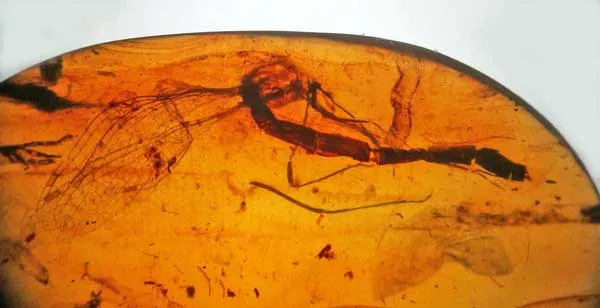
One hundred million years ago in what is now Myanmar, a lizard snapped off a dragonfly's head and tried to dash away. Unfortunately, the reptile didn't escape with its snack: Both creatures were trapped in sticky tree resin, leaving behind a grisly fossilized scene.
The find, reported in the 2010 issue of the journal Palaeodiversity, is the oldest example of a dragonfly preserved in amber, or fossilized tree resin. But what makes the find really interesting is the snapshot of ancient life that looks familiar today, said George Poinar, an entomologist and emeritus professor at Oregon State University.
Next to the decapitated dragonfly are the foot and tail of a small lizard, presumably the creature that beheaded the insect. Both became trapped in the resin and died in the middle of their duel, Poinar said in a statement.
"It's unfortunate we don't have the entire specimen of the lizard," he said, "because it probably had the dragonfly's head in its mouth."
Fossilized dragonflies preserved in stone date back 300 million years, but the specimen from Burma (now Myanmar), which is between 97 million and 110 million years old, is the oldest known specimen preserved in amber. Like modern dragonflies, the Burma specimen was a predator, feeding on larvae and other insects. And like today's dragonflies, the ancient insect had to watch out for predators of its own. Beside lizards, young and hatchling dinosaurs probably ate dragonflies, Poinar said.
"Dragonflies are still eaten by small lizards every day. It's a routine predator-prey interaction," Poinar said. "This shows once again how behaviors of various life forms are retained over vast amounts of time."
Get the world’s most fascinating discoveries delivered straight to your inbox.
