














Parting of Red Sea Jibes With Natural Laws
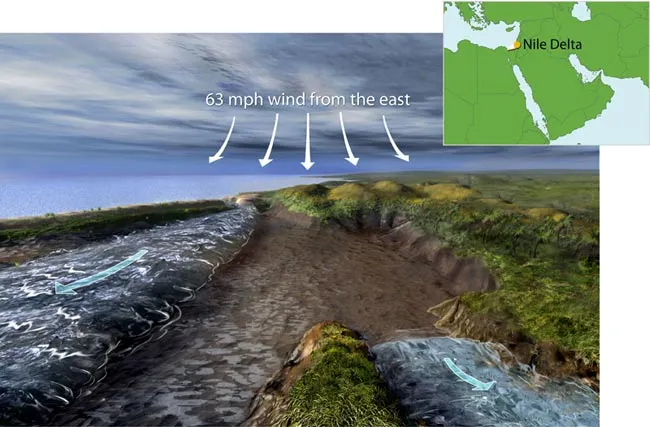
Mother Earth could have parted the Red Sea, hatching the great escape described in the biblical book of Exodus, a new study finds.
A strong east wind, blowing overnight, could have swept water off a bend where an ancient river is believed to have merged with a coastal lagoon along the Mediterranean Sea, said study team member Carl Drews of the National Center for Atmospheric Research. While archaeologists and Egyptologists have found little evidence that any events described in Exodus actually happened, the study outlines a perfect storm that could have led to the 3,000-year-old escape.
"People have always been fascinated by this Exodus story, wondering if it comes from historical facts," Drews said. "What this study shows is that the description of the waters parting indeed has a basis in physical laws."
Drew and his colleagues used models that showed that a wind of 63 mph (101 kph), lasting for 12 hours, would have pushed back waters estimated to be 6 feet (1.8 meters) deep. This would have exposed mud flats for four hours, creating a dry passage about 2 to 2.5 miles (3.2 to 4 kilometers) long and 3 miles (4.8 km) wide.
To match the account in the Bible, the water would have to be pushed back into both the lake and the channel of the river, creating barriers of water on both sides of newly exposed mud flats, which is exactly what the models show could have happened.
As soon as the winds stopped, the waters would come rushing back. Anyone still on the mud flats would be at risk of drowning.
As the Bible story goes, Moses and the fleeing Israelites were trapped between the Pharaoh's advancing chariots and a body of water that has been variously translated as the Red Sea or the Sea of Reeds. In a divine miracle, a mighty east wind blew all night, splitting the waters and leaving a passage of dry land with walls of water on both sides. The Israelites were able to flee to the other shore. But when the Pharaoh's army attempted to pursue them in the morning, the waters rushed back and drowned the soldiers.
Get the world’s most fascinating discoveries delivered straight to your inbox.
"The simulations match fairly closely with the account in Exodus," Drews said. "The parting of the waters can be understood through fluid dynamics. The wind moves the water in a way that's in accordance with physical laws, creating a safe passage with water on two sides and then abruptly allowing the water to rush back in."
A similar phenomenon is found on Lake Erie near Toledo, Ohio, where water will recede several feet when a strong wind blows through, Drews told OurAmazingPlanet.
The research shows how strong and persistent winds can affect water depths, and will also help with understanding storm surges, Drews said.
By pinpointing a possible site south of the Mediterranean Sea for the crossing, about 75 miles (121 km) north of the Suez reef, where other groups have focused, it also could be of benefit to experts seeking to research whether such an event ever took place.
The study is detailed in the online journal PLoS ONE.
- 7 Ways the Earth Changes in the Blink of an Eye
- The World's Biggest Oceans and Seas
- The World's Weirdest Weather
This article was provided by OurAmazingPlanet, a sister site to LiveScience.