
















Mysterious Mountains Hidden Beneath Antarctic Ice Revealed
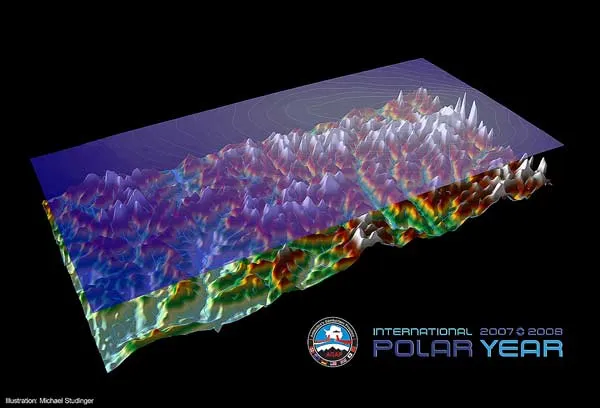
The first detailed pictures of one of the planet's last unexplored frontiers — a vast mountain range that rivals the Alps in majesty buried underneath the ice of Antarctica — were revealed by scientists this week.
The rugged peaks soar to more than 8,000 feet (2,400 meters). They are buried beneath solid ice more than a mile (1.6 kilometers) thick, deep within Antarctica's eastern interior.
The existence of this mountain range, called the Gamburtsev Mountains, shocked the Russian scientists who first discovered it more than 50 years ago, and mystery still shrouds the nearly 750-mile- (1,200-km-) long series of subglacial peaks.
At the International Polar Yearconference in Oslo, Norway, scientists unveiled new radar images of an area of the mountains the size of the state of New York.
"What we'd shown before was an estimate based on gravity data — a little bit of a coarse resolution tool," said Robin Bell, a senior research scientist at Columbia's Lamont-Doherty Earth Observatory in New York. "What we showed at this meeting was the radar data. It's like going from using a big, fat sharpie to using a fine-tipped pencil."
What the pictures reveal, Bell said, is spectacular: a dramatic landscape of rocky summits, deep river valleys, and liquid, not frozen, lakes, all hidden beneath the ice.
Bell was among a team of scientists from seven countries who spent two frigid months collecting geophysical data in the remote antipodean wilderness via sophisticated, aircraft-mounted instruments in late 2008 and early 2009.
Get the world’s most fascinating discoveries delivered straight to your inbox.
The expedition provided researchers with several terabytes of information — just one terabyte could hold two days worth of songs or one million pictures. Although it will take years to process all that data, Bell hopes the numbers will answer some of the questions surrounding the Gamburtsev Mountains. A big one is how they formed in the first place.
"We now know it's not a volcanic mountain range," said study team member Kathryn Rose, of the British Antarctic Survey. "And uplift by a hotspot in the mantle is probably out in terms of a mechanism of formation." (The mantle is the scorching hot, molten rock that underlies Earth's crust and is the source of volcanic magma.)
Rose said the data are also providing invaluable insight into the evolution of the colossal East Antarctica Ice Sheet — the 6 million square miles (15.5 million square km) of ice that conceals the Gamburtsev Mountains and is important to understand in terms of its potential to melt in a warming world.
"Scientists need to improve our understanding of ice sheets and their dynamics because it impacts sea level everywhere," Bell told OurAmazingPlanet, emphasizing that new insights are guaranteed for years to come.
"We're still scratching our heads as to how the mountains were made and why they're still there," she said. "But I think we have the data we need to solve the puzzle."
- 101 Amazing Earth Facts
- Infographic: Tallest Mountain to the Deepest Ocean Trench
- Extreme Living: Scientists at the End of the Earth