













69 Million Years Ago, Crested Duck-Billed Dinosaurs Roamed the Warm, Forested Arctic

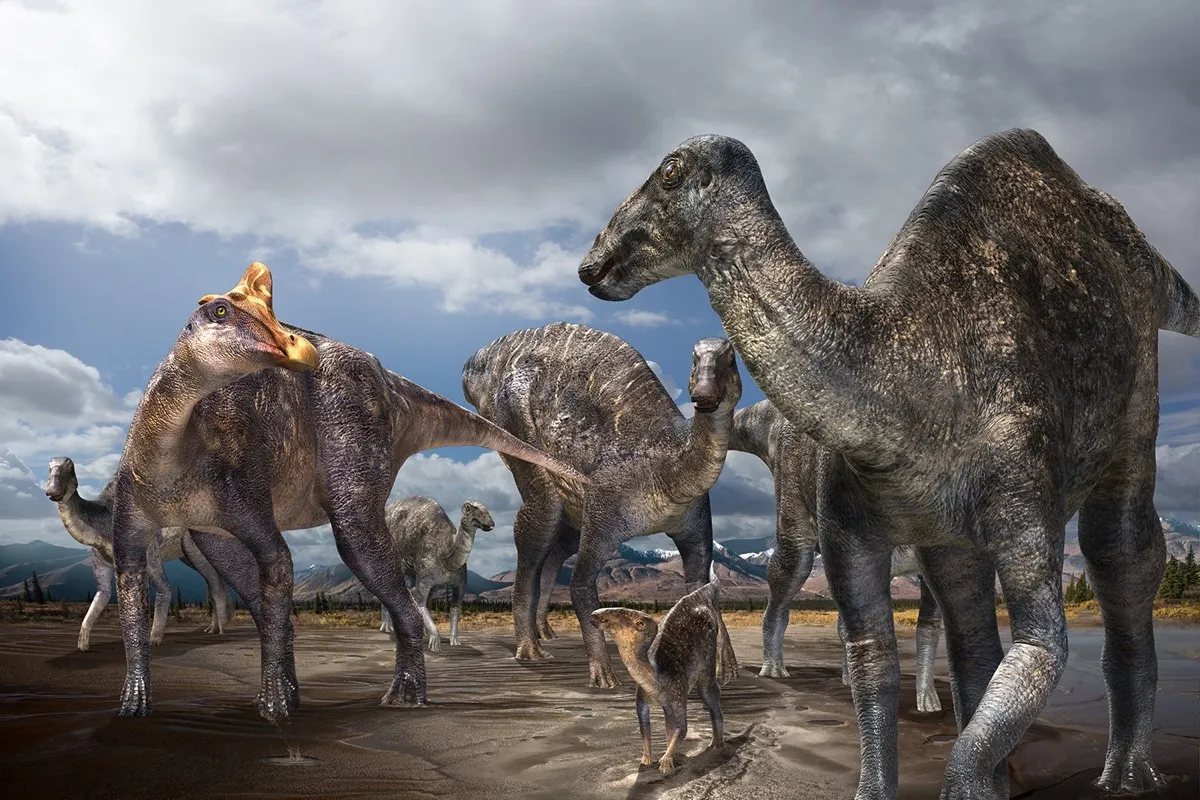
Some 69 million years ago, the Arctic was a relatively warm, forested place, home to roaming herds of duck-billed dinosaurs, feathered raptor-like theropods and even members of the tyrannosaur family.
Now, scientists have discovered a duck-billed dinosaur fossil in Alaska's North Slope that reveals that these animals were more diverse than previously believed. The skull fragment comes from a lambeosaurine, which is a type of crested duck-billed dinosaur. Previously, the only duck-bills known from the Cretaceous Arctic were hadrosaurs, or non-crested duck-billed dinosaurs.
"This new discovery illustrates the geographic link between lambeosaurines of North America and the Far East," study leader Ryuji Takasaki, a paleontologist from Hokkaido University in Japan, said in a statement. "Hopefully, further work in Alaska will reveal how closely the dinosaurs of Asia and North America are connected." [Image Gallery: 25 Amazing Ancient Beasts]
New duck-bill
The new fossil is in the collection of the Perot Museum of Nature and Science in Dallas, Texas. It consists of a chunk of skull from a single dinosaur, found in the Liscomb Bonebed in the remote North Slope of Alaska. The fossils in this bone bed date to approximately 69 million years ago, and more than 6,000 bones and bone fragments have been found there.
The vast majority of the bones belong to hadrosaurines, duck-billed dinosaurs that are often found along coastal flats or river deltas. That's what the Liscomb Bonebed area was in the Cretaceous. The new fossil, though, has skull features that don't match the hadrosaur group. Instead, the skull fits in with a group called the lambeosaurines, which are distinguished by the hollow crests on the tops of their heads.
The skull fragment has strong bone protuberances seen only on lambeosaurines, the researchers reported March 29 in the journal Scientific Reports. The skull was also shorter than a hadrosaurine skull.
Diverse Arctic
Previously, the northernmost lambeosaurines came from southern Alberta, in Canada, the researchers wrote. The new find hints that Arctic populations were similar to those farther south.
Get the world’s most fascinating discoveries delivered straight to your inbox.
The fact that only one lambeosaurine skull has been found in the Liscomb Bonebed might indicate that lambeosaurines, unlike hadrosaurines, didn't gather in coastal areas, the researchers wrote. Lambeosaurines elsewhere in North America and Asia are typically found in inland environments, so there may have been fewer of these crested duck-bills near the ancient coastline in Alaska.
Originally published on Live Science.

Stephanie Pappas is a contributing writer for Live Science, covering topics ranging from geoscience to archaeology to the human brain and behavior. She was previously a senior writer for Live Science but is now a freelancer based in Denver, Colorado, and regularly contributes to Scientific American and The Monitor, the monthly magazine of the American Psychological Association. Stephanie received a bachelor's degree in psychology from the University of South Carolina and a graduate certificate in science communication from the University of California, Santa Cruz.