













Bounty Hunter Kills Gargantuan Burmese Python, Gets $375, Earns Our Undying Gratitude

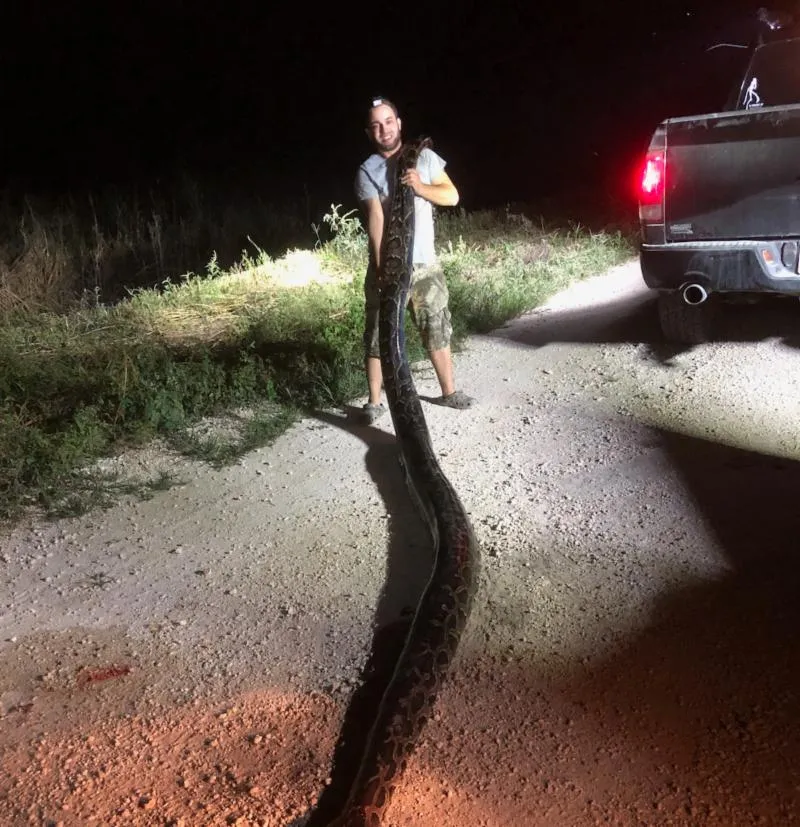
There are snakes, and then there are "SSSSNNNNAAAAAAAAKES!!!!"
Florida resident and professional python bounty hunter Kyle Penniston caught and killed one such SSSSNNNNAAAAAAAAKE earlier this week in the Florida Everglades, according to a news release from the South Florida Water Management District (SFWMD). The gargantuan Burmese python measured 17 feet 5 inches (5.3 meters) long and weighed about 120 lbs. (54 kilograms). It is survived by many children's nightmares. [7 Shocking Snake Stories]
Penniston caught and "humanely euthanized" the snake as part of the SFWMD's Python Elimination Program, which pays a team of 25 mercenary snake hunters to track and kill invasive pythons and deposit the reptiles at designated drop-off locations around several counties in southern Florida. (The program website does not specify what "humane" euthanasia means, but does say that firearm use on snakes is permitted, consistent with local, state and federal regulations.)
Burmese pythons are an invasive species in the Everglades (Florida's extremely biodiverse wetland preserve that spans 1.5 million acres, or 1 million hectares). They were likely introduced to the ecosystem by careless pet owners, the SFWMD wrote. These snakes breed rapidly and pose a serious threat to the area's birds, rodents, deer and even alligators.
"The Everglades is a beautiful buffet for an apex predator like that," David Penning, a snake biologist at Missouri Southern State University, previously told Live Science. "Since the snakes have shown up and increased in number, we have seen a prominent drop in basically every animal that can be consumed by those snakes."
Thus, the state wants the serpents dead. Hunters like Penniston are paid $8.25 an hour to prowl the wetlands in the SFWMD's jurisdiction, earning on-the-spot bonuses that rise with the size of any snakes they fell. Pythons up to 4 feet long (1.2 m) net hunters $50, with every additional foot earning an extra $25. Penniston's near-18-foot quarry earned him a bonus of $375.
According to the SFWMD, the Python Elimination Program has removed nearly 1,900 invasive snakes since March 2017, with Penniston's latest catch setting a new record for the longest snake poached in this program.
Get the world’s most fascinating discoveries delivered straight to your inbox.
Pythons, for the record, get very, very big. Per Guinness World Records, the longest snake ever caught is a 25-foot-long (7.6 m) python named Medusa, currently owned by a Kansas City, Missouri, company that produces haunted houses.
Originally published on Live Science.

Brandon is the space / physics editor at Live Science. With more than 20 years of editorial experience, his writing has appeared in The Washington Post, Reader's Digest, CBS.com, the Richard Dawkins Foundation website and other outlets. He holds a bachelor's degree in creative writing from the University of Arizona, with minors in journalism and media arts. His interests include black holes, asteroids and comets, and the search for extraterrestrial life.