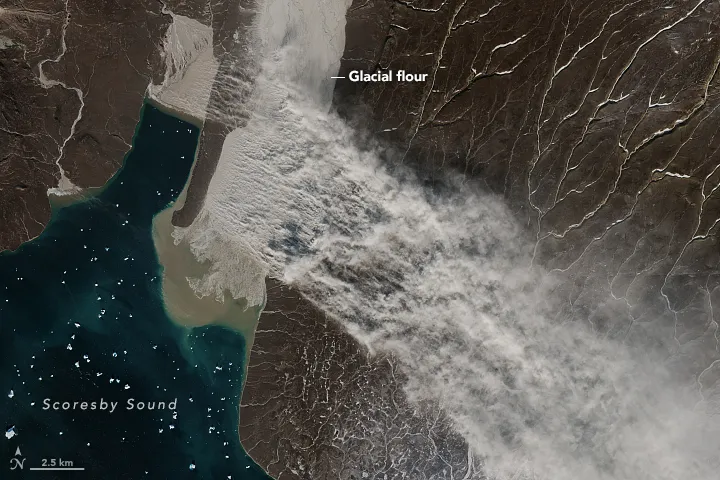
If you're in Greenland and a strange cloud darkens the sky, that cloud might be made up of something scientists call "glacier flour."
Researchers have written and speculated about glacier-flour dust storms in Greenland for a long time, according to NASA. But it took until this September for investigators to spot such a massive plume of the elusive dust forming and drifting 80 miles (130 kilometers) northwest of the far-northern village of Ittoqqortoormiit. Glacier flour is a fine dust created when glaciers pulverize rocks, NASA wrote. While satellites had occasionally spotted smaller storms of the stuff, this one was "by far the largest."
"We have seen a few examples of small dust events before this one, but they are quite difficult to spot with satellites because of cloud cover," Joanna Bullard, a professor of physical geography at Loughborough University in the United Kingdom, said in a NASA statement. "When dust events do happen, field data from Iceland and West Greenland indicate that they rarely last longer than two days." [7 Crazy Facts About Dust Storms]
The flour storm formed when a summer floodplain in the region dried out with late September's colder weather, leaving behind a large deposit of sediment carried south from more-northern glaciers.
NASA satellites watched the floodplain become grayer and grayer as it dried out, then saw the plume form when strong winds swept through the area on Sept. 29.
A composite image shows how the plume emerged over the course of several days.
(Image credit: NASA Earth Observatory)
According to NASA, storms like this are interesting because researchers just don't know much about them or how they affect the climate. While large dust storms found closer to the equator have known climate impacts, the role of glacial flour remains a mystery.
Rafi joined Live Science in 2017. He has a bachelor's degree in journalism from Northwestern University’s Medill School of journalism. You can find his past science reporting at Inverse, Business Insider and Popular Science, and his past photojournalism on the Flash90 wire service and in the pages of The Courier Post of southern New Jersey.