More than 3 million years ago, our adult human ancestors were walking on two feet and didn't have the option of a fashionable baby sling to carry their kids around in. Instead, Australopithecus afarensis toddlers had a special grasping toe that helped them hold on to their mothers and escape into the trees, reports a study published today (July 4) in Science Advances.
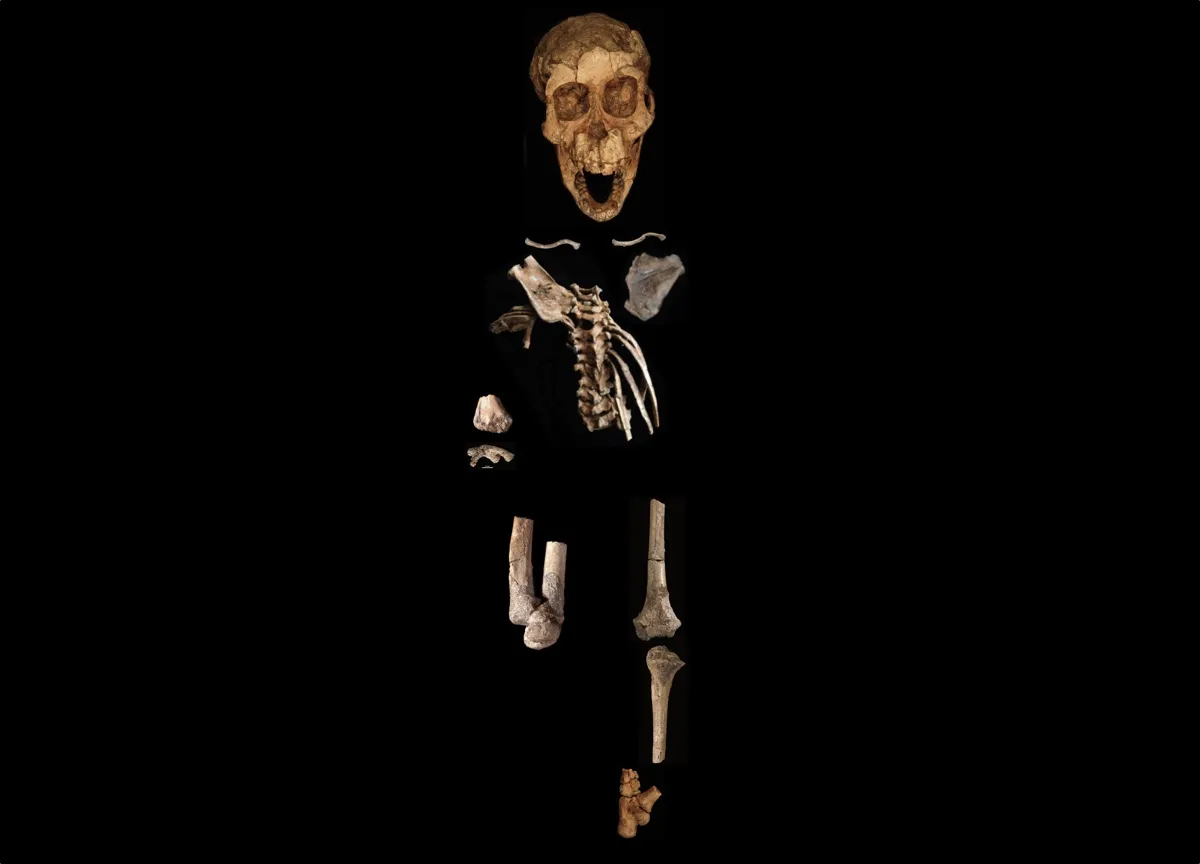
The evidence comes from DIK-1-1 — a relatively complete 3.3 million-year-old skeleton of a 2.5- to 3-year-old female Australopithecus afarensis discovered in Dikika, Ethiopia. The skeleton, nicknamed Selam — after the word for peace in Ethiopia's official language of Amharic – includes the oldest and most complete foot bones of this species ever found. [Image Gallery: 3-Year-Old Human Ancestor 'Selam' Revealed]
"It's a very exciting discovery," said Will Harcourt-Smith, a paleontologist at the American Museum of Natural History in New York, who was not involved in the study and was a reviewer of the paper. "It's really special and really allows us to learn something more about this creature."
Zeresenay Alemseged, a paleoanthropologist at the University of Chicago, discovered Selam's preserved skeleton in 2000. The skeleton was initially dubbed "Lucy's baby" because of its close proximity to the adult female A. afarensis fossil named Lucy, found in 1974. But Selam actually died more than 100,000 years before Lucy was even alive.
Selam's foot was later discovered in 2002 and is about 2 inches (5.5 centimeters) long — that's a little shorter than a sticky note. The structure of the ankle and general anatomy of the foot is the same as a modern human's, with a distinct difference: The big toe is curved, similar to a chimpanzee's. But unlike the chimp's big toe, Selam's is in line with her other toes, similar to toes on a human foot.
Left block of images: The 3.32 million-year-old foot from an Australopithecus afarensis toddler shown in different angles. Right block of images: The child's foot (bottom) compared with the fossil remains of an adult Australopithecus foot (top).
(Image credit: Jeremy DeSilva and Cody Prang)
"So, it's human-like in not sticking out to the side, but it had much more mobility and could probably wiggle and grab on to stuff. Not [as well as] a chimp, but certainly more than a human could," said Jeremy DeSilva, a paleoanthropologist at Dartmouth College in New Hamphshire and lead author of the study.
The anatomy of Selam's heel was also surprising, he said. Lucy and other adult A. afarensis fossils had robust heel bones that are similar to those that humans are born with, and they're suitable for walking upright. But Selam's heel was relatively small and delicate. "So that suggests [A. afarensis] grew their heels very differently than we do," DeSilva told Live Science. "Even though we have the same anatomy they had, we got it differently."
Sign up for the Live Science daily newsletter now
Get the world’s most fascinating discoveries delivered straight to your inbox.
Climbing, but walking more
Selam's curved toe suggests that A. afarensis infants and toddlers were grasping their mother's body while being carried and were also climbing trees for food or protection, especially at night. That's an inference based on the fact there is no evidence of fire or construction for another million years in Africa, said DeSilva. "We also have fossils of very large predators," he said. "I can't image how they would have survived if they didn't go into the trees at night."
This is the 3.32-million-year-old Australopithecus afarensis foot from Dikika, Ethiopia, superimposed over a footprint from a human toddler.
(Image credit: Jeremy DeSilva)
But they still weren't great climbers, explained Carol Ward, an anatomist and paleoanthropologist at the University of Missouri who was not involved in this study, but is analyzing Selam's spine and ribs. "Even if a baby could have fit more things between its first and second toe, it would not have had the grasping capability like an ape," Ward told Live Science in an email. She said Selam's foot is clearly adapted for walking on two feet and shows "how important life on the ground was for these animals, and that effective climbing was much less important."
Although Selam's foot is relatively complete, there could be missing cartilage pieces that rotted away over time. "That makes it a little hard to say everything you might want to about how the joints work," Harcourt-Smith told Live Science. For example, the researchers "argue that the arch is low and perhaps flat in this individual, and I think they're probably correct, but it has to be taken with a bit of salt," he said.
Nonetheless, this discovery is unprecedented and "allows us to study the growth and development of our ancestors in a way we haven't," said DeSilva. "It opens up this window into what the life of a child 3 million years ago was like."
Kimberly has a bachelor's degree in marine biology from Texas A&M University, a master's degree in biology from Southeastern Louisiana University and a graduate certificate in science communication from the University of California, Santa Cruz. She is a former reference editor for Live Science and Space.com. Her work has appeared in Inside Science, News from Science, the San Jose Mercury and others. Her favorite stories include those about animals and obscurities. A Texas native, Kim now lives in a California redwood forest.