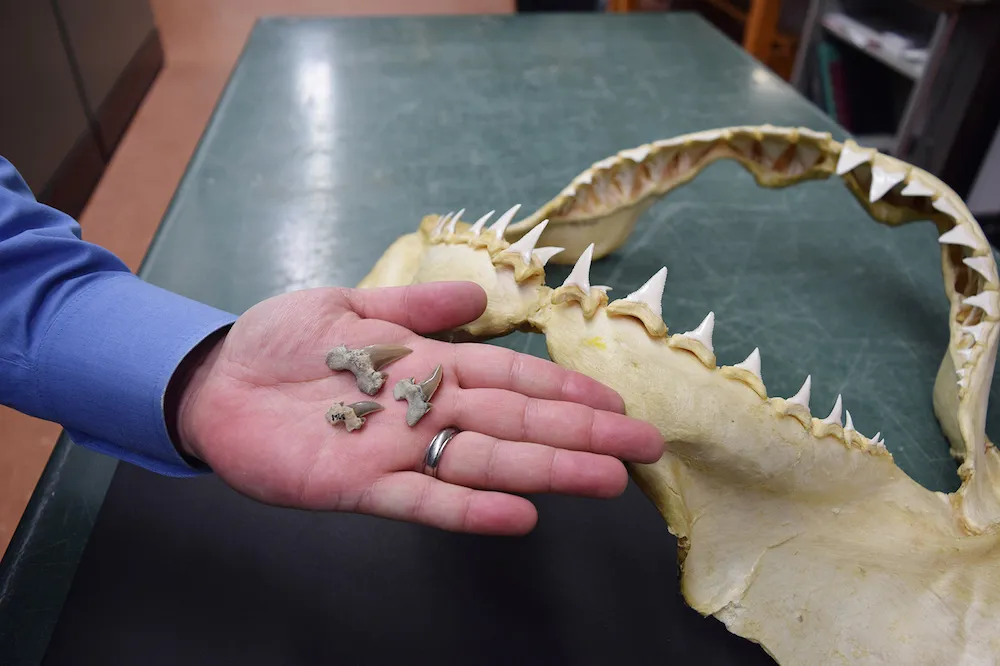
It took nearly 40 years, but researchers have finally collected enough fossil teeth in Alabama to properly identify a previously unknown species of ancient shark — one that was a possible ancestor of megalodon, the largest shark to ever exist.
The newly identified mega-toothed shark lived about 83 million years ago, during the dinosaur age. Its largest tooth discovered so far measures about 1 inch (2.7 centimeters) long, which is substantially smaller than the 7-inch-long (17.7 cm) teeth sported by megalodon (Carcharocles megalodon), the researchers said in a new study.
"Over time, the sharks in the megalodon line acquire [tooth] serrations, lose their cusplets (the little 'fangs' on the sides of the main cusp) and grow to enormous sizes," said study lead researcher Jun Ebersole, director of collections at the McWane Science Center in Birmingham, Alabama. The newfound shark is an early member of this family, so its teeth are small and unserrated, with up to two pairs of cusplets, he said. [Aahhhhh! 5 Scary Shark Myths Busted]
Researchers found 33 teeth from the Cretaceous period shark from nine different sites in central Alabama over a period of 38 years, Ebersole said. He and his colleague named the species Cretalamna bryanti, or the "Bryant Shark" for short, in honor of the late University of Alabama football coach Paul "Bear" Bryant and his family.
The Bryant Shark teeth are tiny compared to a giant megalodon tooth.
(Image credit: McWane Science Center)
It's incredible that until now, C. bryanti was "overlooked, not recognized or misidentified by previous scientists as other shark species," Ebersole said in a statement. The discovery shows that mega-toothed sharks had more diversity than previously realized during the dinosaur age, he noted.
The Bryant Shark's family, the otodontids, evolved more than 100 million years ago, but are now extinct. The family's largest member, the 60-foot-long (18 meters) megalodon, lived during the Miocene and Pliocene, epochs that lasted from 23 million to 2.6 million years ago, Ebersole said.
Given that C. bryanti's teeth had similar chompers to other mega-toothed sharks that survived the nonavian dinosaur extinction 66 million years ago, it's possible that C. bryanti was part of the lineage that led to megalodon, Ebersole said.
Sign up for the Live Science daily newsletter now
Get the world’s most fascinating discoveries delivered straight to your inbox.
The Bryant Shark teeth are different sizes, but the largest one is 1 inch (2.7 centimeters) tall. Notice the small cusplets on the sides of the teeth.
(Image credit: McWane Science Center)
He added that it's difficult to calculate the length of C. bryanti based on its teeth alone. However, the shark's crown teeth are similar to a those of a mako shark, even though the two species are not related. "Thus, using recent makos as a modern analogue, the Bryant Shark may have reached lengths of up to 15 feet [4.5 m]," Ebersole told Live Science.
The public will soon be able to see a handful of C. bryanti's teeth on display in the fossil hall at McWane Science Center. The study was published online today (Jan. 8) in the journal PeerJ.
Laura is the managing editor at Live Science. She also runs the archaeology section and the Life's Little Mysteries series. Her work has appeared in The New York Times, Scholastic, Popular Science and Spectrum, a site on autism research. She has won multiple awards from the Society of Professional Journalists and the Washington Newspaper Publishers Association for her reporting at a weekly newspaper near Seattle. Laura holds a bachelor's degree in English literature and psychology from Washington University in St. Louis and a master's degree in science writing from NYU.