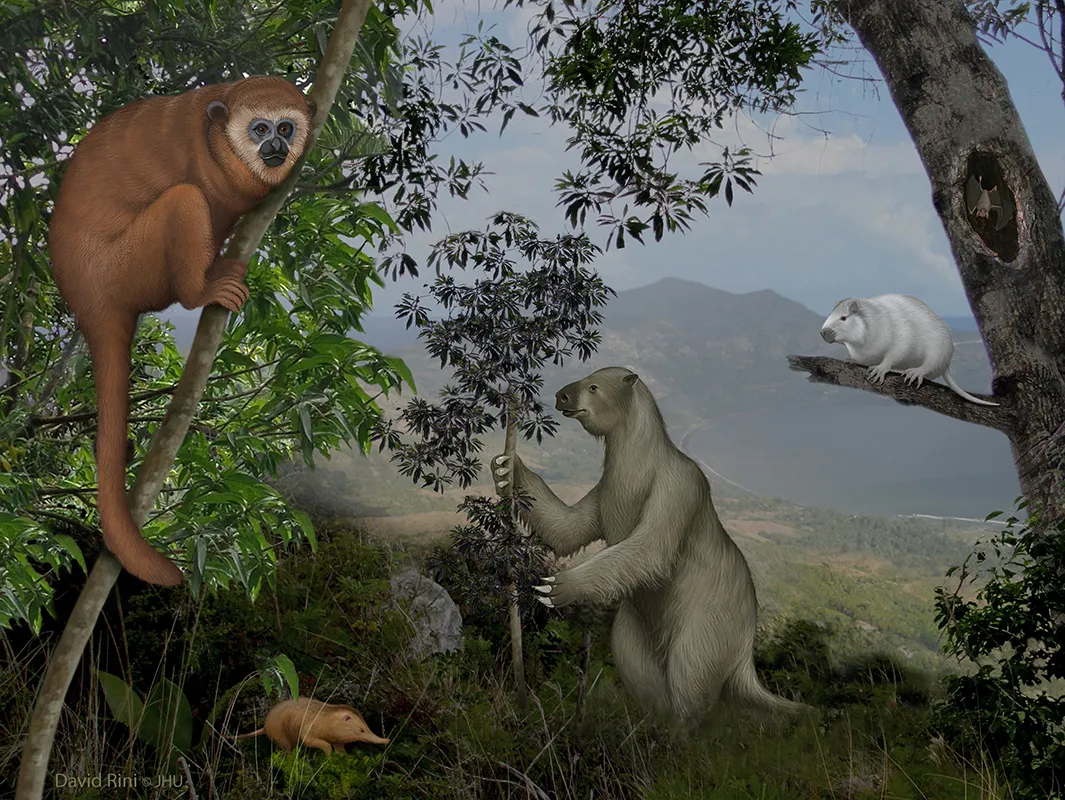
Thousands of years ago, the forests of the Caribbean islands hosted more than 130 species of diverse mammal life, ranging from sloths and giant monkeys to mammoths and oversize rats. But all that changed after humans showed up, around 6,000 years ago.
After humans began populating islands in the Caribbean, native mammal species began to vanish from the region, according to the fossil record. Today, mammal diversity in the Caribbean is far lower than it was during the time after the last ice age, with only 60 bat species and 13 nonflying mammal species remaining. The story of when dozens of mammal species went extinct is written in fossils, but why they died out has been challenging for scientists to pinpoint.
However, a recent study that analyzed extensive geological evidence alongside records of human migration revealed that two waves of humans settling in the Caribbean — first from the Americas, and then from Europe — dealt a one-two punch to native wildlife and were chiefly responsible for driving so many Caribbean mammal species to extinction. [Wipe Out: History's Most Mysterious Extinctions]
By the end of the last ice age, mammal diversity in the Caribbean islands was at its peak, with a variety of ground sloths, moles, primates, bats and rodents, study co-author Liliana Dávalos, an associate professor in the Department of Ecology and Evolution at Stony Brook University in New York, told Live Science.
This period also marked a turning point in Earth's geologic timetable. During the ice age, much of the planet's water was frozen in ice sheets, which meant that sea levels were significantly lower, Dávalos explained. The Caribbean islands, while not ice-covered like much of the continents, were still bigger than they are today, with more of their land area exposed and some of the islands connected to each other. Their climate was also drier, as less water was circulating in the atmosphere, Dávalos said.
Driving extinctions
As the ice age ended and the planet warmed, ecosystems changed dramatically, and in North America, these environmental shifts coincided with the arrival of people. Certain North American mammal species, such as giant ground sloths and woolly mammoths, went extinct around this time, but it's difficult to say with certainty whether these large mammals were doomed by their inability to adapt to a changing climate, or whether human activity drove them over the brink, according to the study.
But people didn't settle in the Caribbean islands until 6,000 years ago, at the earliest — long after climate change reshaped the islands, the study authors wrote. This enabled the researchers to separate the two events — global climate change and human presence — and see where the each might overlap with species extinctions.
Sign up for the Live Science daily newsletter now
Get the world’s most fascinating discoveries delivered straight to your inbox.
The researchers surveyed accumulations of archaeological data that documented signs of human activity across the Caribbean, and compared those findings with fossil data representing the last known appearances of different mammal species.
Stony Brook University evolutionary biologist Liliana Dávalos (in tree) and Miguel Núñez Novas from the Museum of Natural History in Santo Domingo examine a bat roost in the Dominican Republic.
(Image credit: M. Elise Lauterbur)
"If the last time we saw a particular species of mammal on an island was before the arrival of humans, we therefore can't really make a case that humans played a role," Dávalos said.
They found that most of the extinctions on all of the islands happened after people arrived. And once humans were established, "then the fauna disappears," Dávalos told Live Science. [Image Gallery: 25 Amazing Ancient Beasts]
Vanishing in stages
The biggest species, such as ground sloths and large monkeys, were the first to vanish; they were hunted to extinction or displaced by agriculture, or a combination of both, according to the study. Interestingly, large rodents on several Caribbean islands weathered the first waves of human migration about 6,000 years ago. Archaeological evidence showed that people were eating the rodents. But the rodent populations were still successfully reproducing, and they appeared to be adapting to living alongside humans, Dávalos told Live Science.
Then, about 500 years ago, another wave of human settlers arrived — this time, from Europe. They brought a number of Old World animals with them, such as cats, rats and mongooses, and these invasive species decimated the native rodents and eventually wiped them out, according to the study.
"We are by no means the first to make the case for humans playing a role in the extinction of Caribbean fauna, but it's been difficult to get a general pattern," Dávalos said. Much of the previous work in this area had focused on individual islands or dig sites, or on small groups of islands. The new study, however, benefited from an accumulation of data from the archaeological and fossil records, as well as from statistical techniques that had never been applied to this question before, Dávalos explained.
But these findings have implications beyond the possibility of puzzling out extinction pressures and decoding timelines from the distant past. Most native Caribbean mammals today face dire threats from human activity, and lessons from extinctions that took place hundreds, and even thousands, of years ago could help experts shape strategies to preserve the precious biodiversity that remains, the study authors reported.
"It was kind of a revelation for me — nearly every surviving species of nonflying mammal in the Caribbean is in decline or threatened," Dávalos said.
"For bats, the majority are doing OK," she added. "But some species haven't been seen for decades, and we don't know if they're still alive. And these are supposed to be the survivors — the ones who can cope with human change.
"So I have a real sense of urgency now, regarding conservation in the Caribbean," Dávalos said.
Mindy Weisberger is a science journalist and author of "Rise of the Zombie Bugs: The Surprising Science of Parasitic Mind-Control" (Hopkins Press). She formerly edited for Scholastic and was a channel editor and senior writer for Live Science. She has reported on general science, covering climate change, paleontology, biology and space. Mindy studied film at Columbia University; prior to LS, she produced, wrote and directed media for the American Museum of Natural History in NYC. Her videos about dinosaurs, astrophysics, biodiversity and evolution appear in museums and science centers worldwide, earning awards such as the CINE Golden Eagle and the Communicator Award of Excellence. Her writing has also appeared in Scientific American, The Washington Post, How It Works Magazine and CNN.