













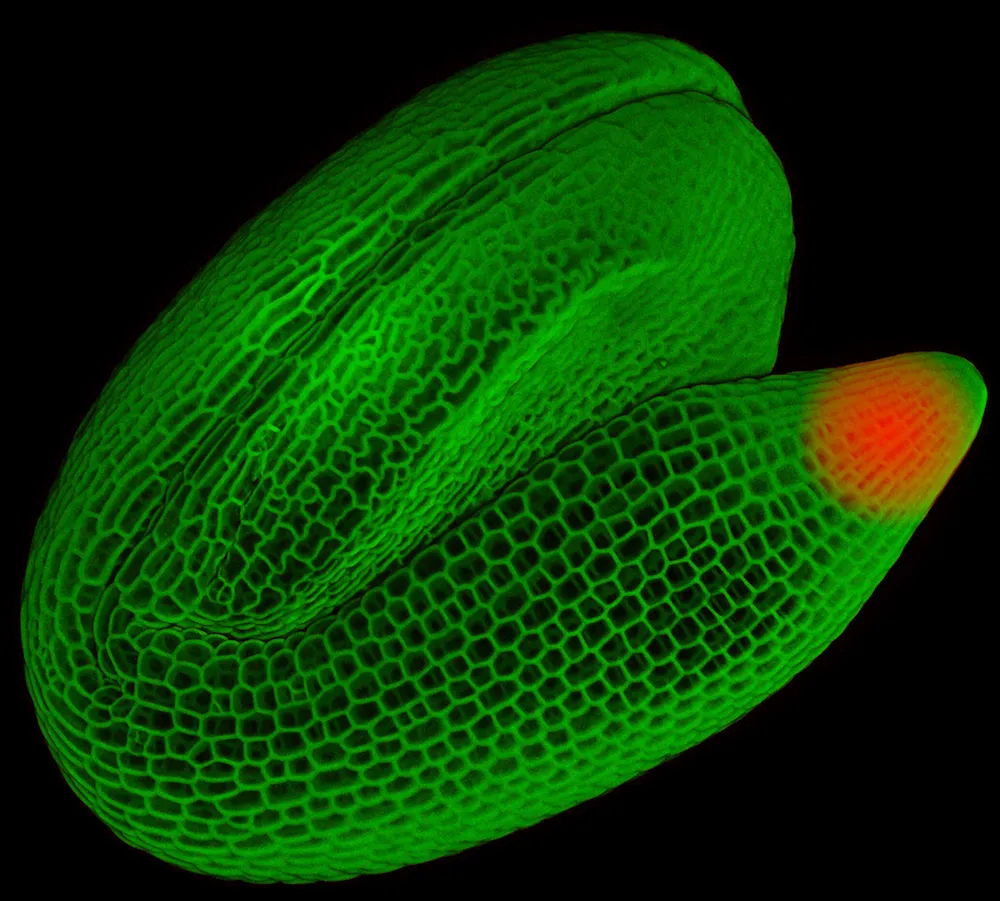
Plant seeds may use miniature "brains" to help them decide whether to sprout or stay dormant, new research suggests.
These seed "brains" don't have traditional gray matter, but they do use the same architecture for information-processing as our brains do, interpreting a cascade of hormone signals to decide when to germinate, the study found.
"Plants are just like humans in the sense that they have to think and make decisions the same way we do," said study co-author George Bassel, a plant biologist at the University of Birmingham in England.
Humans make decisions using small groups of specialized nervous system cells within the brain, Bassel added.
In the same way, "within a dormant seed there is a very small number of cells where the decision is made. These cells act in a similar way to the cells inside the nervous system," Bassel told Live Science.
Scientists could one day use these insights to engineer seeds that all pop open at the same time each season, or to design seeds to have a greater buffer against climate change, Bassel said. [Image Gallery: Carnivorous Plants]
Food for thought
The idea that plants can feel, hear or see is not new; researchers have shown that seedlings arc toward sounds of certain frequencies or hasten their growth when a competing species is planted nearby. And plants can communicate with each other when danger is nearby, according to a 2007 study in the journal Oecologia.
Get the world’s most fascinating discoveries delivered straight to your inbox.
So the idea of plants "thinking" isn't as far-fetched as it sounds, Bassel said. One area where accurately processing environment information is crucial to a plant's survival is in the timing of a seed's germination. Seeds represent the only way a plant can move significant distances from a rough environment to a friendlier one — they can travel far by being eaten by animals or carried on the wind. They also present a plant one of its few ways of moving through time, Bassel said. By lying dormant in the ground until the temperature or other conditions are just right, seeds can optimize their chances of survival, Bassel said.
To understand how plants make these decisions, Bassel and his colleagues created a digital atlas of every single cell inside the embryos (seeds) of the thale cress plant, or Arabidopsis thaliana. They then mapped where specific hormones tended to be localized within the seeds.
They found that two hormones known to play a role in germination, called gibberellin (GA) and abscisic acid (ABA), showed high concentrations in the tip of the embryonic root.
In a seed made up of about 3,000 to 4,000 cells, between 25 and 40 of them seemed to play the dominant role in trafficking and processing these hormones. One clump of cells produced GA, which promotes the "germinate" signal, while another clump of cells, separated at some distance, produced ABA, the "stay dormant" signal. The signals were being sent back and forth between the two regions, the study found.
"There's a tug-of-war between these two signals, some are saying 'go,' some are saying 'stop,'" Bassel told Live Science.
In the default state, the cells put out more ABA than GA. And as conditions outside the seed improve, the GA levels gradually increase until the seed's "decision center" concludes that it's better to germinate than stay dormant, the researchers found in the study, which was published on Monday (June 5) in the journal Proceedings of the National Academy of Sciences.
Timing of germination
The team also altered the expression or activity of the hormones in the plants, and showed that by manipulating the levels and timing of the hormone signaling, they could control when germination occurred.
In the plant seeds, the two opposing centers of the decision complex are separated in distance. In the human brain's motor cortex, two separate regions initiate a "go" or "no go" signal, either promoting or inhibiting the decision to move, Bassel said. In animals, separating the two regions prevents random noise from forcing the body to make decisions that might be incorrect, he said.
In the plant, the separation between the "go" and "no go" regions of the decision center are used to spur germination at times when the temperature is fluctuating, the study found. It's not clear why temperature fluctuations should be so crucial to the plants, but one possibility is that it helps the plants sense how deep they are in the soil. (The deeper they are, the more buffered they are against temperature changes.) Another possibility is that wide temperature swings often happen at the change of seasons, so temperature swings can help the seed sense these transition periods, Bassel said.
The common informational structure between plant and animal brains is even more fascinating because they clearly didn't evolve from the same anatomical structures, Bassel said. The last common ancestor of plants and animals was a single-celled, algae-like organism that lived 1.6 billion years ago, according to a 2002 study in the journal Science. Yet despite this huge evolutionary gap, both plants and animals seem to have arrived at a similar solution because it offered them some advantage in reacting to their environment, he added.
"Both plants and animals, through evolutionary processes, have settled on a similar design," Bassel said.
Originally published on Live Science.

Tia is the editor-in-chief (premium) and was formerly managing editor and senior writer for Live Science. Her work has appeared in Scientific American, Wired.com, Science News and other outlets. She holds a master's degree in bioengineering from the University of Washington, a graduate certificate in science writing from UC Santa Cruz and a bachelor's degree in mechanical engineering from the University of Texas at Austin. Tia was part of a team at the Milwaukee Journal Sentinel that published the Empty Cradles series on preterm births, which won multiple awards, including the 2012 Casey Medal for Meritorious Journalism.