














Fake Walls, Real Shocks: VR System Simulates Physical Barriers

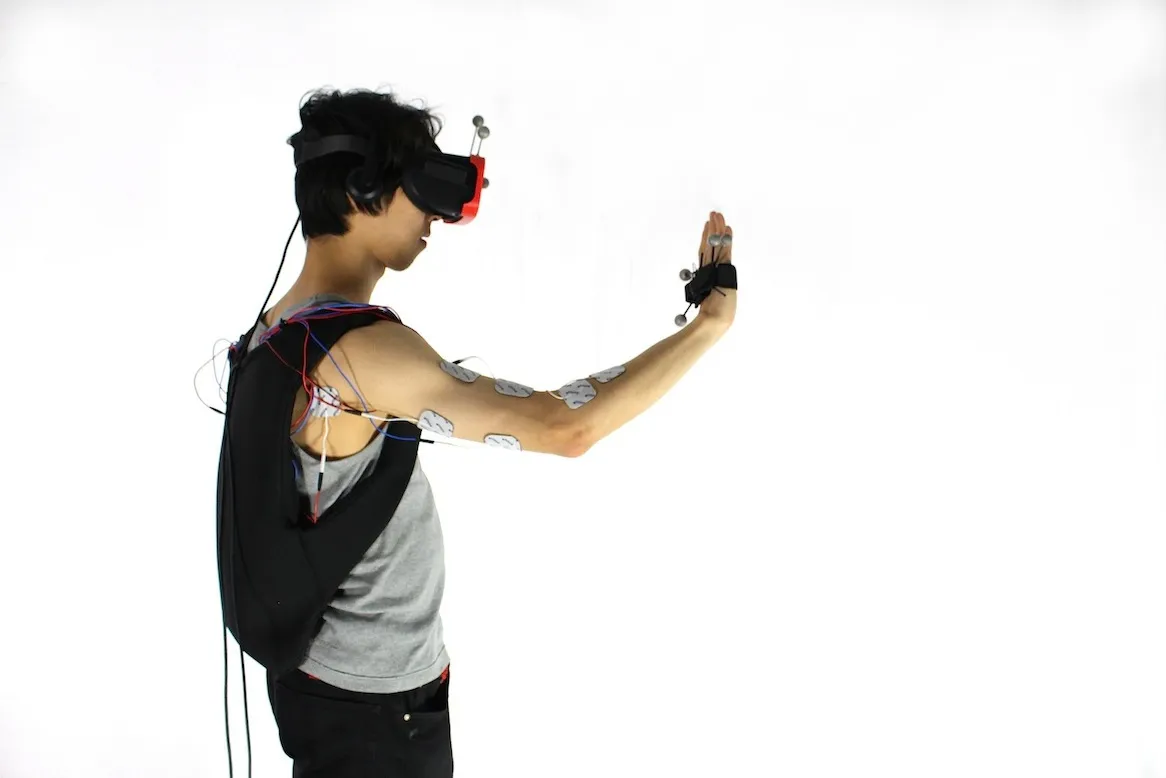
What happens when you walk into a wall in virtual reality? Nothing yet, but soon, your muscles could get shocked when you smack into a barrier, thanks to a new research project that aims to simulate walls and other objects in virtual reality.
This expansion on the virtual reality (VR) experience uses electrical muscle stimulation to give users the sensation of hitting a wall or lifting a heavy object. The effect is created via haptic feedback, a type of tactile communication that uses forces or vibrations to re-create the sense of touch. A team of researchers from the Hasso Plattner Institute at the University of Potsdam in Germany created a wearable system that can shock different muscle groups throughout a person's body.
In addition to a VR headset and tracking gloves, the researchers outfitted users with backpacks containing electrical muscle stimulators and a series of electrode patches that attach to the wearers' skin and produce the shocks. [Beyond Gaming: 10 Other Fascinating Uses for Virtual-Reality Tech]
The researchers explained that the system can simulate interactions with different types of objects, including walls, shelves and projectiles.
"Our system stimulates up to four different muscle groups," the research team wrote about the project on the Hasso Plattner Institute website. "Through combinations of these muscle groups, our system simulates a range of effects. When pushing a button mounted to a vertical surface, for example, the system actuates biceps and wrist."
Their design uses brief pulses, about 200-300 miliseconds long, calibrated to the specific user's maximum intensity.
Haptics can also be used to simulate the feeling of lifting a virtual object, the researchers said. In one test, the user reaches out to lift a virtual cube. To give the user the feeling of resistance (in this case, a solid shape that has weight), the opposition muscle groups are shocked.
Get the world’s most fascinating discoveries delivered straight to your inbox.
"When the user grabs the virtual cube, the user expects the cube's weight to create tension in the user's biceps and the cube's stiffness to create a tension in the user's pectoralis," the researchers wrote in a study published in the Proceedings of the 2017 CHI Conference on Human Factors in Computing Systems, May 6-11, 2017. "In order to create this sensation, the system actuates the respective opposition muscles. In order to put a load onto the user's biceps, it actuates the triceps, and in order to put a load onto the user's pectoralis, it actuates the user's shoulder muscle."
If the cube is heavier, then the system can apply more electrical stimulation, the researchers said.
So far, the system is limited to the upper body, but the researchers said that with additional research, it could be applied to a range of other muscles.
Original article on Live Science.
