














Does salt make water boil faster?

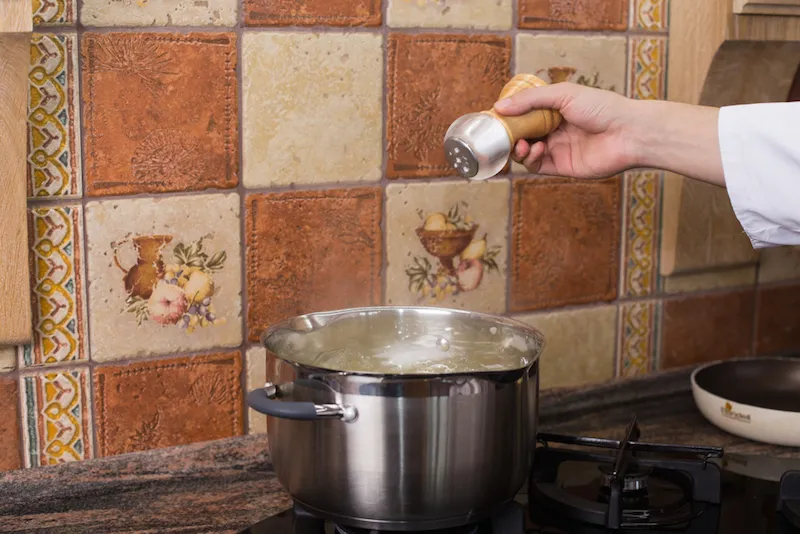
According to an old wives' tale, adding salt to a pot of water on the stove will make it boil faster.
The tale is true, but the difference is negligible, an expert told Live Science.
If you're adding 1 teaspoon (less than 3 grams) of salt to a liter (34 fluid ounces) of water, "it doesn't really make so much of a difference," said Lesley-Ann Giddings, an assistant professor of chemistry and biochemistry at Middlebury College in Vermont.
Related: Where did Earth's water come from?
Translation: The difference in time to boil will be mere seconds, if even that, Giddings said.
It takes quite a bit of energy to bring water to a boil. In fact, you need 1 calorie of energy to raise 1 gram (0.03 ounces) of water by 1 degree Celsius (1.8 degrees Fahrenheit).
In order for water to boil, its vapor pressure has to equal the pressure of the atmosphere, Giddings said. That's partly why water boils at a lower temperature on top of Mount Everest than it does at sea level. There's less atmosphere, or lower pressure, pushing down on the water on the mountain, at 29,000 feet (8,800 meters), she said.
Feed your curiosity with an exclusive mystery every week, solved with science and delivered direct to your inbox before it's seen anywhere else.
However, let's envision a pot of water on a burning stove at sea level. When salt is added, it makes it harder for the water molecules to escape from the pot and enter the gas phase, which happens when water boils, Giddings said. This gives salt water a higher boiling point, she said.
But there's more to the answer, Giddings noted. She explained that the heat capacity — the amount of heat needed to raise the temperature of a substance by 1 degree C — is lower for saltwater than it is for freshwater. This means that saltwater isn't as resistant to changing temperature as freshwater is; put another way, less heat is required to increase saltwater's temperature by 1 degree C than to do the same to freshwater, she said.
"The temperature of saltwater will get hotter faster than that of pure water," Giddings said. "But it still has a higher boiling point, and the mass is still greater when you add salt to the same volume of water, so this doesn't mean that the saltwater boils faster."
But the story changes if you don't have the same volume of water — that is, if you fill a pot with less water and more salt. Let's imagine two pots, pot A and pot B. Pot A is filled with 100 g (3.5 ounces) of water, while pot B has 80 g (2.8 ounces) of water and 20 g (0.7 ounces) of salt.
Related: Why is the ocean salty?
The 100 g of water in Pot A has a high heat capacity, meaning that it requires a substantial amount of energy to bring this water to a boil. In contrast, the salt in Pot B has now dissolved, and dissolved salt has a lower heat capacity than pure water does, according to an article by Mike Dammann, the manager of the Inorganics Section at The Southwest Research Institute in San Antonio, Texas.
Moreover, pot B has only 80 g of water, meaning it has less water to heat up than pot A does. "Twenty percent saltwater will heat up almost 25 percent faster than pure water and will win the speed race to the boiling point," Dammann wrote in an explanation online.
RELATED MYSTERIES
So, pot B will boil faster than pot A because it has less water and more salt, he said.
But a water solution with 20 percent salt is quite salty. Seawater is only about 3.5 percent salt, and most people wouldn't cook with water even that salty, Giddings said.
"You would really have to put a lot of salt in there to make significant difference" in decreasing the time it takes for water to boil, she said.
Editor's Note: This story was updated at 9:56 a.m. EDT on June 1, 2021 to correct a conversion. In the hypothetical scenario with two pots, 100 grams of water is 3.5 ounces, not 2.5 ounces as previously stated.
Original article on Live Science.

Laura is the managing editor at Live Science. She also runs the archaeology section and the Life's Little Mysteries series. Her work has appeared in The New York Times, Scholastic, Popular Science and Spectrum, a site on autism research. She has won multiple awards from the Society of Professional Journalists and the Washington Newspaper Publishers Association for her reporting at a weekly newspaper near Seattle. Laura holds a bachelor's degree in English literature and psychology from Washington University in St. Louis and a master's degree in science writing from NYU.