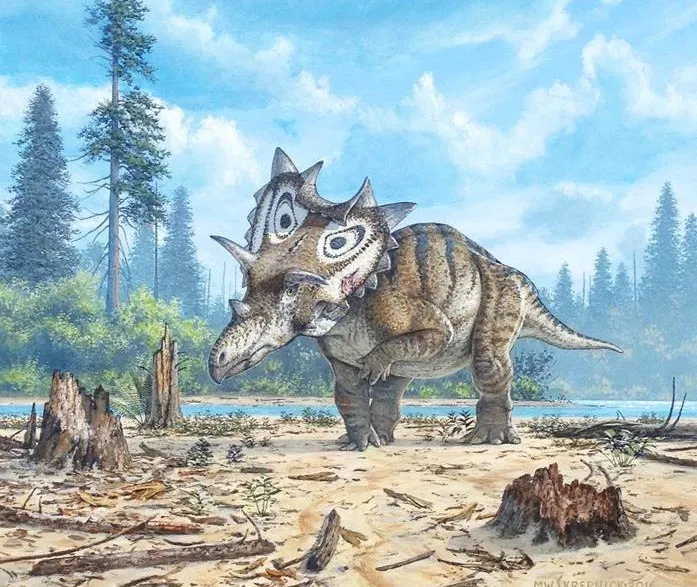
Spiclypeus shipporum (shown here in an artist's illustration) would have plodded along a 76 million years ago in what is now the Judith River Formation of Montana.
A fossil skull found in Montana a decade ago by a retired physicist has officially been declared the head of a new species of dinosaur.
The new dino, dubbed Spiclypeus shipporum, looked a bit like Triceratops, but rather than three smooth horns, it sported a neck frill decorated with bony spikes, some curling in and others curling out. It also had horns over its eyes that projected sideways from the head like misplaced ears. The particular specimen used to identify the species was an adult with a bone infection and arthritis, researchers report today (May 18) in the journal PLOS ONE.
"This is a spectacular new addition to the family of horned dinosaurs that roamed western North America between 85 and 66 million years ago," said study researcher Jordan Mallon of the Canadian Museum of Nature. [Photos: Oldest Known Horned Dinosaur in North America]
Also reported in today's issue of PLOS ONE, the remains of another horned dinosaur, this one with two curved spikes sticking out of the top of its head, was found in Utah.
Dinosaur names and nicknames
A cast of the reconstructed skull of Spiclypeus shipporum shows the sideways-oriented horns and the spikes on its neck frill.
(Image credit: Martin Lipman (c) Canadian Museum of Nature.)
The scientific name Spiclypeus shipporum comes from the Latin words for "spiked shield" combined with the surname Shipp, after Bill Shipp, a retired physicist and amateur fossil hunter who first discovered the bones of the new species. Before being named Spiclypeus shipporum, though, the dinosaur was known by the nickname "Judith." The moniker came from the Judith River geological formation, where the bones were found. The details of the dinosaur's place on the tree of life are online at judiththedinosaur.com, but the new PLOS ONE paper represents its official scientific debut.
Judith lived in what is today dry countryside in north-central Montana near the town of Winifred. Seventy-five million years ago, though, this spot was marshy floodlands not far from the shore of an inland sea. Her bones were preserved under bentonite (a type of clay) and mudstone, Shipp said in a video about Judith's discovery. The first fossil bones of the dinosaur were excavated from the hillside where they rested in 2005.
Diversity of dinosaurs
Sign up for the Live Science daily newsletter now
Get the world’s most fascinating discoveries delivered straight to your inbox.
An artist's illustration of Spiclypeus shipporum.
(Image credit: copyright Mike Skrepnick)
Analysis of Judith's bones revealed that she was at least 10 years old when she died. The upper bone of one of her front legs showed evidence of infection and arthritis in the joint.
Spiclypeus appears to have been unique to Montana, paleontologists reported, which suggests that dinosaurs were highly differentiated and localized in the Late Cretaceous period in western North America. Eight other dinosaur species have been found in the Judith River Formation, they said in a statement. None of those specimens have been found farther south than Canada.
Judith "provides new evidence of dinosaur diversity during the Late Cretaceous period from an area that is likely to yield even more discoveries," Mallon said in a statement.
Stephanie Pappas is a contributing writer for Live Science, covering topics ranging from geoscience to archaeology to the human brain and behavior. She was previously a senior writer for Live Science but is now a freelancer based in Denver, Colorado, and regularly contributes to Scientific American and The Monitor, the monthly magazine of the American Psychological Association. Stephanie received a bachelor's degree in psychology from the University of South Carolina and a graduate certificate in science communication from the University of California, Santa Cruz.