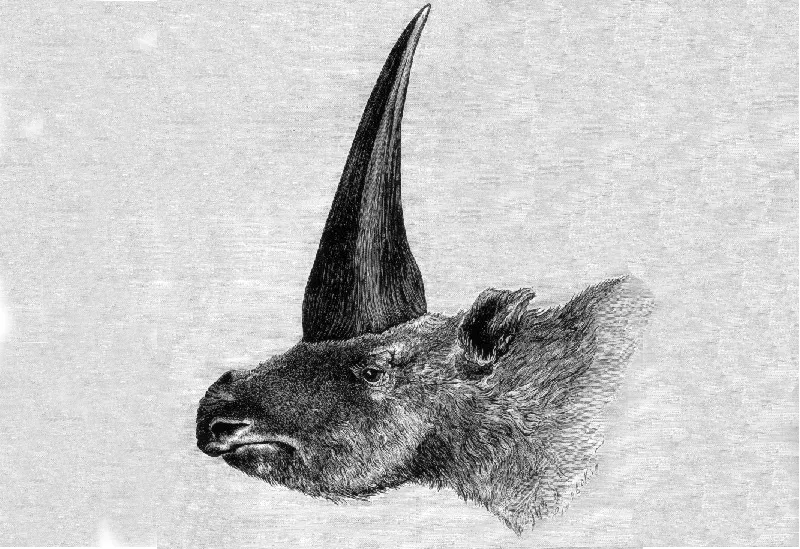
Large, four-legged beasts, each with a single horn growing from its head, once ambled across part of western Siberia, in what is now Kazakhstan.
Sometimes referred to as "unicorns" because of their single horns, these animals were originally thought to have gone extinct 350,000 years ago. However, fossils from a new dig site place the hefty creatures in the region as recently as 29,000 years ago, according to a recent study.
In spite of their magical-sounding nickname, these bruisers share little in common with the graceful and delicate horselike creatures described in song and story and pictured in medieval tapestries. A 1923 publication by paleontologist Henry Fairfield Osborn estimated the creatures to be larger than any of the modern rhino species. Artists' reconstructions hint at a burly build and body plan that resemble that of the animals' extant cousins. And the beasts go by an equally cumbersome name: Elasmotherium sibiricum (ee–laz–moh–THEER–ee–um sih–BIH–rih–cum). [6 Extinct Animals That Could Be Brought Back to Life]
Latest Videos From
A well-preserved skull
The partial skull that the researchers found was well-preserved and in very good condition overall, though the teeth were missing, the scientists said. Dimensions of features in the skull fragment were considerably bigger than those in any other E. sibiricum specimen yet discovered in Eastern Europe, hinting that the skull most likely belonged to a large, older male, said study co-author Andrey Shpanski, a paleontologist at Tomsk State University in Russia.
"The dimensions of this rhino [described] today are the biggest of those described in the literature," Shpanski said in a statement.
E. sibiricum is thought to have ranged from the Don River in southern Russia to the eastern part of Kazakhstan, and prior findings showed that the animal had long inhabited the southeastern part of the West Siberian Plain.
Other fossils found alongside the E. sibiricum skull include two upper teeth from a mammoth, the lower jaw of a steppe elephant and pieces of a bison's horn stem.
Dating a "unicorn"
To find out how old the fossils were, the scientists used a method known as radiocarbon dating, which they employed to analyze the amount of carbon-14 in the skull pieces. Carbon-14 is a carbon isotope, a variation of carbon with a different number of neutrons in its nucleus (14, in this case). Living plants and animals absorb carbon-14 from the atmosphere as long as they're alive.
But once an organism dies, the carbon-14 in its body begins to decay at a regular rate that can be tracked over time, until about 60,000 years have passed and all the carbon-14 is gone. By analyzing bones to see how much carbon-14 is left, scientists can tell when the animal was still alive.
Radiocarbon dating told researchers that the E. sibiricum individual died 29,000 years ago, a dramatic divergence from previous estimates placing the species' extinction at 350,000 years ago.
If the new calculation is correct, the "Siberian unicorn" could have crossed paths with modern humans. An earlier study suggested that humans inhabited the Siberian Arctic as far back as 45,000 years ago, based on the evidence of a butchered mammoth carcass that was likely cut up by hunters.
The new findings were published in the Feb. 2016 issue of the American Journal of Applied Sciences.
Follow Mindy Weisberger on Twitter and Google+. Follow us @livescience, Facebook & Google+. Original article on Live Science.

 Live Science Plus