















Thick-Brained People Are Smarter

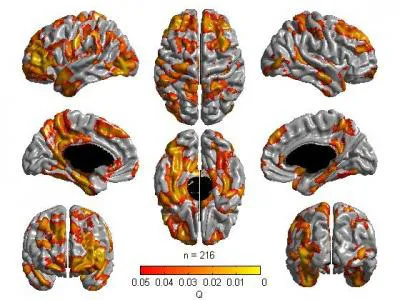
Although being called "thick-headed" means one is dumb, it turns out being literally thick-brained suggests one is smart, new findings reveal. In the past decade, scientists across the world have unearthed conflicting evidence regarding where the seat of intelligence lies in the brain. For instance, in 2000, researchers in England and Germany discovered that intelligence seemed to depend exclusively on the frontal lobes of the brain. "That was a bit surprising," said neuroscientist and psychiatrist Sherif Karama at the Montreal Neurological Institute. "It was hard to understand why something as complex as intelligence was restricted to just a few places in the brain." In the following years, other teams of investigators found signs that intelligence was based in other parts of the brain. One problem with all these experiments was they each looked at relatively small numbers of children. To help settle the argument, Karama and his colleagues used MRI to scan the brains of 216 healthy boys and girls ages 6 to 18 from a range of ethnic groups and socioeconomic statuses, mirroring the 2000 census. These children also took intelligence exams testing analogies, vocabulary, reasoning and visual-spatial skills. The scientists discovered that intelligence was linked in general to the thickness of the "grey matter" — the cerebral cortex of the brain, which plays a key role in memory, thought, language and consciousness. "It's not just a few regions. It's dispersed all throughout, in the areas associated with integrating information coming from diverse areas of the brain, which makes sense," Karama said. If one looked at the average thickness of the cortex in these children, the differences between the lowest and highest IQs is on the order of a half-millimeter, Karama explained. That's roughly a third as thick as a penny. Karama stressed these findings do not mean that cortex thickness — or intelligence — is based solely on genetics. "Environment plays a role, to be sure," he said. By finding out which genes affect thickness of the cortex, one could potentially help treat mental disorders such as Alzheimer's, depression and schizophrenia. "You could help treat a lot of cognitive decline," Karama said. Future research could instead focus on what role, if any, the "white matter" of the brain — the insulation for the grey matter — plays in intelligence. "Perhaps those with higher IQs have better white matter that allows for faster or better connections through disparate areas," Karama told LiveScience. "We can also look at gender differences — if men have different regions of the brain associated with intelligence than women. The possibilities are endless." Karama and his colleagues detailed their findings this week in the March-April issue of the journal Intelligence.
Get the world’s most fascinating discoveries delivered straight to your inbox.
