













Tapeworms: Causes, Symptoms & Treatment

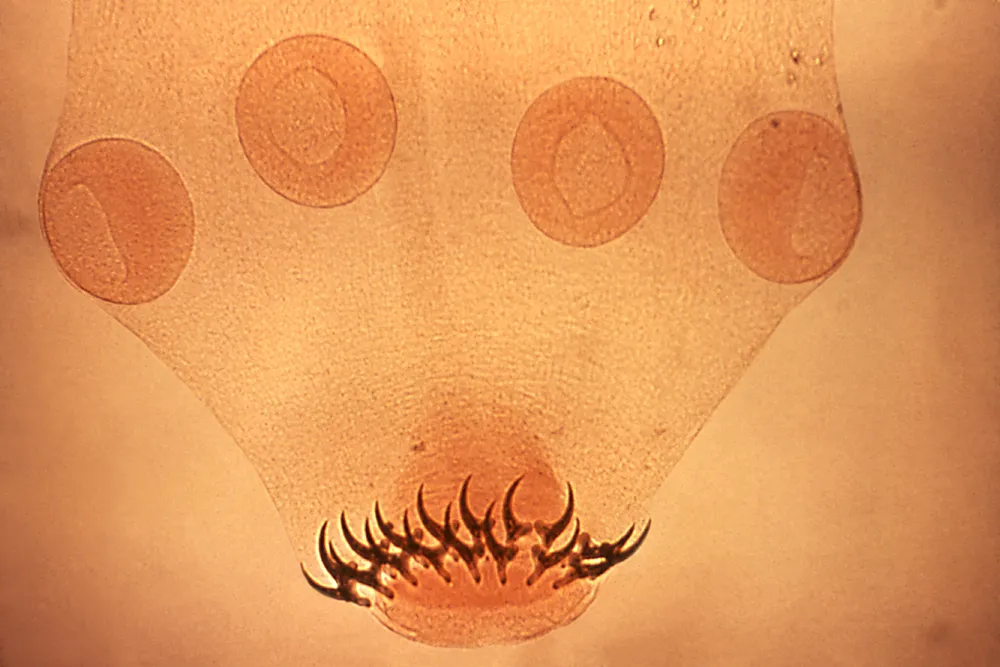
Tapeworms are flat, segmented parasites that can grow from 4 to 28 inches (10 to 71 centimeters) in length. Typically, they attach themselves to a host's intestinal walls and feed off the host's food. The medical term for a parasitic infection of tapeworms in humans is taeniasis. Taeniasis can develop into cysticercosis, which is an infection of the tissue.
Tapeworms belong to a large taxonomic class of flatworms called Cestoda, and more than 1,000 species have been identified. An adult tapeworm's body consists of a head and neck, and a chain of segments called proglottids, which grow and produce eggs, according to the Mayo Clinic. Adult tapeworms can live for up to 30 years in a host.
Causes
Tapeworm infection is caused by consuming an infected intermediate host (such as a pig) or by consuming infected fecal matter. Animals contract tapeworms from consuming prey, such as rabbits and rodents, that are infected with cysts filled with the eggs internally. Once the prey is consumed, the digestion allows the eggs to populate the intestine. (Trichinosis, also an infection caused by eating undercooked meat, is caused by roundworm parasites.)
Melanie Eldridge, an assistant professor of biology and environmental sciences at the University of New Haven, explained that a tapeworm's lifecycle consists of a mammal consuming the eggs (or cyst), the eggs hatching into larval forms within the intestines and the larval forms burrowing through the intestines into other tissues where they develop into cysts. Humans or animals then consume the cysts and the cysts matures into a tapeworm. The worm then sheds eggs through the loss of body segments in the feces of the host and the lifecycle is complete. Each body segment can contain up to 100,000 eggs.

Species that can affect animals and humans include tapeworms in the Taenia genus. Different types of Taenia are associated with different types of meat. Taenia saginata is the beef tapeworm; Taenia solium is the pork tapeworm; and Taenia asiatica is the Asian pork tapeworm.Dipylidium caninum mainly infects dogs and cats, while Echinocococcus granulosus, which infects people and livestock, is rare in the United States. Taenia species are longer than Dipylidium species; they can grow up to 1 yard (nearly a meter) in length.
“The most common tapeworm species we see in dogs and cats is Dipylidium species, which is contracted from consuming an infected flea," said Taylor Truitt, a doctor of veterinary medicine of the Vet Set and Petsmile. "While fairly innocuous in older dogs and cats, large infections in puppies can cause nausea, vomiting, and in serious cases intestinal blockage.”
The Echinococcus species of tapeworm is a rare, but it can be fatal to humans if consumed through infected meat. “On very rare occasions the eggs have been ingested through the accidental consumption of infected dog or coyote fecal material,” said Truitt. “This species is one of the many organisms that can be present in the water found in streams; therefore, it is never recommended that anyone drink untreated water, no matter how pristine it looks,” added Eldridge.
Get the world’s most fascinating discoveries delivered straight to your inbox.
Conditions
Tapeworms generally inhabit the intestines of humans and animals. They have a series of hooks (or suckers) on one end that they use to attach to the intestine to get nourishment from the host. For the most part, having intestinal tapeworms is harmless.
Larval forms of some tapeworms can leave the intestines and reach other body sites such as the muscles, eyes and brain. “One tapeworm that does this is Taenia solium,” Donald C. Lehman, an associate professor of medical laboratory sciences in the University of Delaware’s College of Health Sciences, told Live Science.
When this tapeworm is found in tissue other than the intestines, it is called cysticercosis. This can be a possibly deadly form of tapeworm infection. The tapeworm forms what is called a cysticercus, a larva that consists of a fluid-filled sac nestled in the tissue of the host. According to the Centers for Disease Control and Prevention (CDC), cysticercosis is caused by unintentionally eating fecal matter from a person infected with intestinal tapeworms. It is a myth that cysticercosis by eating undercooked pork, though undercooked pork can cause intestinal tapeworms.
Symptoms
Taeniasis typically has very mild or nonexistent symptoms in humans. Some tapeworms are small and when few are present, the patient might not have any symptoms. Larger tapeworms can produce symptoms such as abdominal discomfort, obstruction, diarrhea, weight loss and anemia.

Cysticerci, the cysts caused from a larval infection, have different symptoms depending on where the cysts are located. Cysts in the muscles typically do not cause symptoms, though those infected may be able to feel lumps under their skin. Cysts in the eyes may cause floaters or blurry or disturbed vision, swelling or detachment of the retina.
An infection of the brain by cysticerci is called neurocysticercosis, according to the CDC. Symptoms of cysticerci may not become apparent for months or even years. The symptoms vary depending on the location of the cysticerci and their size, though the most common symptom is epilepsy. “In fact, this is the most common cause of adult-onset epilepsy in the world,” said Lehman. T. solium is the cause of 30 percent of epilepsy cases in many endemic areas where people and roaming pigs live nearby, according the World Health Organization. Other symptoms of cysticerci include abnormal behavior, disequilibrium and visual problems.
Observing a pet is usually the best way to see if they have tapeworms. “Tapeworms are easy to see in dogs as they leave the anus [in what resembles] moving pieces of white rice. Some dogs will scoot their rear on the ground, but scooting is more commonly associated with anal sac problems,” said Truitt. Cats infected with tapeworms will often vomit or lose weight, according to the American Society for the Prevention of Cruelty to Animals.
Treatment
Tapeworms must be diagnosed and treated by a medical professional. Intestinal tapeworms are simple to diagnose. “To determine if you or a pet has tapeworm, ultimately a stool sample taken to a medical professional is the best method of diagnosis,” said Eldridge. Once diagnosed, intestinal tapeworms are easily treated with antiparasitics.
Cysticerci is a little more difficult to diagnose and treat. Diagnosis may require blood tests and/or imaging studies through MRI or CT scans. Anti-parasitic drugs combined with anti-inflammatory drugs are the most common treatment. Surgery may be required to remove the tapeworms and fix the damage caused by the parasite in those that are not helped by anti-parasitic and anti-inflammatory drugs.
Additional Resources
